
Learn Kmer (Cambodian) numbers the easy way. This guide is practical. You will learn how to speak what is most important in day-to-day life.
GemsOfTravel will walk through the steps of what you need to know and how to remember it, adding in complexity along the way.
We teach things not in logical order, but in order of importance starting with the most common words first. There is a lot to remember in a new foreign language, so start at the top first and work towards the bottom as you progress.
Note
Khmer numbers are more confusing & less straightforward than Thai and Vietnamese. However, the basics will certainly take you far.
About The Language
Khmer (“come-eye”) is the language of Cambodia.
Perhaps to the layman, you can call it the “Cambodian language”, but locals don’t call it that – it’s called “Kmer”.
Furthermore, the name “Cambodia” is pronounced “C-ah-m-poo-chee-ugh”, which is different from the English pronunciation “Cam-bow-dee-ah”.
Khmer is not a tonal language. That makes things much easier! 👍🙂
However, it’s got some different sounds that you are not familiar with, so your pronunciation may not be 100% perfect.
GemsOfTravel will get your pronunciation “close enough”.
You will become better over time with real world experience. Real-world experience is needed for you to hear, speak, and practice the language.
Getting Started & Practicing
Majority Of Conversations
The majority of your conversations will be:
(1) “How much does this cost?
(2) Using the numbers – listening and speaking numbers.
👉 These are the first things you should learn!
Practicing Speaking & Listening
This simple method will help you learn the numbers fast – speaking & listening, both.
Also, do not rely on pronunciations on google translate as they are not always correct.
To practice:
(1) Speak : Ask “how much” (in Khmer, the Cambodian language)
(2) Listening skill : They will respond with a number.
(3) Speaking skill : Repeat the number back to them, as a question to confirm the price.
Note
Repeating a word = “yes”
They may respond by saying the number again.
This is a way to confirm a question, instead of saying “yes”. Repeating a word or number back to a question is a common way in Southeast Asian languages to confirm “yes”.
So, by repeating the number back to them ‘(3) Speaking skill..’, you are seeking to confirm if you correctly heard the number that they spoke. Essentially, you are asking them if the number is correct … “30,000?” … “[did you say] “30,000”?
Speaking: Asking “How Much Does It Cost?”
Q: -> “How much does this cost?”
| Khmer | Pronunciation | |
|---|---|---|
| How much? | Bon Man | B-hone M-ah-n Pronunciation is “B” (as in Bone) + “hone” (as in to hone your skils). This pronunciation is NOT as in “telephone”. “M-ah-n” is the “M” sound + a slightly drawn out “ahhh” sound + the “n” sound. |
| Expensive | T’lay | T’ Lie Pronunciation is “T” like make a quick “T-ugh” sound on a drum symbol + the word “Lie” (as in to tell a lie, not the truth). |
A: -> Now, they will reply with a number in Khmer (a.k.a. Cambodian)!
Note
Unlike Thai, Khmer does not have a politeness particle.
Thai would add a “Krub” (for men) / “Ka” (for women) at the end of the sentence for politeness. Khmer does not do this.
Speaking & Listening: Numbers And Currency
⭐ This guide teaches you in order of what you need to know for real-world usage. It skips some numbers, teaching the most used ones first.
Yea, it seems weird, we know.
It will feel strange doing this, but trust us – it makes sense.
Learning everything at once is a bit much, so learning bit-by-bit is a smart approach. By doing this you will learn the speaking and listening of numbers much faster.
⭐ A quick glance:
👉 Prioritize learning:
The above is the logical order for learning Khmer (Cambodian) numbers. It is in the order of what you’ll use on a daily basis.
Tip
Learn the number “10”, but don’t worry about using it right away.
-> use of the number “10” (ex. ONLY 10 through 19… NOT 20-99)
-> “How to construct 20/30/40/…/90”
-> How to construct 20 through 99(ex. 20, 22, 57, 91)
These are used for more complicated prices, but the merchant will always have a calculator on hand to display the price in this case. So, don’t worry about these numbers until later.
Structure Of Numbers: 1 through 10
Khmer uses Roman numeral-like number structure for numbers 1 through 10. In this way, it is different than the other Southeast Asian languages.
For example, 6 is “five one”…. 7 is “five two”.
As long as you know 1 – 5, you can say 6 – 9 … easy!
| # | How It’s Spoken |
|---|---|
| 1 | 1 (one) |
| 2 | 2 (two) |
| 3 | 3 (three) |
| 4 | 4 (four) |
| 5 | 5 (five) |
| 6 | 5 1 (five one) |
| 7 | 5 2 (five two) |
| 8 | 5 3 (five three) |
| 9 | 5 4 (five four) |
| 10 | 10 (ten) |
Learn Numbers: 1 through 10
The number script (see below) is nearly identical to Thai number script, but pronounced differently.
| # | Spoken | Khmer | Pronunciation | |
|---|---|---|---|---|
| 1 | ១ | Muay | Moo-ee | |
| 2 | ២ | Bpii | Pee | |
| 3 | ៣ | Bey | Bay | |
| 4 | ៤ | Buan | Boo-ugh-n | |
| 5 | ៥ | Bpram | P-ram (the ‘r’ is lightly rolled) | |
| 6 | ៦ | 5 1 (five one) | Bpram-Muay | P-ram Moo-ee |
| 7 | ៧ | 5 2 (five two) | Bpram-Bpii | P-ram Pee |
| 8 | ៨ | 5 3 (five three) | Bpram-Bey | P-ram Bay |
| 9 | ៩ | 5 4 (five four) | Bpram-Buon | P-ram Boo-ugh-n |
| 10 | ១០ | Dap | Dob (as in “mob”, but with a ‘d’ instead of an ‘m’) |
Note
Khmer numbers get really confusing compared to Vietnamese, Thai, Lao, and Chinese.
Constructing numbers 30 through 90:
⭐ The Gist: The numbers 3 through 9 change for construction the numbers 30 through 99.
⭐ Learn This Later: Prices are most common uses of numbers (they are in the thousands in Cambodia). Also, there is a special number for ‘ten-thousand’. So, the number “ten” does not get used that much! Therefore, we will discuss the nuance for “ten” & construction numbers using ten (i.e. 30/ 40/ 50/…/ 90), below (see “Caveat #3 …” and “Caveat #4 …“). Lastly, the number 20 has it’s own special word (see “Caveat #2“).
EXAMPLES:
For example, thirty (30) is not “Bey Dap” … Khmer uses the Thai spoken words for 3 (Sam) & 10 (Sib) with a slight change in pronunciation … therefore, thirty (30) is “S-ah-m S-ub” (S-ah-m = 3, S-ub = 10).
Khmer (Sup = “S-up”) vs Thai (Sib = “S-ee-b”): Note that 10 in Khmer (Sub) is a slight change in pronunciation from Thai (Sib).
This deviation is only for 30, 40, 50, 60, 70, 80, and 90.
⭐ Example: Saying “33” (thirty-three) in Khmer = “S-ah-m S-up Bay”. The structure is 3 10 3 (three ten three), where 3 10 (three ten) = thirty.
-> “S-ah-m” is 3 in Thai.
-> “S-up” is 10 and borrowed from the Thai version “S-ee-b”.
-> “Bay” is 3 in Khmer.
Colloquial Pronunciations
⭐ It is common for locals to pronounce 5 (“Bpram”) as a “P” sound.
This just makes it easy to say the number 5.
Saying 5 as “P” is only used for number 6, but sometimes you’ll hear it for 8 and 9 … but, not 7.
⭐ As for “7” … Sometimes, as special word for 7 is used, pronounced “Pil” (“P” sound + “ugh” + “L” sound).
| # | Spoken | Khmer | Pronunciation |
|---|---|---|---|
| 1 | |||
| 2 | |||
| 3 | |||
| 4 | |||
| 5 | Bpram (no change) | P-ram (no change) | |
| 6 | 5 1 (five one) | P-m Muay | P-ram Moo-ee |
| 7 | special word | PiL | P-ugh-l (“P” sound + “ugh” + “L” sound) |
| 8 | 5 3 (five three) | P-m Bey | P-ram Bay |
| 9 | 5 4 (five four) | P-m Buon | P-ram Boo-ugh-n |
| 10 |
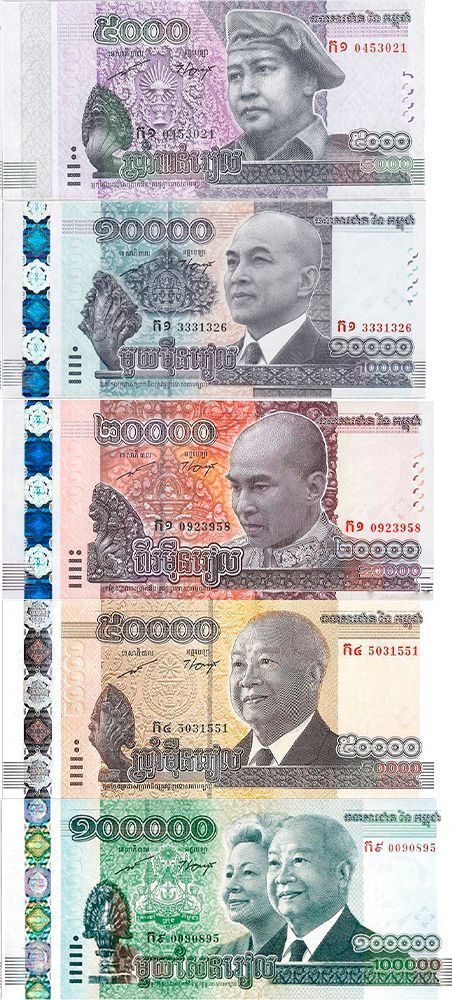
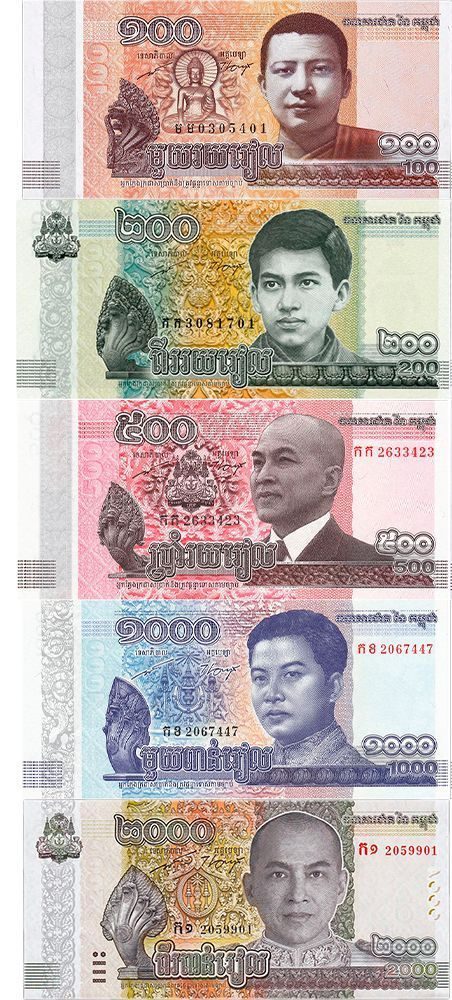
Currency
The currency of Cambodia is the Khmer Riel. Riel is pronounced “Real” (as in real, not counterfeit).
The currency is mostly in the thousands (~4,000 VND is $1 USD).
There are 100 Riel bills that get used often, too, though.
Khmer people rarely say “Riel” along with the price. So, no need to say the currency Riel for a price … just say the number!
| # | Khmer | Pronunciation |
|---|---|---|
| 1000 | Poan | Poe-ah-n Say “Poe” (as in Edgar Allen Poe) + “ah” + “n” sound |
Caveat #1 – Using “thousands” (1,000)
Cost of daily items will be in the thousands or tens of thousands.
The word for 1000 is “Poan”.
| 1000 | Poan | Poe-ah-n Say “Poe” (as in Edgar Allen Poe) + “ah” + “n” sound |
When speaking the currency, the word “thousand” gets used before the word “hundred” in Khmer.
Huh, why!? Because, the currency and most pricing in Cambodia is in the thousands. There are 100 KHR bills, but they are not used often. Therefore, for most everyday life purchases, speaking the numbers & currency will be in thousands, then ten-thousands (more on ten-thousand, below).
As mentioned above, for currency the word “thousand” gets added at the end, almost as a replacement for the word of the currency, Riel. We say this, because only the number (without the word thousand) is spoken for simplicity, most of the time.
Therefore, the price of “five thousand Riel” (5,000 Riel)
-> will shorten to “five thousand” (5,000)
30,000 VND -> 5,000
Some typical prices:
| # | How It’s Spoken | Khmer |
|---|---|---|
| 1,000 Riel | 1 1,000 (one thousand) | Moo-ee Poan |
| 5,000 Riel | 5 1,000 (five thousand) | P-ram Poan |
| 9,000 Riel | 9 1,000 (nine thousand = five four thousand) | P-ram Boo-ugh-n Poan |
Note
The numbers 4 and 1,000 sound very similar.
Learn the number 1,000 and 10,000
Larger purchases or rental costs will be in the thousands or tens of thousands.
| # | Khmer | Pronunciation |
|---|---|---|
| 1,000 | Muay Poan | Moo-ee Poe-ah-n Say “Poe” (as in Edgar Allen Poe) + “ah” + “n” sound |
| 2,000 | Bpii Poan | Pee Poe-ah-n |
| 3,000 | Bei Poan | Bay Poe-ah-n |
| … | ||
| 9,000 | Bpram-Buon Poan | P-ram Boo-ugh-n Poe-ah-n |
Khmer people use a special word designated for 10,000 = “Meun” (same as Thai), and spoken as “one ‘ten-thousand’ (Muay Meun)”.
To say “10,000” you say “one + the word for ‘ten-thousand’. You do not say “ten (Dob) thousand (Poan)”!
This is hard & confusing for Westerners. Essentially, they have 4 decimal places instead of 3.
-> 1,0000 (ten-thousand = 4 decimal places) instead of 1,000 (thousand = 3 decimal places)
| # | Khmer | Pronunciation |
|---|---|---|
| 10,000 | Muay Meun (NOT Dob Poan) | Moo-ee M-ugh-n Say “M” sound + “ugh” + “n” sound |
| 20,000 | Bpii Meun (NOT Bpii Dob Poan) (NOT Mpei Poan)* | Pee M-ugh-n |
| 30,000 | Bay Meun (NOT Bay Dob Poan) (NOT Sam Sup Poan) | Bay M-ugh-n |
| … | ||
| 90,000 | Bpram Buon Meun (NOT Bpram-Buon Dob Poan) (NOT Gao Sup Poan) | P-ram Boo-ugh-n M-ugh-n |
Note
For the number 20, see below, “Caveat #2 – The Number 20“.
20 = Mpei (NOT Bpii Dob = “two ten”)
Construct Numbers Using: 10,000 through 99,000
| # | Spoken As | Khmer |
|---|---|---|
| 10,000 | one ‘ten-thousand’ | Muay Meun (NOT Dob Poan) |
| 12,000 | one ‘ten-thousand’ two thousand or one one ‘ten-thousand’ two (thousand is implied, so not spoken) | Muay Meun Bpii Poan or Muay Meun Bpii |
| 15,000 | one ‘ten-thousand’ five thousand or one one ‘ten-thousand’ five | Muay Meun Bpram Poan or Muay Meun Bpram |
| 18,000 | one ‘ten-thousand’ eight (five three) thousand or one one ‘ten-thousand’ eight (five three) | Muay Meun Bpram Bay Poan or Muay Meun Bpram Bay |
| # | Spoken As | Khmer |
|---|---|---|
| 20,000 | two ‘ten-thousand’ | Bpii Meun (NOT Bpii Dob Poan) (NOT Mpei Poan)* |
| 30,000 | three ‘ten-thousand’ | Bay Meun (NOT Bay Dob Poan) (NOT Sam Sup Poan) |
| 60,000 | six (five one) ‘ten-thousand’ | Bpram Muay Meun (NOT Bpram Muay Dob Poan) (NOT Hok Sup Poan) |
| … | ||
| 90,000 | nine (five four) ‘ten-thousand’ | Bpram Buon Meun (NOT Bpram Buon Dob Poan) (NOT Gao Sup Poan) |
Caveat #2 – The Number 20
Quick detour! The word for twenty is confusing, because it deviates for some reason.
The number 20 has it’s own special word, Mpei (pronounced “M-Pay”)
| # | Khmer | Pronunciation | Alternate Pronunciation |
|---|---|---|---|
| 20 | M-pei (NOT Pee Sup) | M-Pay | “Mmm” (as in the expression when something tastes good) + “pay” (as in to pay for something) |
Caveat #3 – The Number 10
Khmer uses the number “10” to construct other numbers…. such as 15 (spoken as “ten” “five”).
The issue is that when construction 20/30/40/…/80/90 the word for “ten” is different🤯.
Yes, Khmer uses 2 different words for “ten” 🤯.
(1) Dap = “ten” for 10-19
(2) Sup = “ten” for 30/40/50/60/70/80/90
Note: 20 has it’s own special word, which does not use either word for “ten”.
Fun Fact
“Sup” is a lone-word from Thai (“Sip” is “ten” in Thai).
So, for 10-19 the Khmer word is used, but for 30/40/…90 the modified Thai word is used.
Going one step further, the words for 30 through 90 use Thai lone-words for “3”/”4″/”…”/”9″, too 🤯. We discuss this in the next sub-section.
This cross-breeding of the words is confusing, and takes some getting used to!
The word for ten is “dob” when used for numbers 10 through 19.
| # | Khmer | Pronunciation |
|---|---|---|
| 10 | Dap | Dob (as in “mob”, but with a ‘d’ instead of an ‘m’) (for numbers 10 through 19) |
However, for 20 through 99 the word for ten changes. As noted in “Caveat #2 – The Number 20”, ten is not used to construct the number 20.
For number 30 through 99 the word “Sup” is used, which sounds very similar to the Thai word for ten, “Sib”.
| # | Khmer | Pronunciation |
|---|---|---|
| 10 | Sup | Pronounced exactly the same the American English slang word “sup”, meaning “what’s up”. (for number 30 through 99) |
Caveat #4 – The Numbers 3-9 For Constructing Numbers 30 Through 90.
Whew! There are a lot of deviations within Khmer – Roman numeral style numbers and changes in the words for twenty and ten. Now, the numbers 3 through 9 change when construction numbers 30 through 90.
For the most part, these Khmer numbers sound nearly identical (with a slight variation) to spoken Thai numbers.
Warning
*This is a brief stop to prepare for the next section.
👉These numbers are not used alone. They are only used when constructing 30/ 40/ 50/ 60/ 70/ 80/ and 90.
(ex. 50 = Haa Sup ….. “Ha” is only used together with “Sup” …. So, NOT Ha instead of Bpram, or NOT Bpram Sup, or NOT Ha Dap)
-> Next section teaches this.
| # | Khmer | Pronunciation | Alternate Pronunciation |
|---|---|---|---|
| 3 | Saam | S-ah-m | Same as the word “somber” (which means a sad feeling), but only speaking the first letters, “som” ….. “s” (as in “somber”) + “ah” (as in “ah” (opening your mouth for the dentist)) + “m”. |
| 4 | Sae | Sigh | Pronounced “sigh” as in to make the facial expression, or “sight” without the “t” sound. |
| 5 | Haa | Ha | Pronounced as if you are laughing “ha ha ha”. Actually, Thais express “lol” (laughing) in text message as 555 (ha ha ha). |
| 6 | Hok | Ho-k | “Ho” (as in “hoe”, a garden tool, but pushing the air out from your lungs for the “h” sound) + the sound “k” (more like a “k” not a “g”) without finishing the end of the sound, so the “k” is not fully pronounced – it’s cut short a bit. |
| 7 | Jet | Jed | As in the name, Jeff but with a “d” instead of “ff”. This word is spoken slightly fast as 1 syllable. |
| 8 | Bpaet | Buy-t (or Bite) | Pronounced “Buy” (to buy something) with a “t” sound at the end. This sounds similar to the word “bite” without fully pronouncing the separate “t” sound at the end of the word. |
| 9 | Kau | G-ough | “G” sound (as in “go”) + “ough” (as in “ough or ouch, that hurts!”) |
Note
Compare these numbers for the standard 1-10 pronunciations.
Construct Numbers: 10 through 99
These are not common when using the currency for buying things, because currency is in the thousands and ten-thousands.
As previously mentioned, the word for ‘ten-thousand’ is it’s own special word, so the use of (1) “Dob” and (2) “Sup” are do not apply to pricing.
| # | Khmer | uses __ for “ten” |
|---|---|---|
| 10 | Dob | “Dob” (10 – 19) |
| 13 | Dob Bay | “Dob” |
| 18 | Dob P-ram Bay | “Dob” |
| # | Khmer | uses __ for “ten” |
|---|---|---|
| 20 | Mpei | none – special word for 20 |
| 22 | Mpei Bpii | none |
| 24 | Mpei Buan | none |
Now, it transitions to using “Sup” for constructing 30/40/50/60/70/80/and 90.
Note
Notice the use of the Thai lone-word for 3-9, then using the Thai lone-word for “10”, and lastly using the Khmer number for 1-9.
Confusing 🤯, right!?
Ex. 38 = S-ah-m Sup P-ram Bay
-> (spoken as 3 10 8, where 8 is spoken as “5 3”)
-> (spoken as “three [3] ten [10] five three [8]”)
S-ah-m (3 = Thai lone-word)
Sup (10 = Thai lone-word)
P-ram Bay (8 or “5 3” = Khmer word)
Ex. 33 uses two different words for 3, “Sam” (Thai lone-word) and “Bey” (Khmer word).
S-ah-m (3 = Thai lone-word)
Sup (10 = Thai lone-word)
Bay (3 = Khmer word)
| # | Khmer | uses __ for “ten” |
|---|---|---|
| 30 | S-ah-m Sup (NOT Bay Sup) (NOT Bay Dob) | “Sup” (30/40/50/60/70/80/90) |
| 40 | Sigh Sup (NOT Buan Sup) (NOT Buan Dob) | “Sup” |
| 50 | Ha Sup (NOT Bpram Sup) (NOT Bpram Dob) | “Sup” |
| … | ||
| 90 | Gao Sup (NOT Bpram Buan Sup) (NOT Bpram Buan Dob) | “Sup” |
| # | Khmer | uses __ for “ten” |
|---|---|---|
| 30 | S-ah-m Sup | “Sup” (30/40/50/60/70/80/90) |
| 33 | S-ah-m Sup Bay | “Sup” |
| 35 | S-ah-m Sup P-ram | “Sup” |
| 38 | S-ah-m Sup P-ram Bay | “Sup” |
| 42 | Sigh Sup Pee | “Sup” |
| 45 | Sigh Sup P-ram | “Sup” |
| 56 | Haa Sup P-ram Moo-ee | “Sup” |
| 67 | Hok Sup P-ram Pee | “Sup” |
| 78 | Jed Sup P-ram Bay | “Sup” |
| 89 | Buy-t Sup P-ram Boo-ugh-n | “Sup” |
| 99 | Gao Sup P-ram Boo-ugh-n | “Sup” |
Learn the number 100
| # | Khmer | Pronunciation |
|---|---|---|
| 100 | Roy | R-oh-y (or l-oh-y, with the “R” pronounced as an “L”) Spoken as 1 sylable. Say the word “lobe (as in ear lobe), but replace the “be” with a “y” … “l-ohhh-y”. This also sounds like “toy”, but with an “L” sound at the beginning instead of a “t” sound. Some people will pronounce it as a rolling “R” sound, depending on where they are from. |
Fun Fact
100 is the same between Khmer and Thai.
1,000 sounds similar between them (Poan vs. Pan).
Construct Numbers Using: 100
🚨 When speaking the word for 100, it is pronounced by “one hundred” (not “hundred” by itself as is in Thai).
| # | Khmer |
|---|---|
| 100 | Muay Roy |
| 200 | Bpii Roy |
| 300 | Bey Roy |
| … | |
| 800 | Bpram Bey Roy |
| 900 | Bpram Buan Roy |
Tip
*In Khmer, when using English spelling the ‘R’ is actually pronounced as an ‘L’.
Sometimes people will pronounce it as a rolling “R” sound depending on where they are from.
Just for practice… 220 uses the words for “2” (Khmer) and also “20” (has it’s own special word).
| # | Khmer | Pronunciation |
|---|---|---|
| 220 | Bpii Roy Mpei | Pee Loy M-Pay |
Just for practice… 333 uses the words for “3” (Khmer) and also “30” (Thai lone-word) with “3” (Khmer) at the end as part of “33”.
| # | Khmer | Pronunciation |
|---|---|---|
| 333 | Bey Roy Sam Sup Bey | Bay Loy S-ah-m Sup Bay Bay (3) Loy (100) S-ah-m (3) Sup (10) Bay (3) Bay (Khmer) Loy (Khmer) S-ah-m (Thai) Sup (Thai) Bay (Khmer) *300 = Bay (3) Loy (100) *30 = S-ah-m (3) Sup (10) *33 = S-ah-m (3) Sup (10) Bay (3) |
Here’s a little harder example… 888.
| # | Khmer | Pronunciation |
|---|---|---|
| 888 | Bpram Bey Roy Bpaet Sup Bpram Bey | P-ram Bay Loy Buy-t Sup P-ram Bay Bay (3) Loy (100) Buy-t (3) Sup (10) Bay (3) P-ram Bay (Khmer) Loy (Khmer) Buy-t (Thai) Sup (Thai) P-ram Bay (Khmer) |
Practice using 100; 1,000, and 10,000:
| # | Spoken as | Pronunciation |
|---|---|---|
| 1,900 Riel | 1 1,000 9 100 | Moo-ee Poan P-ram Boo-ugh-n R-oh-y Moo-ee (1) Poan (1,000) P-ram Boo-ugh-n (9) R-oh-y (100) *saying “Riel” is not common, but you can say it if you wish to. |
| 5,500 Riel | 5 1,000 5 100 | P-ram Poan P-ram R-oh-y P-ram (5) Poan (1,000) P-ram (5) R-oh-y (100) |
| 18,600 Riel | 1 10,000 5 3 1,000 6 100 | Moo-ee M-ugh-n P-ram Bay Poe-ah-n Pram Moo-ee R-oh-y Moo-ee (1) M-ugh-n (10,000) P-ram Bay (8) Poe-ah-n (1,000) Pram Moo-ee (6) R-oh-y (100) |
| # | Spoken as | Pronunciation |
|---|---|---|
| 11,000 | one ten-thousand one thousand or one ten-thousand one *(thousand is implied, so not spoken) | Moo-ee M-ugh-n Moo-ee Poe-ah-n or Moo-ee M-ugh-n Moo-ee |
| 12,300 | one ten-thousand two thousand three hundred or one ten-thousand two thousand three *(hundred is implied, so not spoken) | Moo-ee M-ugh-n Pee Poe-ah-n Bay Roy or Moo-ee M-ugh-n Pee Poe-ah-n Bay |
| 15,800 | one ten-thousand five thousand eight (five-three) hundred or one ten-thousand five thousand eight (five-three) | Moo-ee M-ugh-n P-ram Poe-ah-n Pram Bay Roy or Moo-ee M-ugh-n P-ram Poe-ah-n Pram Bay |
| 18,900 | one ten-thousand eight (five-three) thousand nine (five-four) hundred or one ten-thousand eight (five-three) thousand nine (five-four) | Moo-ee M-ugh-n P-ram Bay Poe-ah-n Pram Boo-ugh-un Roy or Moo-ee M-ugh-n P-ram Bay Poe-ah-n Pram Boo-ugh-un |
| 90,000 | nine (five-four) ten-thousand | P-ram Boo-ugh-n M-ugh-n |
| 99,000 | nine (five-four) ten-thousand nine (five-four) thousand or nine (five-four) ten-thousand nine (five-four) | P-ram Boo-uh-n M-ugh-n P-ram Boo-uh-n Poe-ah-n or P-ram Boo-uh-n M-ugh-n P-ram Boo-uh-n |
Conclusion
There you have it! This will get you started with numbers in Khmer.
Thai is NOT a tonal language 🙂👍, so your pronunciation may not be 100% perfect. This makes speaking easier than Thai and Vietnamese.
However, the numbers are more complicated 👎, having several caveats 👎, which will lead to confusion 🤯.
GemsOfTravel is not an expert in Khmer language. There may be regional variations and slang as to speaking the numbers. But, if you stick with our lesson, then you’ll be off to a great start and understood!