
Learn Thai numbers the easy way. This guide is practical. You will learn how to speak what is most important in day-to-day life.
GemsOfTravel will walk through the steps of what you need to know and how to remember it, adding in complexity along the way.
We teach things not in logical order, but in order of importance starting with the most common words first. There is a lot to remember in a new foreign language, so start at the top first and work towards the bottom as you progress.
About The Language
In Thailand, the language of the country is spoken as “Thai”.
Thai is a tonal language, so your pronunciation may not be 100% perfect. However, do not worry about perfect tonal pronunciation. They will understand you within the context of the situation. After all, they do want to understand so that they can sell you something!
The tones are considered soft compared to languages such as Vietnamese and Chinese. Therefore, the word tones may be hard to notice, yet not as critical to get them correct for a begginner.
GemsOfTravel will get your pronunciation “close enough”.
You will become better over time with real world experience. Real-world experience is needed for you to hear, speak, and practice the language.
Getting Started & Practicing
Majority Of Conversations
The majority of your conversations will be:
(1) “How much does this cost?
(2) Using the numbers – listening and speaking numbers.
👉 These are the first things you should learn!
Practicing Speaking & Listening
This simple method will help you learn the numbers fast – speaking & listening, both.
Also, do not rely on pronunciations on google translate as they are not always correct.
To practice:
(1) Speak : Ask “how much” (in Thai)
(2) Listening skill : They will respond with a number.
(3) Speaking skill : Repeat the number back to them, as a question to confirm the price.
Note
Repeating a word = “yes”
They may respond by saying the number again.
This is a way to confirm a question, instead of saying “yes”. Repeating a word or number back to a question is a common way in Southeast Asian languages to confirm “yes”.
So, by repeating the number back to them ‘(3) Speaking skill..’, you are seeking to confirm if you correctly heard the number that they spoke. Essentially, you are asking them if the number is correct … “30,000?” … “[did you say] “30,000”?
Speaking: Asking “How Much Does It Cost?”
Q: -> “How much does this cost?”
✅ Typically, people will just say “how much” (Tao Rai)
| Thai | Pronunciation | |
|---|---|---|
| How much? | Tao Rai | T-ou Lie (“ou” as in ‘ouch’ + “lie” as in ‘telling a lie.’ A better explanation: say “Town” but do not speak the ‘n’ part + “lie” as in ‘telling a lie.’) |
| Price (written) | Ra Ka | L-ah K-ah (as in saying “ahhh” when the doctor instructs your to open your mouth and say “ahhh” to check your tonsils.) |
| Price is how much? | Ra Ka Tao Rai | L-ah K-ah T-ou Lie |
A: -> Now, they will reply with a number in Thai!
Tip
*In Thai, when using English spelling the ‘R’ is actually pronounced as an ‘L’.
Sometimes people will pronounce it as a rolling “R” sound depending on where they are from.
Note
You can add a “ka” or “krub” at the end for politeness (Tao Rai, Ka/Krub).
We will skip that for now. They are forgiving since they know you do not speak Thai.
P.S. Men say “Krub” and Women say “Ka”.
Speaking & Listening: Numbers And Currency
⭐ This guide teaches you in order of what you need to know for real-world usage. It skips some numbers, teaching the most used ones first.
Yea, it seems weird, we know.
It will feel strange doing this, but trust us – it makes sense.
Learning everything at once is a bit much, so learning bit-by-bit is a smart approach. By doing this you will learn the speaking and listening of numbers much faster.
⭐ A quick glance:
Learn Numbers: 2, 3, 4, 5, 10
Start with learning only these 5 numbers. These are the numbers that you use almost only need for daily things. Most prices are a combination of these.
| # | Thai | Pronunciation | Alternate Pronunciation |
|---|---|---|---|
| 2 | Song | Saw-ung (only one syllable, said as if “saw” and “ung are mixed together) | |
| 3 | Sam | S-ah-m | Same as the word “somber” (which means a sad feeling), but only speaking the first letters, “som” ….. “s” (as in “somber”) + “ah” (as in “ah” (opening your mouth for the dentist)) + “m”. |
| 4 | Si | See | See (as in “see” that bee) |
| 5 | Ha | Ha | As if you are laughing “ha ha ha”. Actually, Thais express “lol” (laughing) in text message as 555 (ha ha ha). |
| 10 | Sip | See-b or See-p | “See” (as in “see” that bee) + a “b” or “p” sound that is not completely finished (think of the work “beep” but do not make the popping sound at the end. Do not push the air out for the “p” sound). |
Structure Of Numbers
The structure for constructing numbers is very logical.
⭐ Some examples (Viet, Khmer, and Chinese are the same):
| # | How It’s Spoken | The Logic |
|---|---|---|
| 50 | five tens | 5 * 10 = fifty |
| 32 | three tens two | 3 * 10 + 2 = thirty two |
This number structure will become more apparent further along in this guide.
Fun Fact
This number structure is used across the languages in Southeast Asia.
Vietnamese, Thai (language in Thailand), Lao, and Khmer (Language in Cambodia) all share this structure or constructing numbers.
Chinese language also uses it, in which Vietnamese is derived from (Southern Chinese).
Caveat #1 – The Number 20
Quick detour! The word for twenty is confusing, because it deviates for some reason.
Basically, instead of using the word for 2 (Song), use “Yi”.
| # | Thai | Pronunciation | Alternate Pronunciation |
|---|---|---|---|
| 20 | Yi Sip (NOT Song Sib) | Yee See-b (NOT Saw-ung See-b) | “Yee” (as in “see”, but with a “y” sound as in “yay”, instead) + the word for ten (See-b). |
Construct Numbers Using: 2, 3, 4, 5, 10
Now you can construct the below numbers:
| # | Thai |
|---|---|
| 2 | Song |
| 3 | Sam |
| 4 | Si |
| 5 | Ha |
| 10 | Sip |
Most common numbers:
| # | How It’s Spoken | Thai |
|---|---|---|
| 5 | 5 | see above |
| 10 | 10 | see above |
| 15 | 10 5 (ten five) | Sib Ha |
| 20 | “Yi” 10 (NOT 2 10) | Yi Sib (NOT Song Sib) |
| 25 | “Yi” 10 5 (“Yi” ten five) (NOT 2 10 5) | Yi Sib Ha (NOT Song Sib Ha) |
| 30 | 3 10 | Sam Sib |
| 35 | 3 10 5 (three ten five) | Sam Sib Ha |
| 40 | 4 10 | Si Sib |
| 45 | 4 10 5 | Si Sib Ha |
| 50 | 5 10 | Ha Sib |
| 55 | 5 10 5 | Ha Sib Ha |
Extra numbers: (less common)
| # | How It’s Spoken | Thai |
|---|---|---|
| 12 | 10 2 (ten two) | Sib Song |
| 13 | 10 3 | Sib Sam |
| 22 | “Yi” 10 2 (two ten two) (NOT 2 10 2) | Yi Sib Song (NOT Song Sib Song) |
| 23 | “Yi” 10 3 (NOT 2 10 3) | Yi Sib Sam (NOT Song Sib Song) |
| 32 | 3 10 2 | Sam Sib Song |
| 33 | 3 10 3 | Sam Sib Sam |
| 42 | 4 10 2 | Si Sib Song |
| 43 | 4 10 3 | Si Sib Sam |
| 52 | 5 10 2 | Ha Sib Song |
| 53 | 5 10 3 | Ha Sib Sam |
Currency
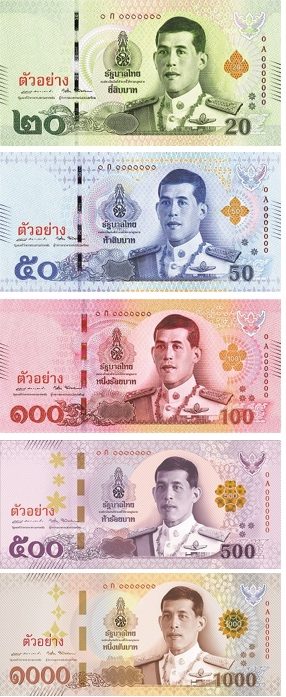
The currency of Thailand is the Thai Baht, spoken as “baht”. Baht is pronounced “b-ah-t”
About 50% of the time, Thai people say “baht” along with the price. You can say it if you feel like or just say the number.

Learn Numbers: 1, 6, 7, 8, 9 (count from 1 to 10)
| # | Thai | Pronunciation | Alternate Pronunciation |
|---|---|---|---|
| 1 | Neung | N-ugh-ng | “N” as in ‘new’ language + ugh + “ng” (as in “sung” a song) |
| 2 | Song | ||
| 3 | Sam | ||
| 4 | Si | ||
| 5 | Ha | ||
| 6 | Hok | Ho-k | “Ho” (as in “hoe”, a garden tool, but pushing the air out from your lungs for the “h” sound) + the sound “k” (more like a “k” not a “g”) without finishing the end of the sound, so the “k” is not fully pronounced – it’s cut short a bit. |
| 7 | Jaed | Jed | As in the name, Jeff but with a “d” instead of “ff”. This word is spoken slightly fast as 1 syllable. |
| 8 | Paad | Pad | As in a “pad” of paper. This word is spoken slightly fast as 1 syllable – “a” sound is not drawn out as is in English when referring to a note pad (“paaad”). Also, it is spoken without finishing the end of the “d” sound, so the “d” is not fully pronounced – it’s cut short a bit. |
| 9 | Gao | G-ough | “G” sound (as in “go”) + “ough” (as in “ough or ouch, that hurts!”) |
| 10 | Sip |
| # | Thai Script |
|---|---|
| 1 | ๑ |
| 2 | ๒ |
| 3 | ๓ |
| 4 | ๔ |
| 5 | ๕ |
| 6 | ๖ |
| 7 | ๗ |
| 8 | ๘ |
| 9 | ๙ |
| 10 | ๑๐ |
Caveat #2 – Using The Number 1 After Another Number
If you use the number 1 alone, by itself, then it is pronounced normal.
| 1 | Neung |
Every other situation the number 1 is coming after another number. Then, you use the secondary word for the number 1, “Et”
| # | Thai | Alternate Pronunciation |
|---|---|---|
| 1 | Et (NOT Neung) | Pronounced “bet” without the “b” sound. This word is spoken as 1 syllable. The “t” sound is spoken without finishing the end of it, so the “t” is not fully pronounced – it’s cut short a bit. |
| # | Thai | Pronunciation |
|---|---|---|
| 11 | Sip Et (NOT Sip Neung) | See-b Et |
| 21 | Yi Sib Et (NOT Yi Sip Neung) (NOT Song Sip Neung) | Yee See-b Et |
| 31 | Sam Sib Et (NOT Sam Sip Neung) | Sam See-b Et |
Learn the number 100
🚨 When speaking the word for 100, it is pronounced by itself (just say “hundred” not “one hundred”).
| # | Thai | Pronunciation |
|---|---|---|
| 100 | Roy (NOT Neung Roy) | R-oh-y (or l-oh-y, with the “R” pronounced as an “L”) Spoken as 1 sylable. Say the word “lobe (as in ear lobe), but replace the “be” with a “y” … “l-ohhh-y”. This also sounds like “toy”, but with an “L” sound at the beginning instead of a “t” sound. Some people will pronounce it as a rolling “R” sound, depending on where they are from. |
| 200 | Song Roy (NOT Yi Roy) | Saw-ung R-oh-y |
| 300 | Sam Roy | S-ah-m R-oh-y |
| … | ||
| 900 | Gao Roy | G-ough R-oh-y |
Tip
*In Thai, when using English spelling the ‘R’ is actually pronounced as an ‘L’.
Sometimes people will pronounce it as a rolling “R” sound depending on where they are from.
Just for practice… 220 uses the words for “2” (Saw-ung) and also “20” (Yi See-b).
| # | Thai | Pronunciation |
|---|---|---|
| 220 | Song Roy Yi Sip | Saw-ung R-oh-y Yee See-b |
Learn the number 1,000 and 10,000
Larger purchases or rental costs will be in the thousands or tens of thousands.
| # | Thai | Pronunciation |
|---|---|---|
| 1,000 | Pan (NOT Neung Pan) | P-ha-n |
| 2,000 | Song Pan | Saw-ung P-ha-n |
| 3,000 | Sam Pan | S-ah-m P-ha-n |
| … | ||
| 9,000 | Gao Pan | G-ough P-ha-n |
| # | Thai | Pronunciation |
|---|---|---|
| 10,000 | Meun (NOT Neung Meun) | M-ugh-n |
| 20,000 | Song Meun | Saw-ung M-ugh-n |
| 30,000 | Sam Meun | S-ah-m M-ugh-n |
| … | ||
| 90,000 | Gao Meun | G-ough M-ugh-n |
Conclusion
There you have it! This will get you started with numbers in Thai.
Thai is a tonal language, so your pronunciation may not be 100% perfect. However, within the context they will understand you – messing up the tones.
After all, they do want to understand so that they can sell you something!