
Fees and security – prevent (1) paying ATM fees and (2) getting scammed. See tips below on ATM fees.
Get a debit card that reimburses ATM fees and choose a secure ATM, and you’re off to a good start.
Warning
Always count + inspect your cash💲💵 right there in front of the camera ATM, after withdrawing money.
Sometimes the ATM miscounts. If so, you want to be counting it in front of the camera so that the bank will oblige in assisting you with the mistake.
If counting cash away from the camera and finding an issue, then the bank will not be held liable as it is based only on your word of mouth – no camera proof.
Same goes for fake or damaged bills (an issue in Cambodia when withdrawing $ US Dollars). Local currency is never an issue for fakes/damaged.
Tip
After getting cash from an ATM, go inside the bank and exchange the cash for smaller bill sizes.
ATMs will give larger denominations, and you’ll have to continually be concerned about getting change.
Smaller bills are best for taxi rides (use a ride-hailing app, btw), local food, and general purchases. Basically, all things that are in the local price range will be easier with smaller bills.
ATM Security
Choose a “good” ATM.
Appearance
Use ATMs that appear “reputable”. This is generic, but you get the point. If the machine looks shoddy, then it’s worth it to try another one. If it looks like it is not well-kept or no-one uses it, then hard pass.
Location
An ATM with security personnel and/or cameras is best. Areas such as inside a well-known chain convenience store (7-11, Circle K, Indomaret), inside a mall, or right Infront of a bank.
Use the same ATM
GemsOfTravel recommends that you use the exact same ATM over and over. Why? This sets a pattern with your bank – they like predictable, repeating, patterns in your card usage.
You don’t want any false flags for fraudulent charges when abroad, and getting a new card sent to you in Southeast Asia is a major pain. Hopefully, you do not have to experience that.
Receipt
Click the button “Yes, I want a receipt”. Get a physical one.
Having a receipt for your transaction is a good idea. Hold onto it for a while. The receipt has information on it confirming your transaction, the amount, and ATM machine location and specific details on it.
Your bank may ask for proof of transaction if you ever have issues (cross your fingers that you don’t), and they may even ask for these ATM slips.
Cash Withdraw
Do not flash cash around. Be discrete about larger amounts of cash you withdraw.
Southeast Asia is safe, and robbery is rare, but this is good practice.
Also, do not take out too much money. It is up to you to define “too much money”, but no-one wants to risk loosing “too much”. The more you carry around the more pain you feel if you loose it or gets stolen.
This is just good practice. There is nothing wrong with going to the ATM weekly, bi-weekly, or to get cash for specific higher-cost purchases. See below about ATM fees and avoiding them.
ATM Fees By Country
ATM fees feel like robbery. In Southeast Asia the fees get really high, and there seems to be no real reason other than “because we can charge you whatever we want”.
Tip
To save on ATM fees:
[ 1 ] Reimbursed Fees: Open a bank account (in your home country) that refunds the ATM fee for international and domestic cash withdraw.
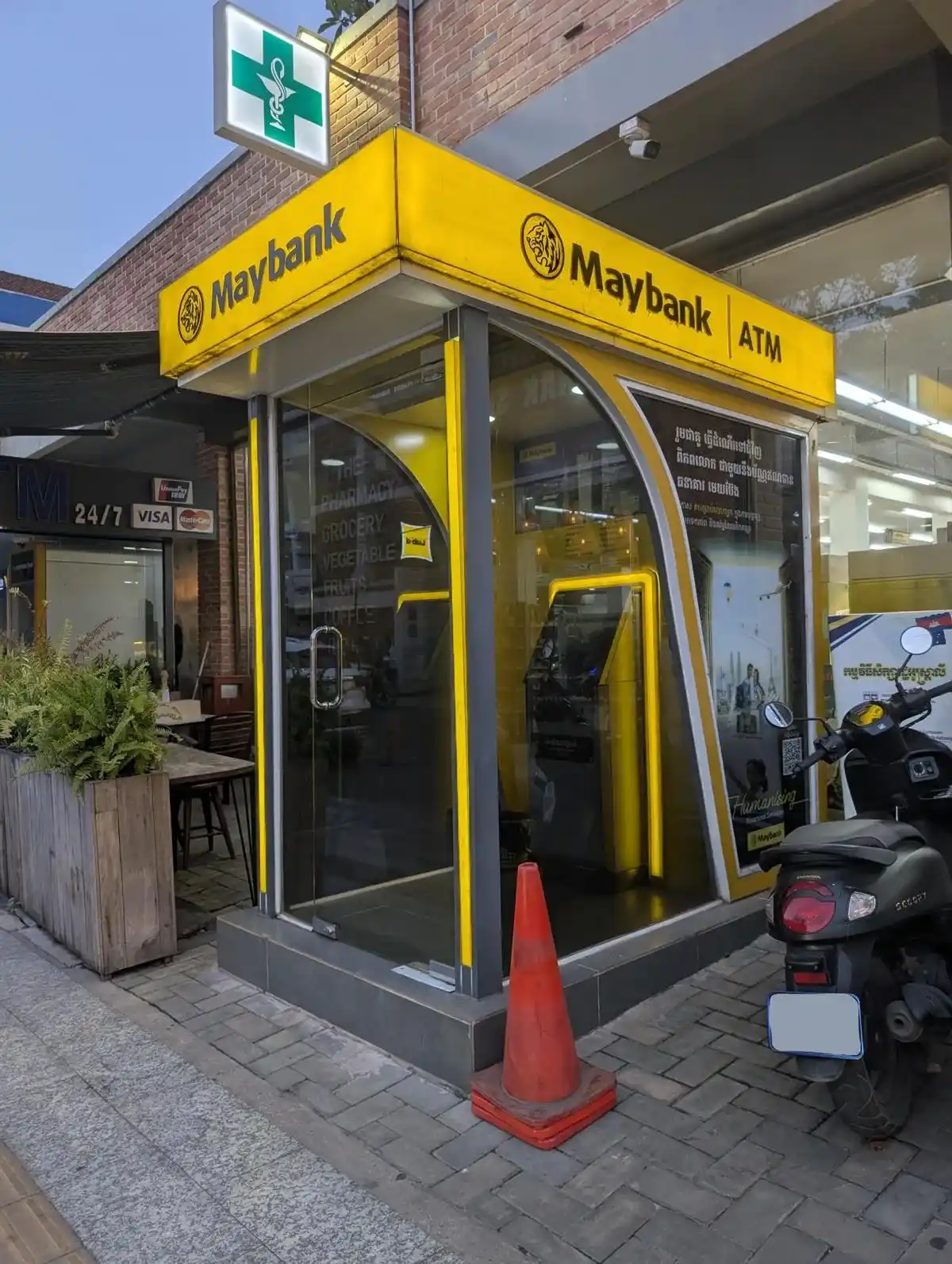
[ 2 ] Lower Fees: Opt for the Muslim bank ATMs. The banks of Muslim countries such as Maybank do not charge ATM fees (never seen it, anyway). They are not common outside of Malaysia and Indonesia, but there are some around.
[ 3 ] Don’t Pay Fees at all: This is for more serious expats/retirees. Open a local bank account
and wire money into from your home country bank account. You will have to pay a fee to do this, but the ATM fees will be free through the local account.
A Maybank ATM:
Indonesia 🇮🇩
$0
= Free (Muslim banks do not charge ATM fees.)
Malaysia 🇲🇾
$0
= Free (Muslim banks do not charge ATM fees.)
Vietnam 🇻🇳
~$2
= 50,000 vnd (Vietnam Dong)
Cambodia 🇰🇭
~$5
= 20,000 khr (Khmer Riel)
Thailand 🇹🇭
~$6.5
= 220 thb (Thai baht)
Laos 🇱🇦
ATM fees depends on the bank in Laos. The fees listed per the ATM during the transaction seem to be false. We have experienced much higher fees than the ATM listed. Possibly anecdotal? But, this happened many times.
$1.5 per transaction
= 30,000 KIP flat rate fee per transaction
$1 per ~$45
= 20,000 KIP per 1,000,000
$3 per $100
= 3% flat rate fee per transaction
Tip
Use Visa.com’s Exchange Rate Calculator -> here’s the link. It will tell you exactly the exchange rate for your transaction based on the day you make the transaction.
[ 1 ] Convert the foreign currency to your home country currency, not the other way around! That is, from Lao Kip -> EUR/USD/etc. See below as to why.
[ 2 ] Also, set the bank fee to 0%.
This will give you the exchange rate that you will be subject to. This is specific to the Lao Kip exchange rate.
Note
We want to share with you a intriguing insight.
When your bank does currency conversion, it does not exchange your home currency with the foreign currency (the country you are within). It does the reverse.
For example, for a European it will exchange Lao Kip to Euros (not Euro that are in your account to Kip).
Interesting right!? Well, the issue is that these have different exchange rates!
The rate for Kip/Baht/Ringit/etc -> Euros is not the same as for Euros -> Kip/Baht/Ringit/etc.
It just so happens that sometimes the Lao -> Euro exchange rate is about 7% worse than Euro -> Kip! READ THAT AGAIN! Wild, right!? Note: we’ve check recently and it was only 1% worse – not bad.
This has to do with the Lao Kip being a considered risky currency to trade in the global marketplace.
Use Visa.com’s Exchange Rate Calculator (link here) and set the bank fee to 0%. It will tell you exactly the exchange rate for your transaction based on the day you make the transaction. Again, convert the foreign currency to your home country currency, not the other way around!
For all other currency other than the Lao Kip, the exchange rates are nearly identical, as you’d expect. For some reason the country of Laos had a major difference in the exchange rate. And again, it does not happen all the time. It can be a simple 1% up to 7% difference, you just don’t know until you check Visa.com’s Exchange Rate Calculator.
In conclusion, if you notice a large “fee” it is not the dynamic currency conversion done by the ATM, it is the difference in the exchange rates (Kip -> Euro versus Euro -> Kip).