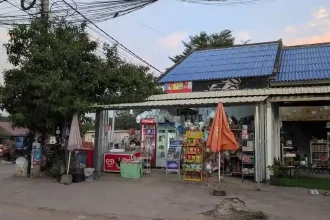
How do you define “good location”? A location enables your personal preferences to be met. It also enables convenience, adventure, and a certain lifestyle that you wish to live.
Whether just traveling or renting longer-term, be sure to choose your area wisely. The area you stay in can make or brake your traveling or living experience… just depends on what you are looking for.
Move Around – Try Different Areas
👉 Move around the city – stay in different areas to make sure you commit to an area that you like.
Strategies detailed in this post:
- Benefit : You can try different areas. You may discover an area that resonates with you! And, you’ll experience the travel destination from different viewpoints.
Define “Good Location”
⁘ Define what a “good location” is for you.
Choose a place by what is walking distance nearby, or by choosing a certain type of area.
⁘ Want to be near:
- A park or nature 🏞️.
- Food spots and restaurants 🍴 (including food markets, informal street-side stalls).
- Convenience stores and/or grocery stores 🏪.
- Place to exercise 🤸💪.
- Access to athletic activities such as a gym 🏀🎾🏊.
- Work spaces 💻☕.
- Work (your physical place of employment).
- Public transportation 🚃.
- Healthcare. Maybe a certain hospital 🏥.
- Schooling for your children 🚸🏫.
⁘ Areas you might prefer:
- Local area : Local area, perhaps with few to no other foreigners.
- International area : Businesses that cater towards expat & English language speakers.
- Secluded area : A location outside the cities, away from civilization.
- Tourist area : Where the tourism industry flourishes and tourists from all walks of life gather.
Verify The Location
You may find the perfect rental, but the location could be really bad. It happens a lot. Check on Apple/Google Maps for things that you care about nearby the area you will potentially be staying.
Search for keywords that are important to you. You can do this for the keywords that you use to define what “good location” means to you.
Below are some examples:
- Keyword is “convenience store” or “mini marts” : You find that there are several within a few minute walking distance – great! Or, you find that you’ll have to walk 10-15 minutes to go a convenience store that closes at 7 pm everyday – not so great and not so convenient for you.
- Keyword is “grocery store” : You find that there is a “hypermarket” nearby (or close enough) that has everything you need, even food from back home – great! Or, you see the so called “grocery store” is a local food market that would not have anything other than raw meats, vegetables, and ingredients that you’d never cook with – not so great?
- Keyword is “food” : You find many amazing places to eat, within your daily budget, and you save a list of these places – great! You search, but do not see much of any places to eat that are conveniently located – not great. You search but don’t see any places, however the places are not on Apple/Google Maps – great, but not great because you have to go to the area in person to find out if any eateries exist there or not.
It is very common for restaurants to not be on Apple or Google Maps, or without pictures and information.
- Keyword is “gym” or “exercise” : You search for a place to exercise, the rental does not have (some do!) a work-out room, or it is too minimal for your workout needs. You find a gym with a good daily rate or even better monthly rate – great!
- Use Google Street view to evaluate “walking” : You check Google Street View and see the roads just aren’t made for walking – you can, but the side walks are small or covered with a store’s items that spill out onto the sidewalk – not so great. You check Google Street view in a area and see that the sidewalks are really good, just like at home – great!
Transportation
Walking is the primary, reliable, form of transportation when being a foreign tourist or nomad in Southeast Asia. Using ride hailing apps (Grab), public bus or rail, and renting/buying a bicycle or motorbike are all options, too. However, you’ll want to make sure things are within walking distance.
Transportation = more 🏠 Housing options.
- Walk (yes, with your legs!) 🚶
- Public transportation – bus line, metro rail line 🚌🚄
- Ride share 📲🚕
- Bicycle 🚲
- Motorbike 🛵
- Car 🚗 (it’s not as common for foreigners to have a car)
Benefits of having transportation: (bicycle 🚲 / motorbike 🛵)
- More Options : It ‘opens the door’ to more housing options
- Better Options : It enables you to find a better price or better quality deals. Rentals in the popular spots, or near public transportation can be more expensive. Great quality rentals and lower costs are often in less convenient locations.
- Not Limited By Walking : It can make the “bad location” (10 – 15 minute walk) into a great compromise (few minute bike ride away)! You are not limited by walking distance.
- Cheaper and More Convenient : It can be significantly cheaper and convenient (yay freedom!) than using local transportation or grab app.
Bicycle And Motorbike PROs & CONs
- No license required.
- Cheaper than a motorbike.
- You can easily buy them used or new.
- Maybe convenient enough.
- You might be able to take it with you when you leave.
- You cannot travel as far, easily, or as fast compared to a motorbike. 👉 Though, you can always rent a motorbike for any trips that you wan to do.
- Faster + easier that a bicycle.
- Fun and can take trips outside the city.
- Parking is never an issue.
- Rental shops are everywhere.
- Repair (flat tire, mechanics) shops are everywhere.
- Rental cost per month is good ($45-60) or bad ($100+) depending on where you are.
- Purchase price can be cheaper than renting per month if riding over many months.
- Safety is a risk. A very real risk!
- License required, but rarely checked ✅ (expectation is Cambodia in which no license is required for bikes including 110 cc and below).
- Harder to find used bikes to buy (Vietnam and Cambodia is the exception where it is easy to find).
- Financial commitment, but 👉 you can sell it when you leave.
- Financial cost of repairs. But, the costs are often 👉 not expensive.