
Learn Vietnamese numbers the easy way. This guide is practical. You will learn how to speak what is most important in day-to-day life.
GemsOfTravel will walk through the steps of what you need to know and how to remember it, adding in complexity along the way.
We teach things not in logical order, but in order of importance starting with the most common words first. There is a lot to remember in a new foreign language, so start at the top first and work towards the bottom as you progress.
About The Language
In Vietnam, the language of the country is spoken as “Viet Nam”. The name “Vietnamese” is what is spoken in English.
Vietnamese is a tonal language, so your pronunciation may not be 100% perfect. However, do not worry about perfect tonal pronunciation. They will understand you within the context of the situation. After all, they do want to understand so that they can sell you something!
GemsOfTravel will get your pronunciation “close enough”.
You will become better over time with real world experience. Real-world experience is needed for you to hear, speak, and practice the language.
Getting Started & Practicing
Majority Of Conversations
The majority of your conversations will be:
(1) “How much does this cost?
(2) Using the numbers – listening and speaking numbers.
👉 These are the first things you should learn!
Practicing Speaking & Listening
This simple method will help you learn the numbers fast – speaking & listening, both.
Also, do not rely on pronunciations on google translate as they are not always correct.
To practice:
(1) Speak : Ask “how much” (in Vietnamese)
(2) Listening skill : They will respond with a number.
(3) Speaking skill : Repeat the number back to them, as a question to confirm the price.
Note
Repeating a word = “yes”
They may respond by saying the number again.
This is a way to confirm a question, instead of saying “yes”. Repeating a word or number back to a question is a common way in Southeast Asian languages to confirm “yes”.
So, by repeating the number back to them ‘(3) Speaking skill..’, you are seeking to confirm if you correctly heard the number that they spoke. Essentially, you are asking them if the number is correct … “30,000?” … “[did you say] “30,000”?
Speaking: Asking “How Much Does It Cost?”
Q: -> “How much does this cost?”
| Vietnamese | Pronunciation | |
|---|---|---|
| How much? | Bao nieu | Bow knee-you (spoken as 1 word with 2 syllables) |
A: -> Now, they will reply with a number in Vietnamese!
Speaking & Listening: Numbers And Currency
⭐ This guide teaches you in order of what you need to know for real-world usage. It skips some numbers, teaching the most used ones first.
Yea, it seems weird, we know.
It will feel strange doing this, but trust us – it makes sense.
Learning everything at once is a bit much, so learning bit-by-bit is a smart approach. By doing this you will learn the speaking and listening of numbers much faster.
⭐ A quick glance:
Learn Numbers: 2, 3, 5, 10
Start with learning only these 4 numbers. These are the numbers that you use almost only need for daily things. Most prices are a combination of these.
| # | Vietnamese | Pronunciation | Alternate Pronunciation |
|---|---|---|---|
| 2 | Hai | Hi | As in the other word for ‘hello’ |
| 3 | Ba | B-ah | As in “ah” (opening your mouth for the dentist – say “ahhh”) with a ‘b’ sound. Like a baby would call their father “baba” (similar to “mama”). |
| 5 | Nam | N-ah-m | Same “ah” as for the number 3. Add the “n” and “m” sounds at the beginning and end. This sounds like “nom nom” when English speakers refer to eating food. |
| 10 | Mu’oy | M-oo-ugh-ee | This uses a sound from the throat, and will need some practice. Don’t be shy to put yourself out there and mispronounce it the first few times. Sounds are “m-oo-ugh” + “ee” (“moo” as a cow says, “ugh” as English speakers say for expressing dissatisfaction, “ee” as in bee) |
Structure Of Numbers
The structure for constructing numbers is very logical.
⭐ Some examples (Thai and Chinese are the same):
| # | How It’s Spoken | The Logic |
|---|---|---|
| 50 | five tens | 5 * 10 = fifty |
| 32 | three tens two | 3 * 10 + 2 = thirty two |
This number structure will become more apparent further along in this guide.
Fun Fact
This number structure is used across the languages in Southeast Asia.
Vietnamese, Thai (language in Thailand), Lao, and Khmer (Language in Cambodia) all share this structure or constructing numbers.
Chinese language also uses it, in which Vietnamese is derived from (Southern Chinese).
Construct Numbers Using: 2, 3, 5, 10
Now you can construct the below numbers:
| # | Vietnamese |
|---|---|
| 2 | Hai |
| 3 | Ba |
| 5 | Nam |
| 10 | Mu’oy |
Most common numbers:
| # | How It’s Spoken | Vietnamese |
|---|---|---|
| 10 | 10 | Mu’oy |
| 15 | 10 5 (ten five) | Mu’oy Lam (or Nam)* |
| 20 | 2 10 | Hai Mu’oy |
| 25 | 2 10 5 (two ten five) | Hai Mu’oy Lam (or Nam)* |
| 30 | 3 10 | Ba Mu’oy |
| 35 | 3 10 5 | Ba Mu’oy Lam (or Nam)* |
| 50 | 5 10 | Nam Mu’oy |
| 55 | 5 10 5 | Nam Mu’oy Lam (or Nam)* |
Note
“Nam” actually changes to “Lam” with an “L” when it is the last number spoken, for some weird reason.
An example to demonstrate this is 55: 5 10 5 = Nam Mu’oy Lam
But, people will understand you if you just say “Nam” (Nam Mu’oy Nam) in stead of “Lam”.
Extra numbers: (less common)
| # | How It’s Spoken | Vietnamese |
|---|---|---|
| 12 | 10 2 (ten two) | Mu’oy Hai |
| 13 | 10 3 | Mu’oy Ba |
| 22 | 2 10 2 (two ten two) | Hai Mu’oy Hai |
| 23 | 2 10 3 | Hai Mu’oy Ba |
| 32 | 3 10 2 | Ba Mu’oy Hai |
| 33 | 3 10 3 | Ba Mu’oy Ba |
| 52 | 5 10 2 | Nam Mu’oy Hai |
| 53 | 5 10 3 | Nam Mu’oy Ba |
Currency
Vietnamese currency is the Vietnam Dong. The currency is in the thousands (~25,000 VND is $1 USD).
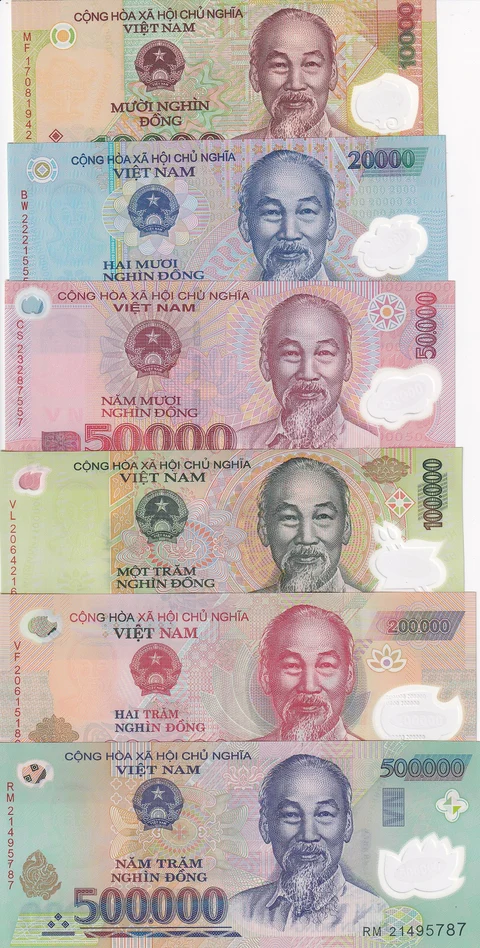
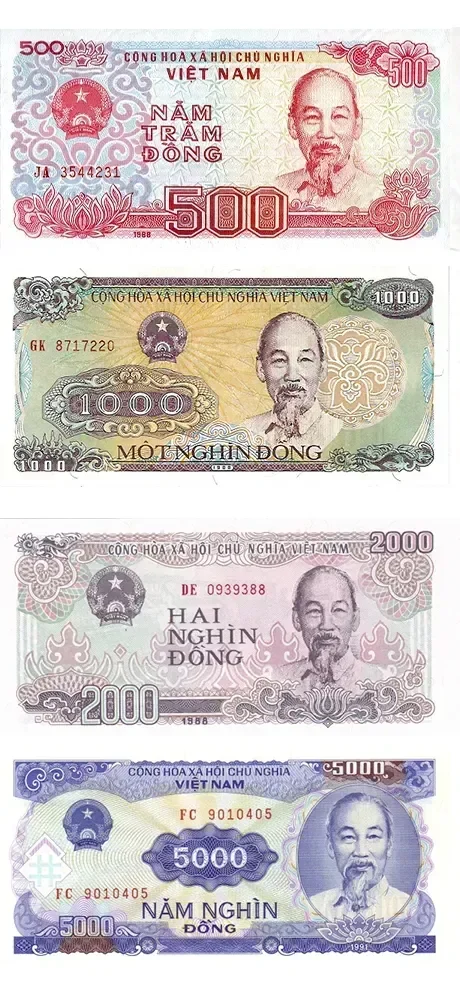
How do you say the currency? Well, you don’t! Vietnamese people never say “Vietnam Dong” or “Dong” after saying the numerical price.
Instead, the word “Nighn” (the word for “thousand”, see below) is said, acting as a filler word and replacing the name of the currency, if you will. And, even then, “Nighn” (thousand) is not always said.
If you do hear someone say “Vietnam Dong”, then it is probably within the tourist areas, and spoke so that foreigners to understand them.
| # | Vietnamese | Pronunciation |
|---|---|---|
| 1000 | Nighn | knee-n or knee-ng Say the English word “knee” and add an “n” or “ng” sound (“ng” as in having fun!) |
Caveat #1 – Using “thousands” (1,000)
The word for 1000 is “Nighn”.
| 1000 | Nighn | knee-n or knee-ng Say the English word “knee” and add an “n” or “ng” sound (“ng” as in having fun!) |
When speaking the currency, the word “thousand” gets used before the word “hundred” in Vietnamese.
Huh, why!?🤔 Because, the currency in Vietnam is in the thousands starting with 1,000 vnd bills. There are no 100 VND bills. Therefore, in everyday life, speaking the numbers & currency will be first in thousands, then hundred-thousands.
As mentioned above, for currency the word “thousand” gets added at the end, almost as a replacement for the word of the currency, Dong. We say this, because sometimes only the number (without the word thousand) is spoken for simplicity.
Therefore, the price of “thirty thousand Dong” (30,000 VND)
-> will shorten to “thirty thousand” (30,000)
-> -> and further shorten to simply just “thirty” (30).
30,000 VND -> 30,000 -> 30
Some typical prices:
| # | How It’s Spoken | Vietnamese |
|---|---|---|
| 35,000 Dong | 3 10 5 1000 (three ten five thousand) | Ba Mu’oy Lam (or Nam)* Nighn |
| 50,000 Dong | 5 10 1000 (five ten thousand) | Nam Mu’oy Nighn |
Note
Again, the word “Dong” (the currency) is rarely spoken.
The number “nighn“(1,000) is spoken maybe 50% of the time. Therefore, 35,000 would be shortened to “3 10 5” (three ten five) – omitting the word “thousand” (nighn).
Note
“Nam” actually changes to “Lam” with an “L” when it is the last number spoken, for some weird reason.
An example to demonstrate this is 55: 5 10 5 = Nam Mu’oy Lam
But, people will understand you if you just say “Nam” (Nam Mu’oy Nam) in stead of “Lam”.
Caveat #2 – Using “ten” (10) When Constructing Numbers
When speaking numbers in the 10’s (mu’oy) locals sometimes do not say the ten.
Same as for speaking thousands, it can be confusing because sometimes they say “ten” and sometimes they do not.
The caveat is that this is only for numbers that have 10 sandwiched in the middle. These are numbers that start with a non-ten number and end in a non-ten number.
An example is “25” (spoken as “2” “10” “5”), which can be shortened to just “2” “5”, omitting the “10” for quickness & simplicity.
An example this does not apply to is “15” (spoken as “ten five”), which starts with “ten”, so they must say “ten” – cannot omit it! Another example is 20 = spoken as “2” “10” – they must say “ten”.
Examples:
| # | Spoken | Vietnamese | |
|---|---|---|---|
| 15 | 10 5 | Mu’oy Lam* | no change |
| 20 | 2 10 | Hai Mu’oy | no change |
| 25 | 2 10 5 | Hai | ❌Do not say “ten” |
| 30 | 3 10 | Ba Mu’oy | no change |
| 35 | 3 10 5 | Ba | ❌Do not say “ten” |
| 50 | 5 10 | Nam Mu’oy | no change |
| 55 | 5 10 5 | Nam | ❌Do not say “ten” |
Note
As noted above: “Nam” actually changes to “Lam” with an “L” when it is the last number spoken, for some weird reason.
Fun Fact
Sellers are speaking numbers all day – they probably get tired of it.
We assume that is why they shorten the numbers so much. Wouldn’t you get tired of adding on “thousand” to the end of the price…. many times a day?!
⚠️ Now it gets even more confusing! If they are really lazy they will extend this way of speaking to anything for the # 20 and above.
This further simplifies how the currency numbers are spoken.
Examples:
| # | Spoken | Vietnamese | |
|---|---|---|---|
| 20 | 2 10 | Hai | ❌Do not say “ten” |
| 30 | 3 10 | Ba | ❌Do not say “ten” |
| 50 | 5 10 | Nam | ❌Do not say “ten” |
| # | Spoken | Vietnamese | |
|---|---|---|---|
| 20,000 | 2 10 1,000 | Hai | ❌Do not say “ten” or “thousand” |
| 30,000 | 3 10 1,000 | Ba | ❌Do not say “ten” or “thousand” |
| 50,000 | 5 10 1,000 | Nam | ❌Do not say “ten” or “thousand” |
Learn Numbers: 1
Vietnam drinking saying: “🍻 Mot, Hai, Ba, Yo! 🍻”, which means “one, two, three, yo!”
This saying helps us remember the numbers, 1, 2, and 3 😃.
Remember it. Well, actually, you will hear all over Vietnam. Beer drinking is a popular hobby there, and locals always cheer this saying before 🍻clanking beers.
| # | Spoken | Vietnamese |
|---|---|---|
| 1 | Mot | Moat |
| 2 | Hai | already know |
| 3 | Ba | already know |
| “yo” | “yo” | does not mean 4! |
Learn Numbers: 4, 6, 7, 8, 9 (count from 1 to 10)
Now you can fill in the rest of the numbers.
| # | Vietnamese | Pronunciation |
|---|---|---|
| 1 | Mot | |
| 2 | Hai | |
| 3 | Ba | |
| 4 | Bon | B-oh-n As in bon’a petite (without the “a”) |
| 5 | Nam | |
| 6 | Sau | S-ough S + “ough” (“ough” as in “ough, that hurt) |
| 7 | Bei | Bay As in San Francisco “bay” area |
| 8 | Tam | D-ah-m Sounds very similar to the word “dam” (as in water dam). “d” (dull ‘d’ sound) + “ah” (as in “ah” (opening your mouth for the dentist) with a ‘b’ sound. Like a baby would call their father “baba” (similar to “mama”)) + “m” (‘m’ sound) |
| 9 | Cheen | Ch-een Sounds very similar to the word “clean”, but with a “ch” (as in Charlie) instead of “cl” |
| 10 | Mu’oy |
Learn the number 100
As previously established, when speaking the currency, the word “thousand” gets used before the word “hundred” in Vietnamese.
So, after “thousand” you will now learn the word “hundred”, since it is used to say “hundred thousand”
| # | Vietnamese | Pronunciation |
|---|---|---|
| 100 | Tram | Ch-jam Sounds very similar to “jam” as in toast with a spread of cherry jam (or grape jam). The difference is that you mix the “ch” sound (as in cherry) with the “j” (as in jam). |
🚨 Actually, 100 is never pronounced by itself.
| # | Vietnamese |
|---|---|
| 100 | Mot Tram |
| 200 | Hai Tram |
| 300 | Ba Tram |
| 400 | Bon Tram (not “Yo” Tram!) |
Conclusion
There you have it! This will get you started with numbers in Vietnamese.
Vietnamese is a tonal language, so your pronunciation may not be 100% perfect. However, within the context they will understand you – messing up the tones.
After all, they do want to understand so that they can sell you something!