Cost of Living – Food: how to save money in SE Asia

Bookmark:

Saving money or finding the best bang for your buck, however you want to say it, is journey that leads you through the local lifestyles of SEA.

Searching a destination with cheaper food costs will pull you out of the comfy tourist bubble and will have you question yourself, “am I not supposed to be here?”.  The answer is, YOU ARE!  The eateries will give you looks not of contempt, but of open hearts to try their menu and food offerings.

Food is their livelihood, it is their culture, and even more so it is their family’s recipe that has been handed down to them, whispered into their ear as a secret.  You are more than welcome to try the food, just do not ask them for their secret recipe!

Note

Localizing: By following this guide, you will localize.  This guide encourages you, in order to save money, to eat at local eateries that serve locals @ local prices.


Local food

Eat local food over Western-style food.  Local food cost is lower (local price), where as Western food labeled as “premium” and higher priced.

Local food is cheaper, but do not let that misguide you …  the food is YUMMY and fresh!  The local eatery may not appear hygenic or welcoming at first to the inexperienced eye, however, these concerns are not an issue!  Go for it and once you cross that imaginary cultural boundary, you’ll never go back! 
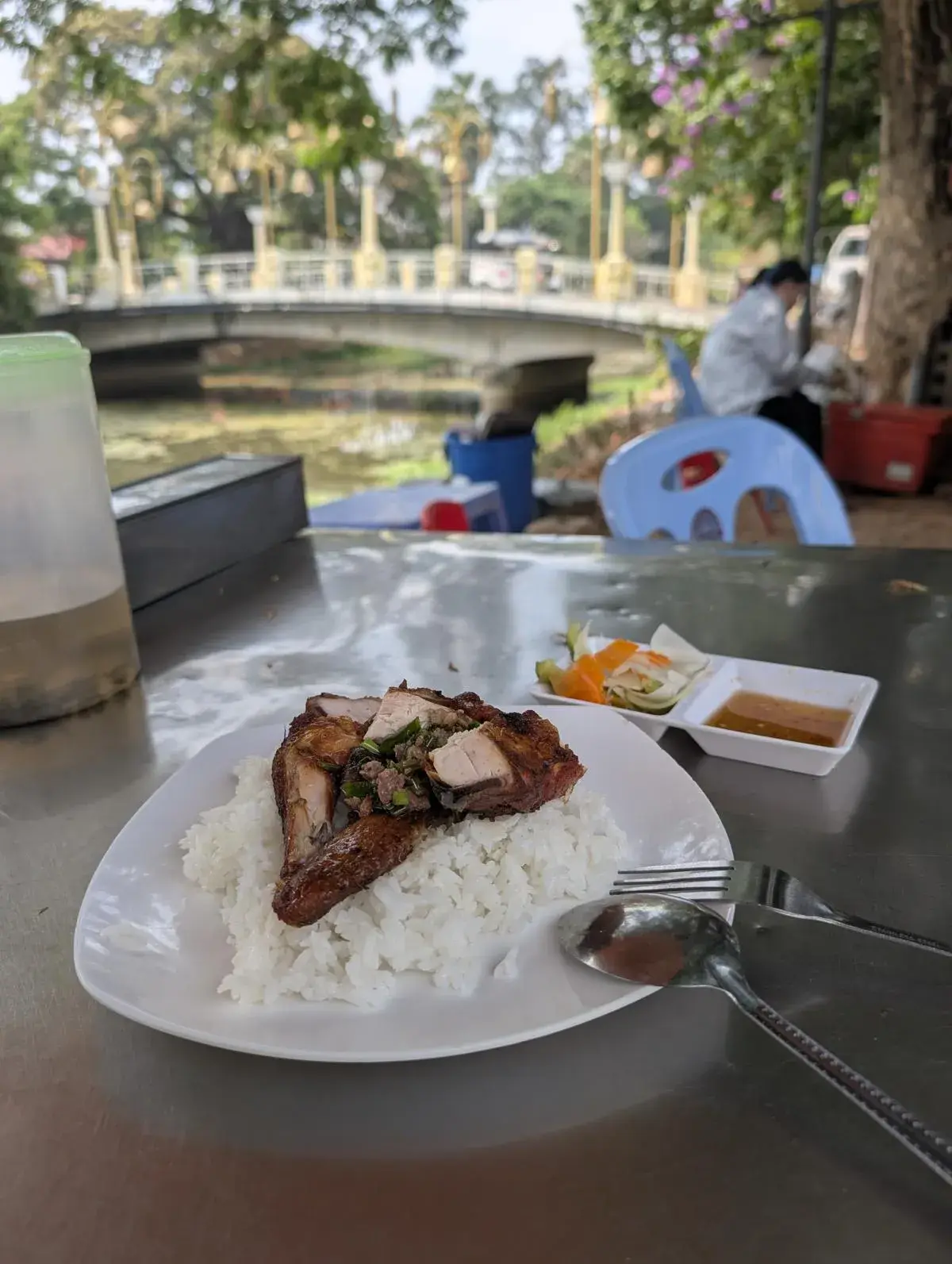
Outdoor table and seating along the sidewalk, at an outdoor food stall, with a plate of chopped grilled chicken on rice in Southeast Asia. The dish has pickled vegetables as a condiment, sauce, and a jug of tea on the table for customers. The background shows that the table is also along a small river with a bridge crossing from one side to the other. Trees abound.
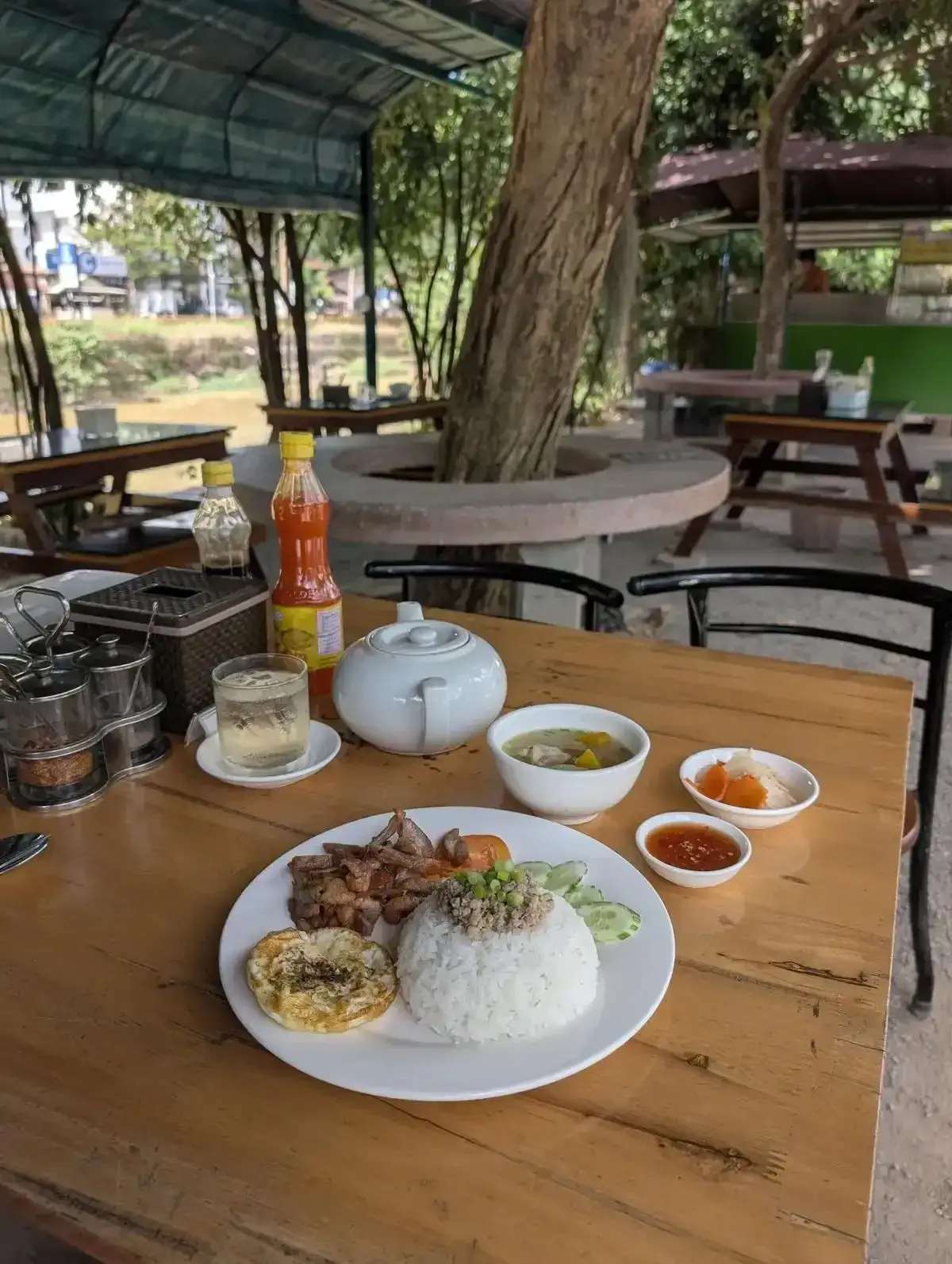
Outdoor table and seating with overhead covering along the road in Southeast Asia. On the customer's table is a plate of chopped grilled pork on rice with a fried egg, sliced cucumber and tomato. The dish comes with a soup, and pickled vegetables as a condiment, sauce, and a pot of tea on the table for customers. The background shows that the table is also along a small river. There is a tree within the seating area that pokes through the overhead cover, and several small trees beyond the covering's structure.
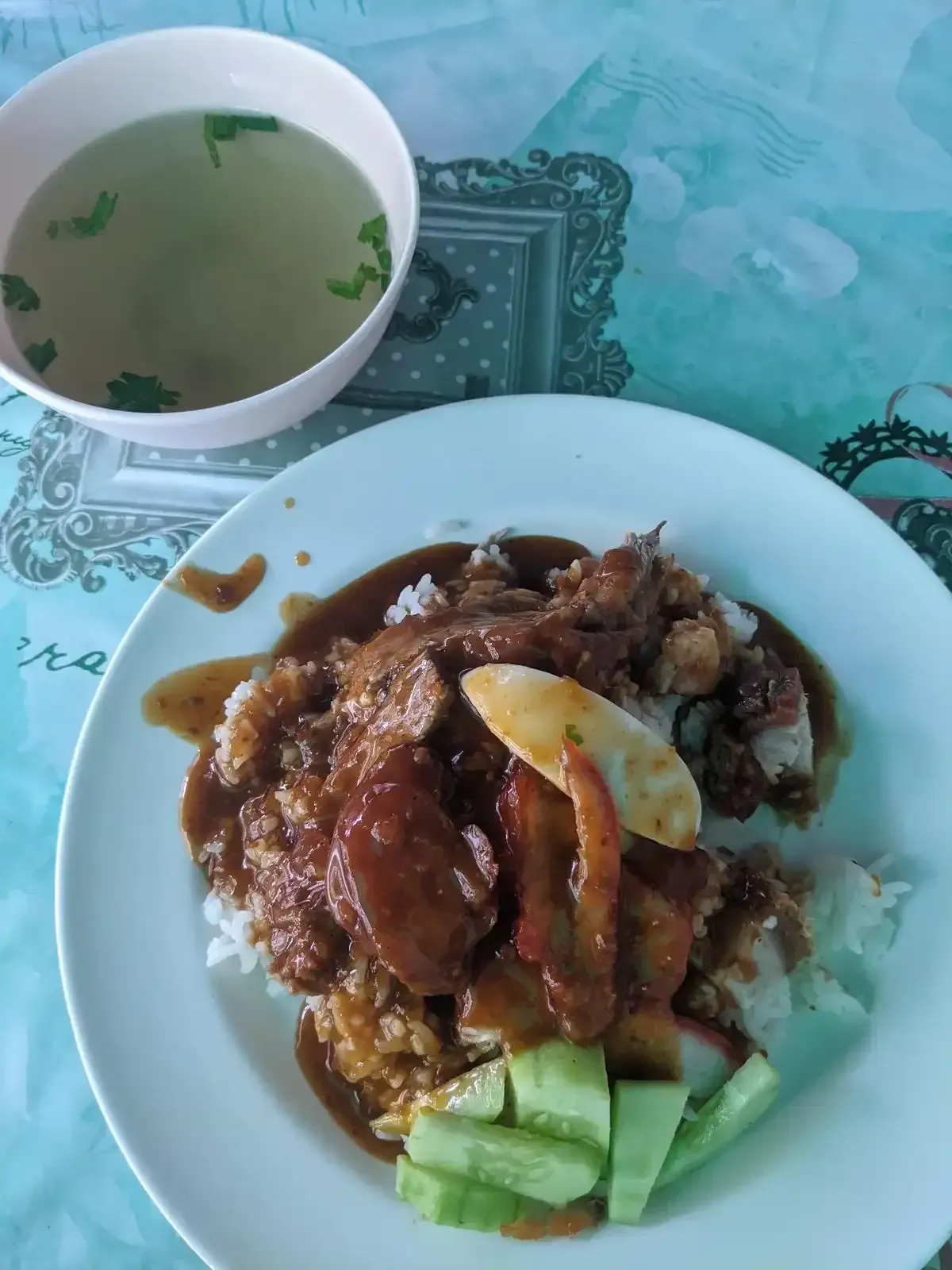
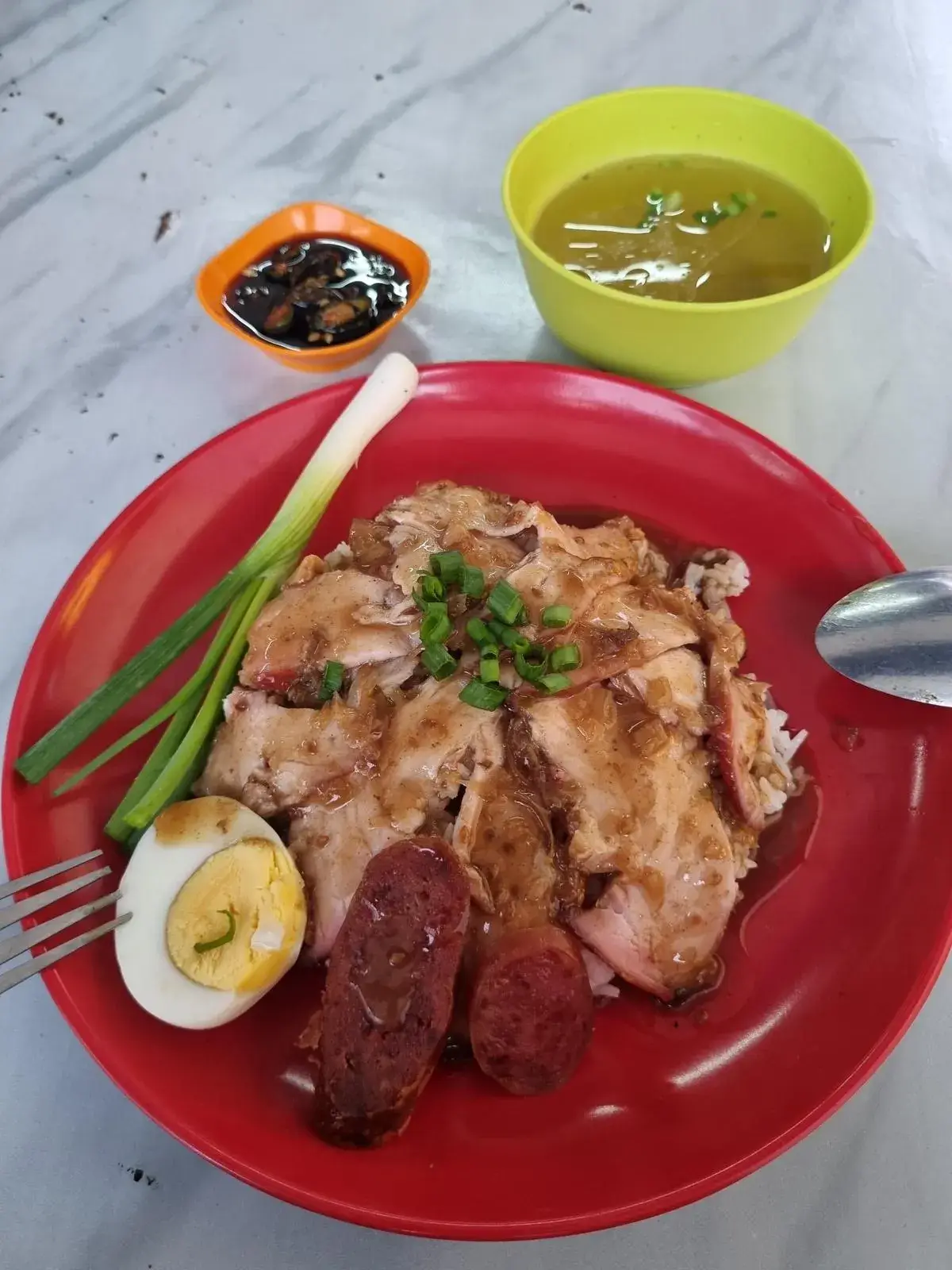
A dish in Laos called grilled red pork rice, and it is just exactly that. It comes with sliced cucumber on the side, sliced boiled egg, a few slices of Chinese sweet sausage, and a brown sauce that covers the entire dish. A simple brothy soup is included.

… and more food:

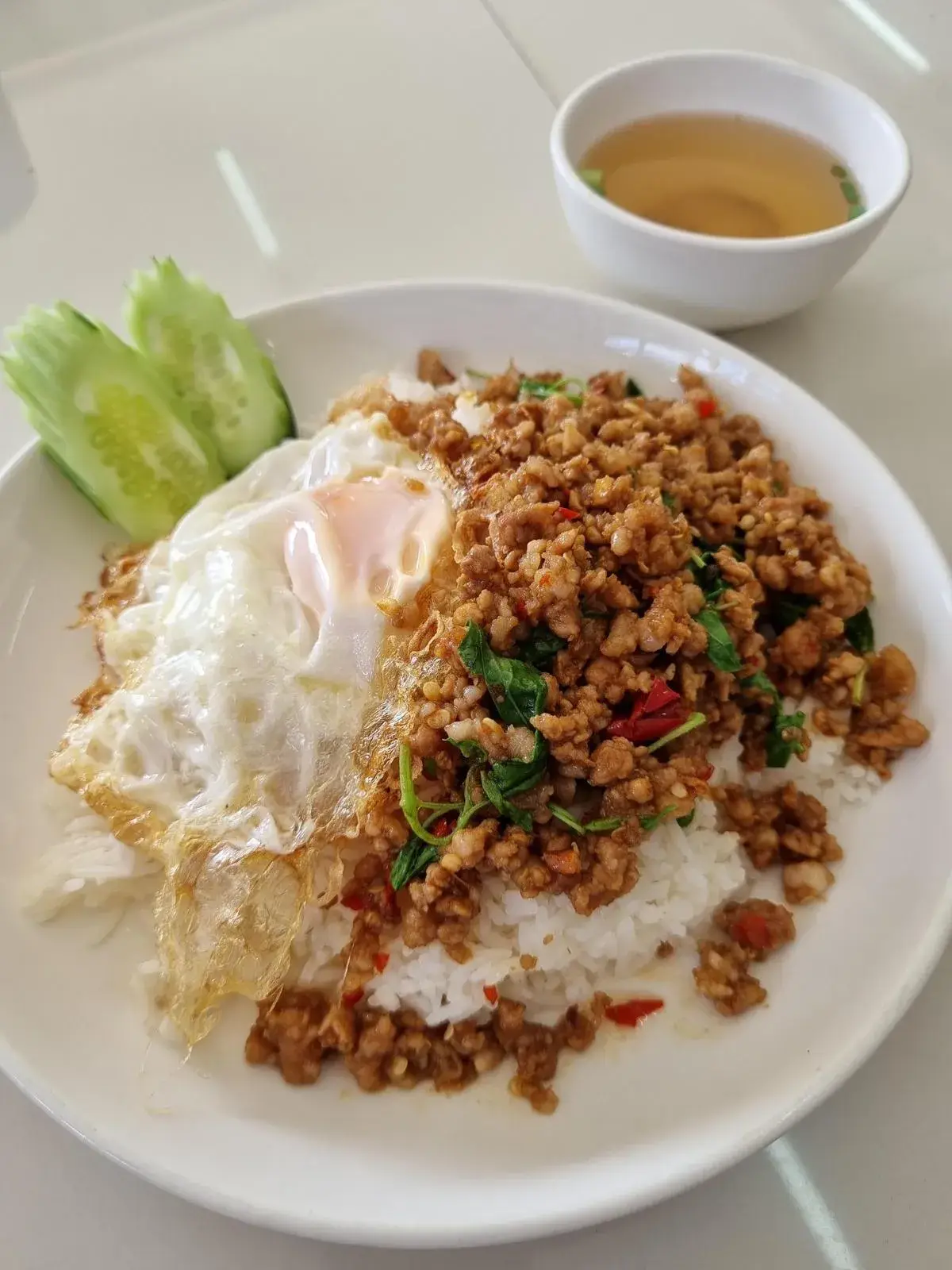
A dish in Thailand called "Pad Krapao Kai Dao". This is stir fried diced pork with Thai basil and red chillies added to liking, with a fried egg, and sliced cucumber on the side. A simple bowl of soup is included, with broth and some scalions thrown in.
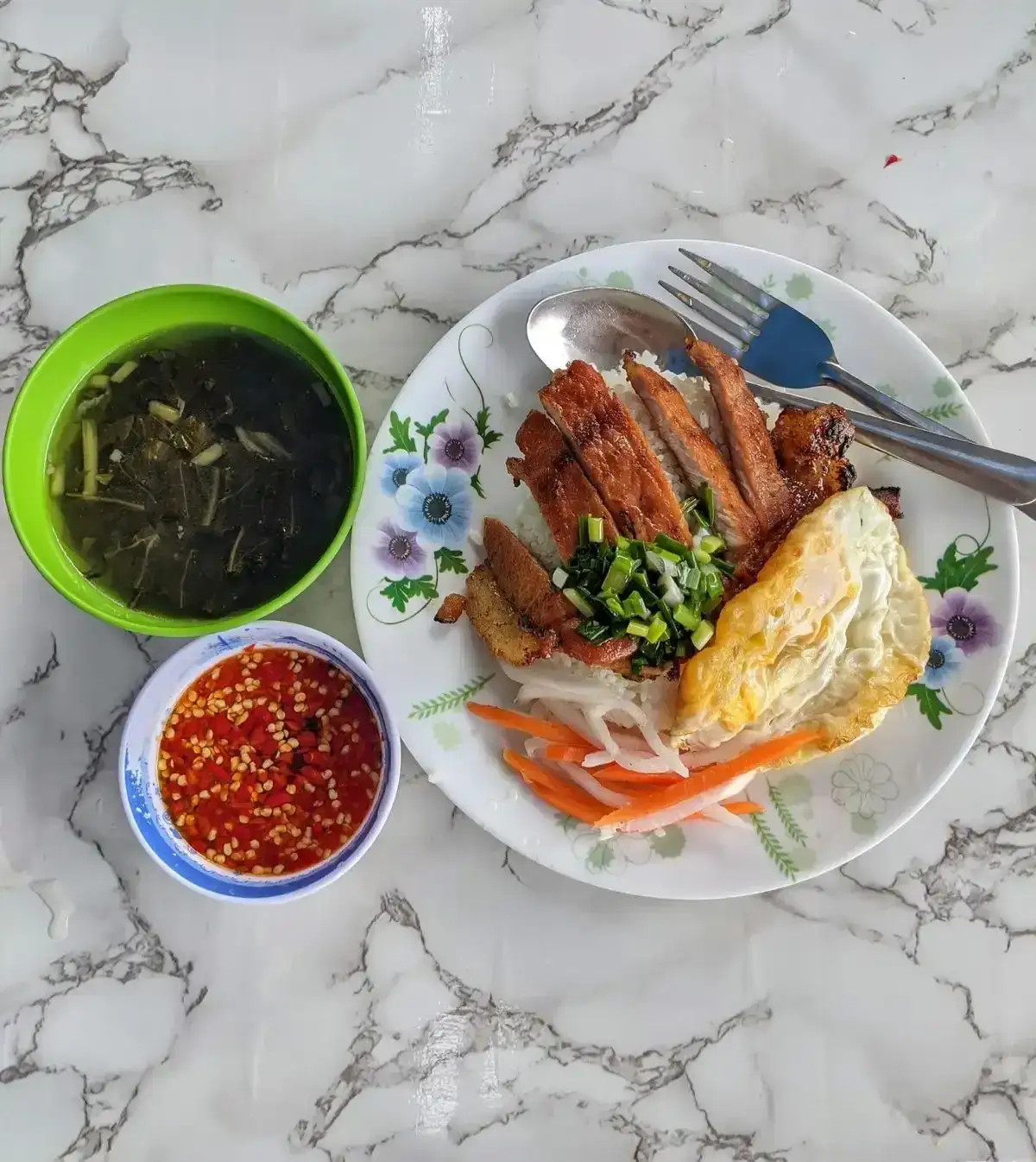
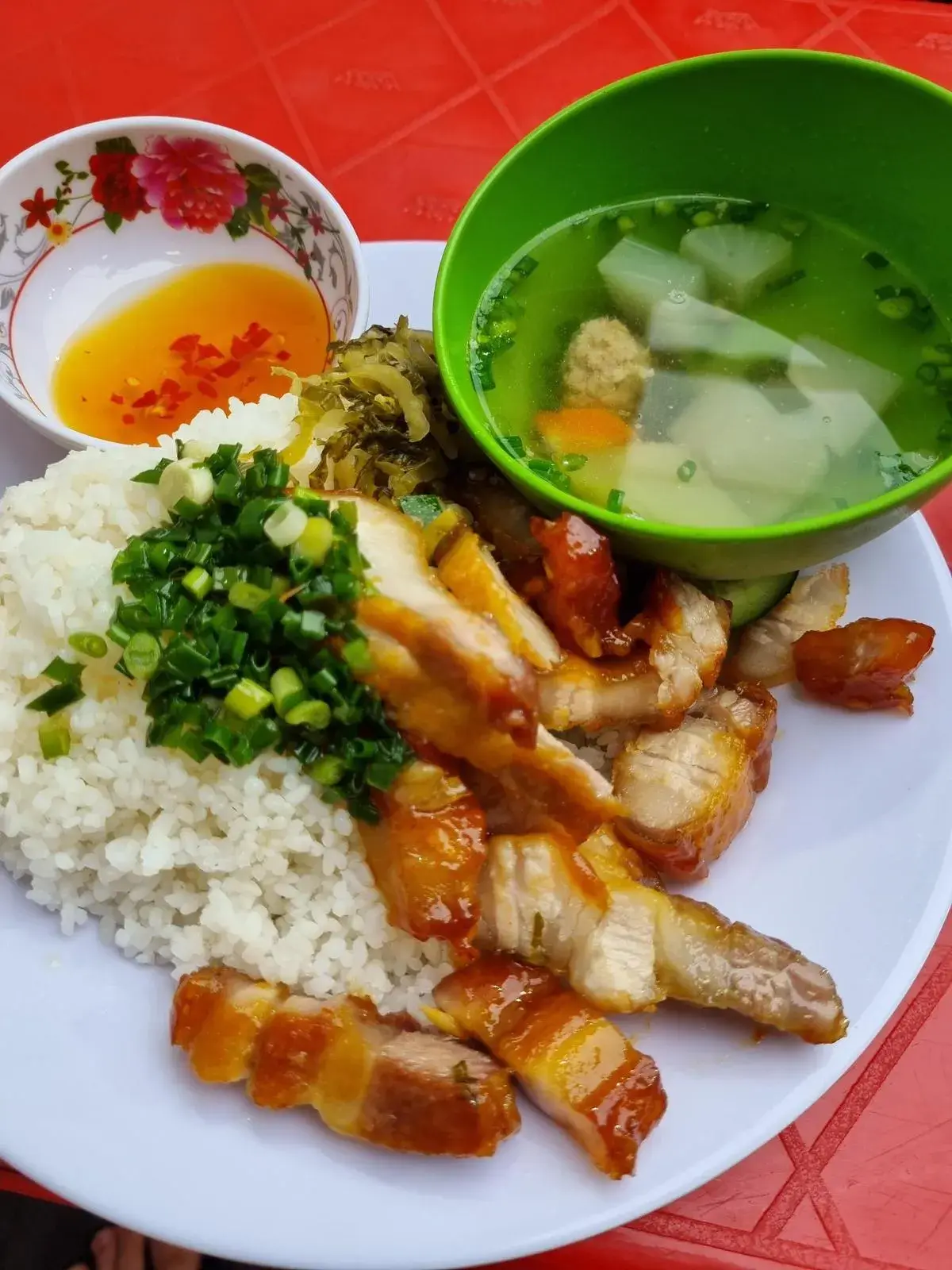
On a granite table is a plate of chopped grilled pork on rice with a fried egg, pickled carrot, and a small bowl of sauce with red chillies inside. The dish comes with a soup. This dish is in Vietnam.
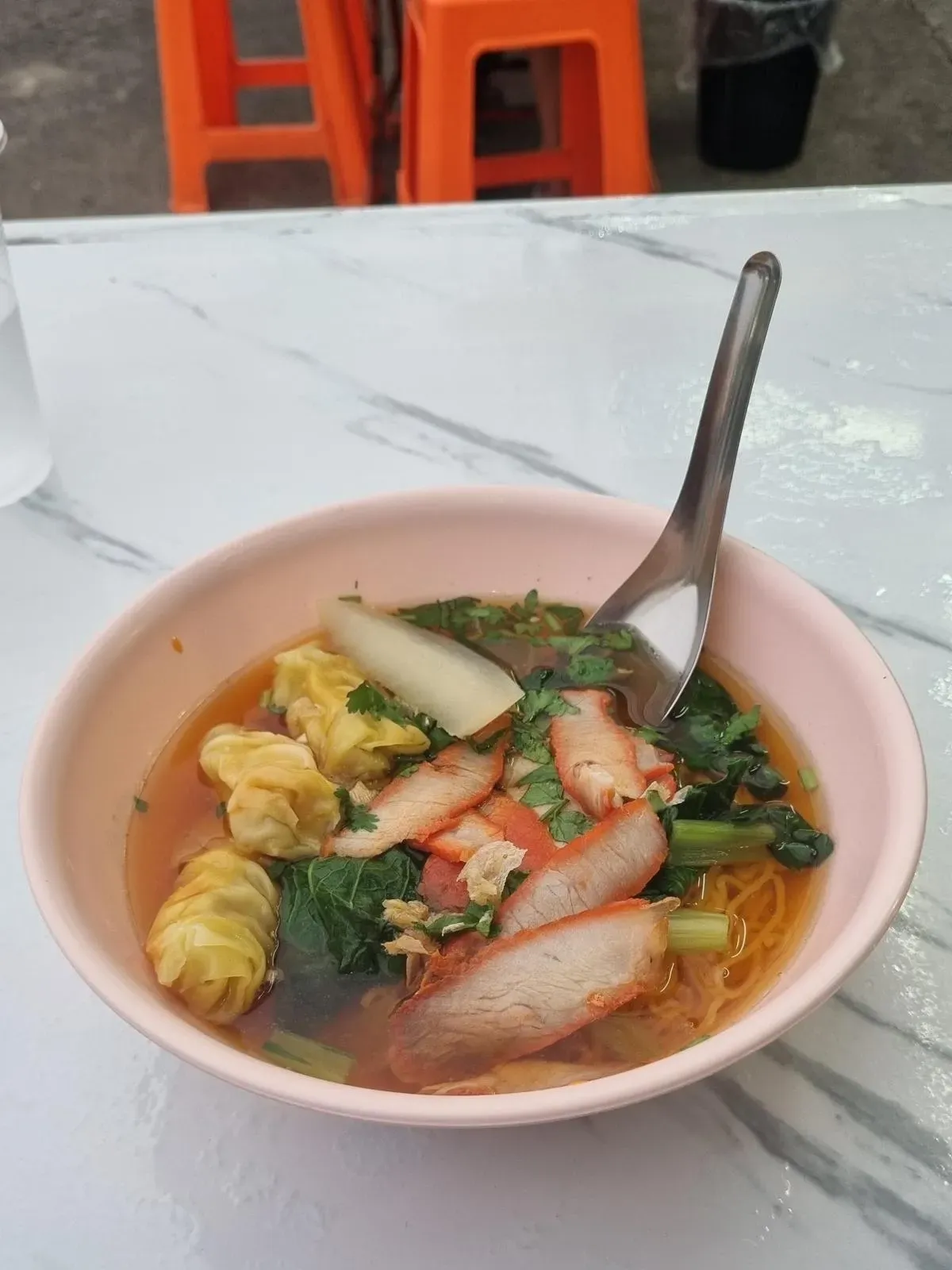
A bowl of egg noodles with red grilled pork, spinach, and a few dumplings inside. An asian-style soup spoon is sticking out of the bowl. The scenery is outdoors, and a couple of small plastic stool seats can partially be seen in the image.
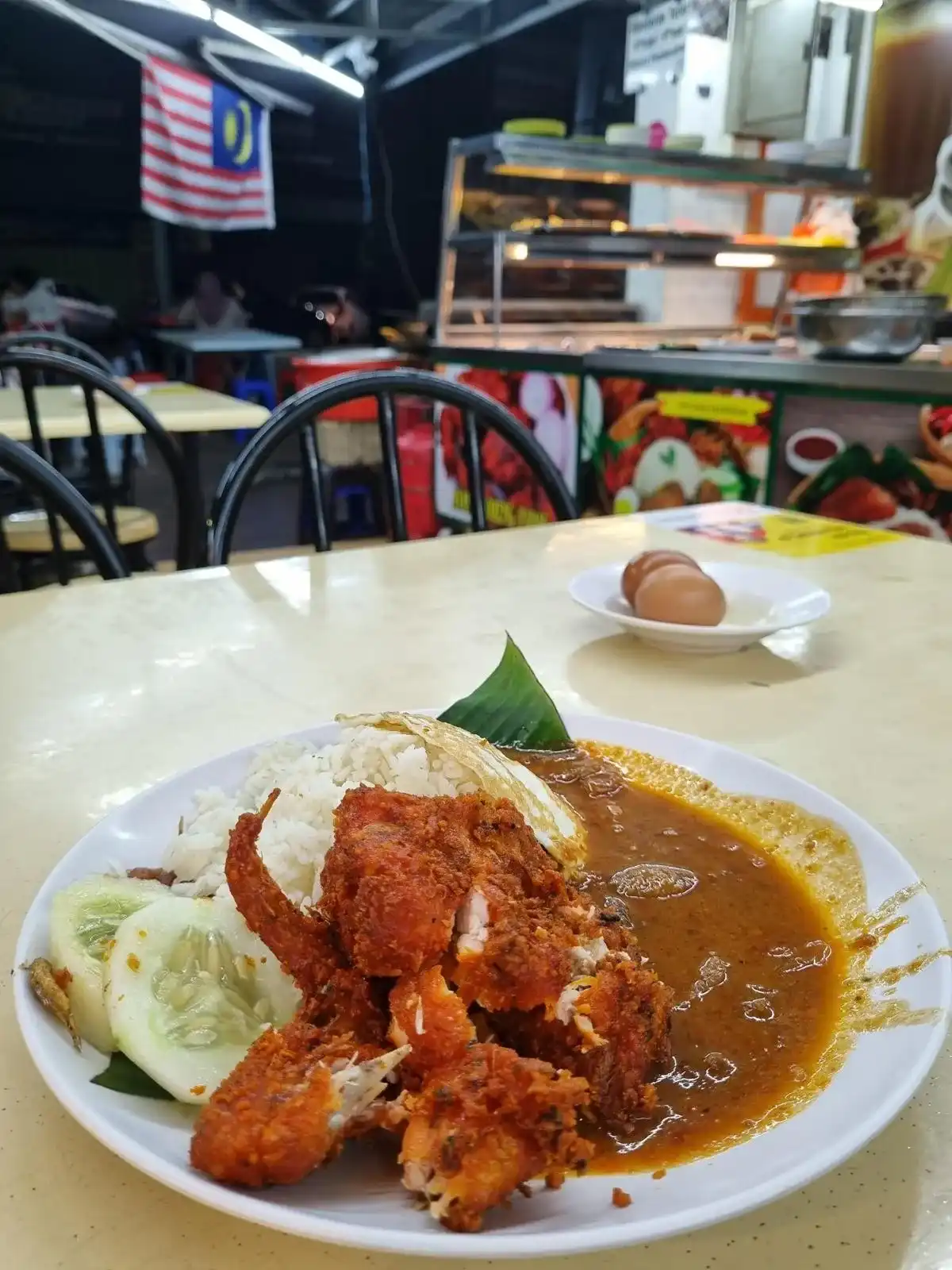
A dish in Malaysia called Nasi Lemak Ayam Goreng. Nasi (rice) Lemak (which is just a name?) Ayam (chicken) Goreng (fried) is fried chicken on rice cooked with coconut milk, sambal as a sauce, a fried egg, sliced cucumber, fried anchovies, and peanuts. This is dish is on display on a table at an open-air Indian-Malaysian restaurant called a Mamak or Nasi Kandar.
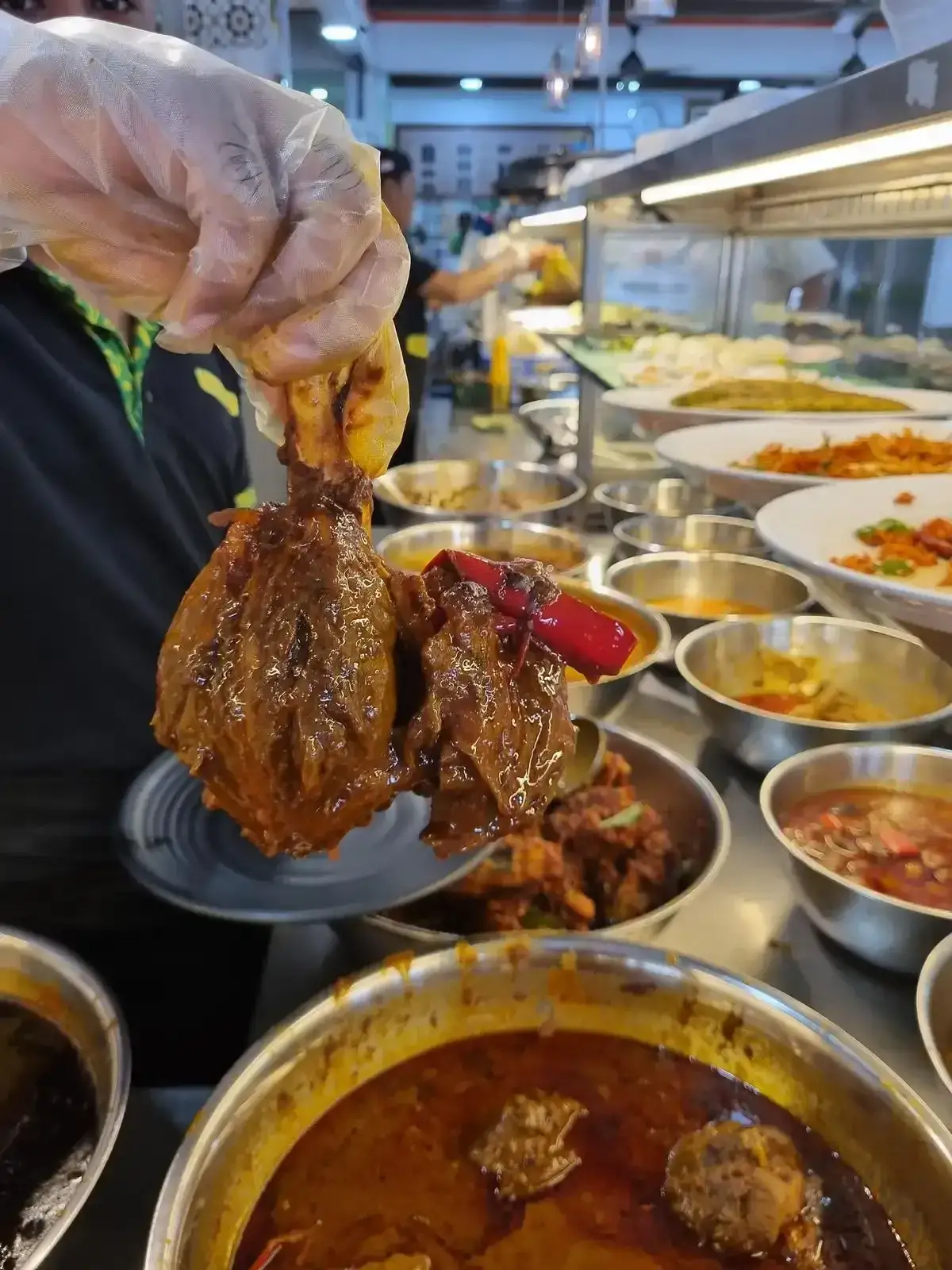
A lamb shank being shown to the photographer of this image by the Indian worker at an Indian-Malaysian restaurant called a Mamak or Nasi Kandar.
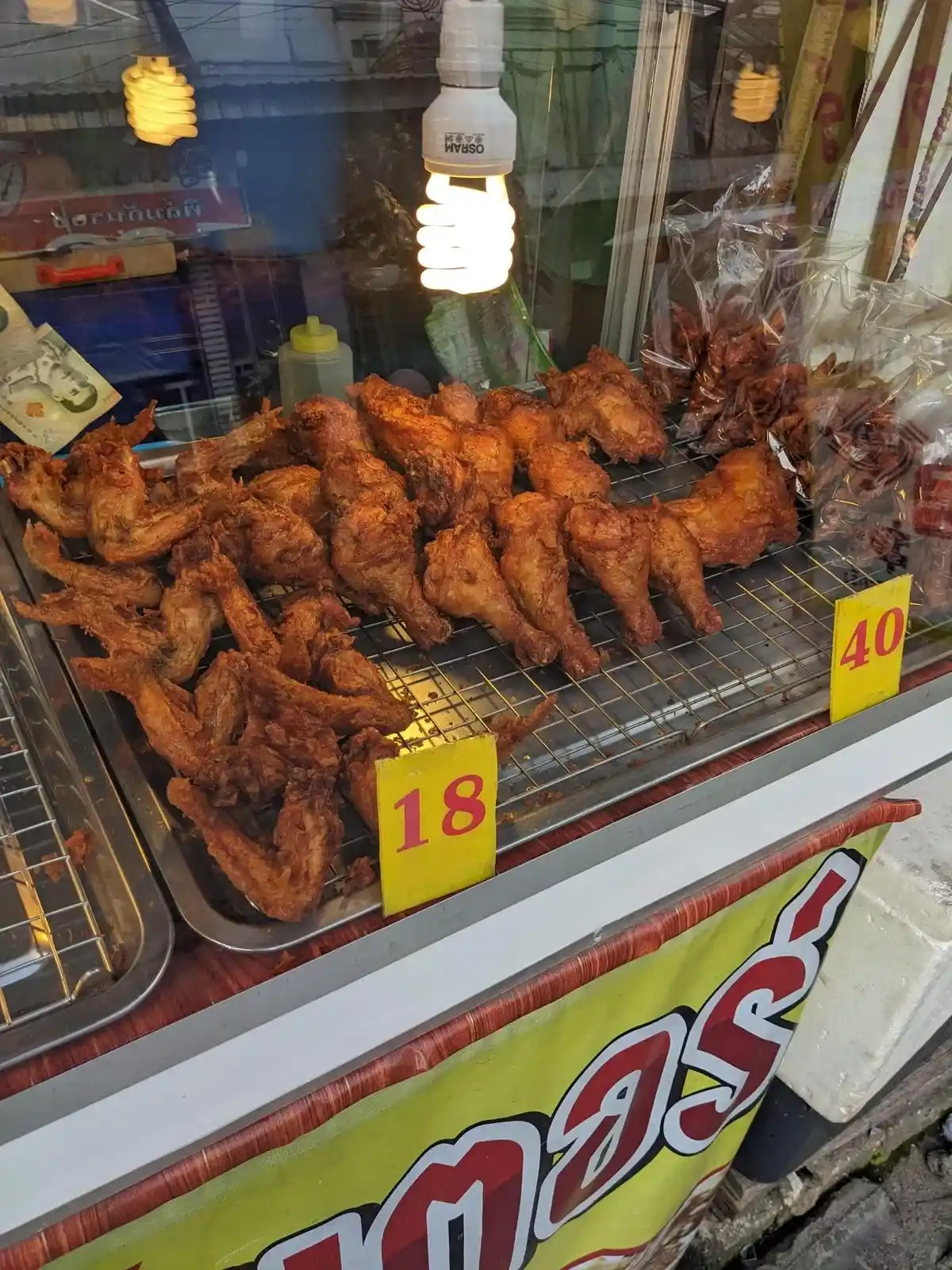
Fried chicken being sold in Thailand. Wings are eighteen Thai Baht (about sixty US cents), and chicken legs are forty baht (about one US dollar and twenty-five cents).
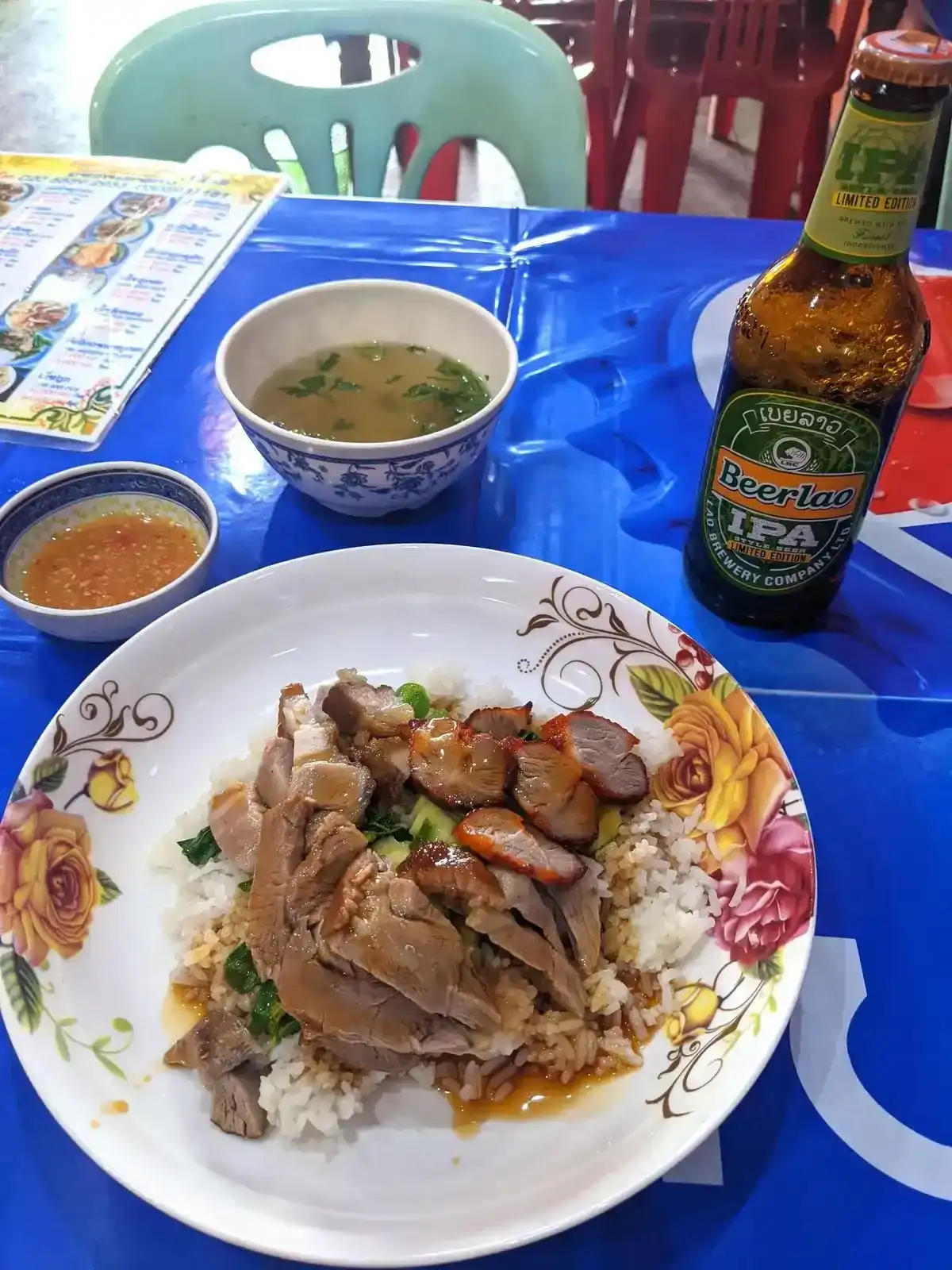
A pork dish in Laos consisting of pork leg, grilled red pork, and crispy pork on rice with a little bit of brown sauce added ontop. It comes with sliced cucumber and a garlic sauce to be added. A simple brothy soup is included. A Beer Lao IPA beer is alongside the dish.
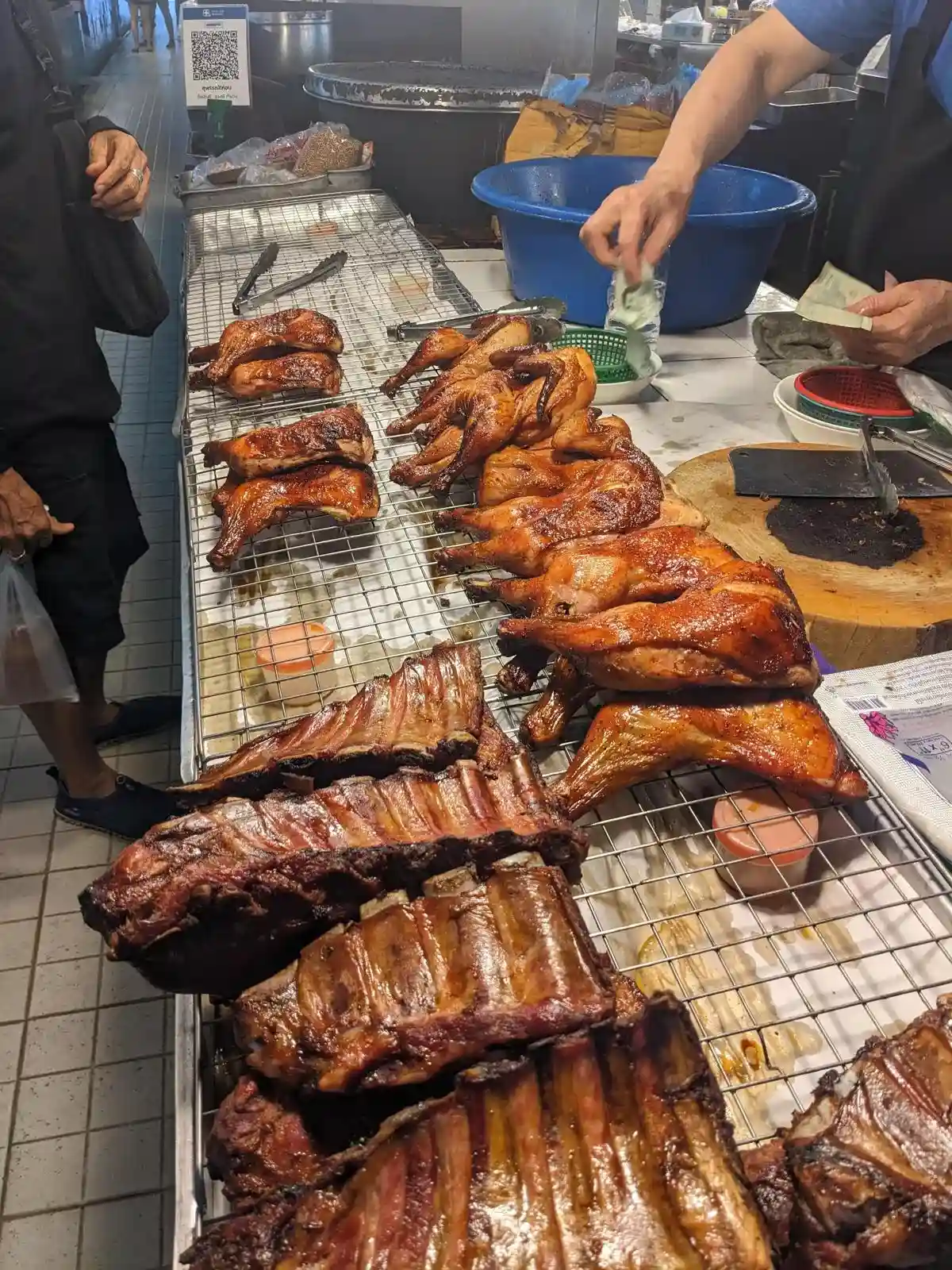
A counter of grilled meat at a food market in Thailand. Grilled pork ribs, chicken chops, and whole chickens are for same. The seller has a meat clever and chopping board to chop up the meat as you desire. A customer is purchasing something in this image, exchanging cash with the seller.
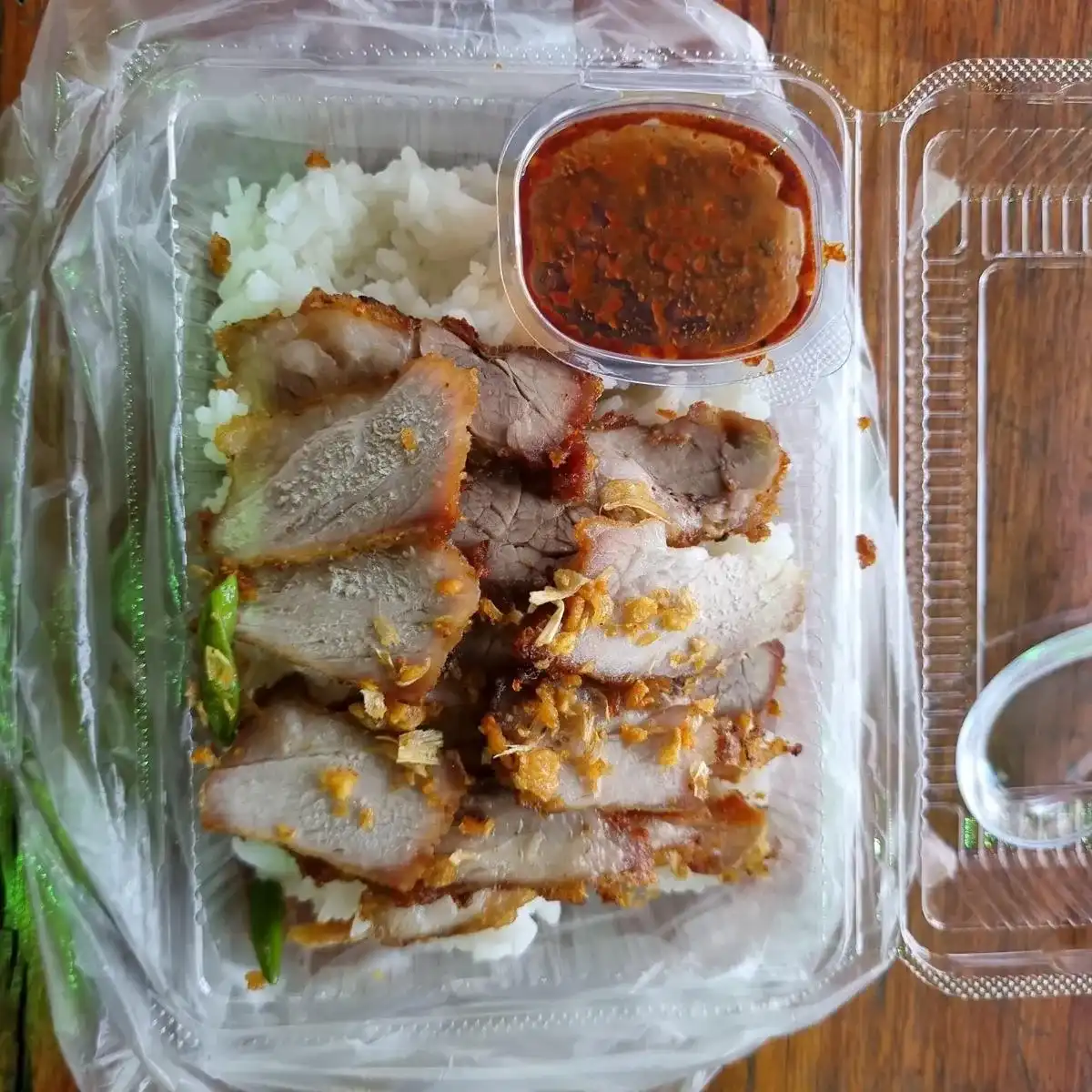
A portion of Thai crispy pork on white rice with a sauce, packaged to take home.
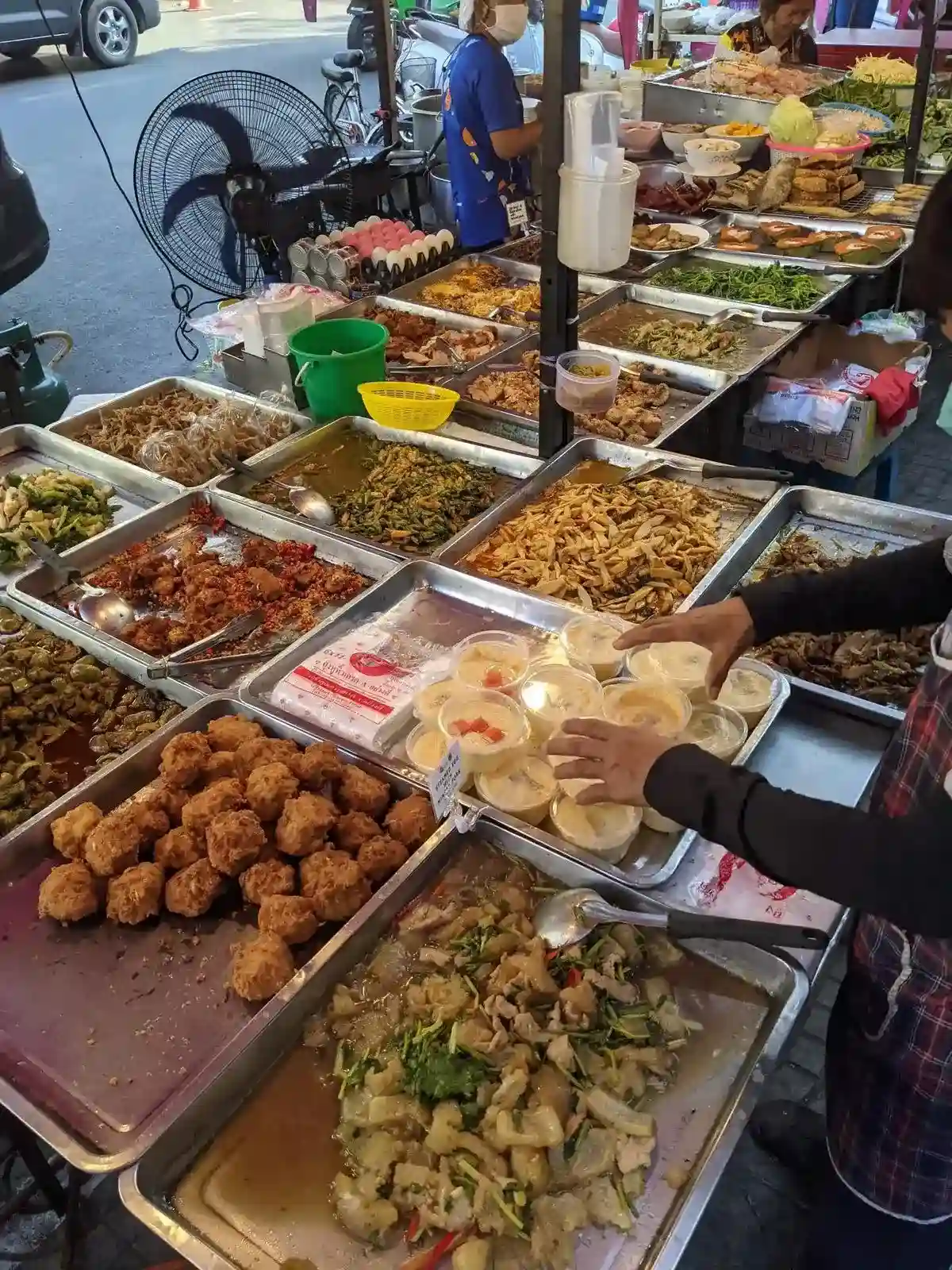
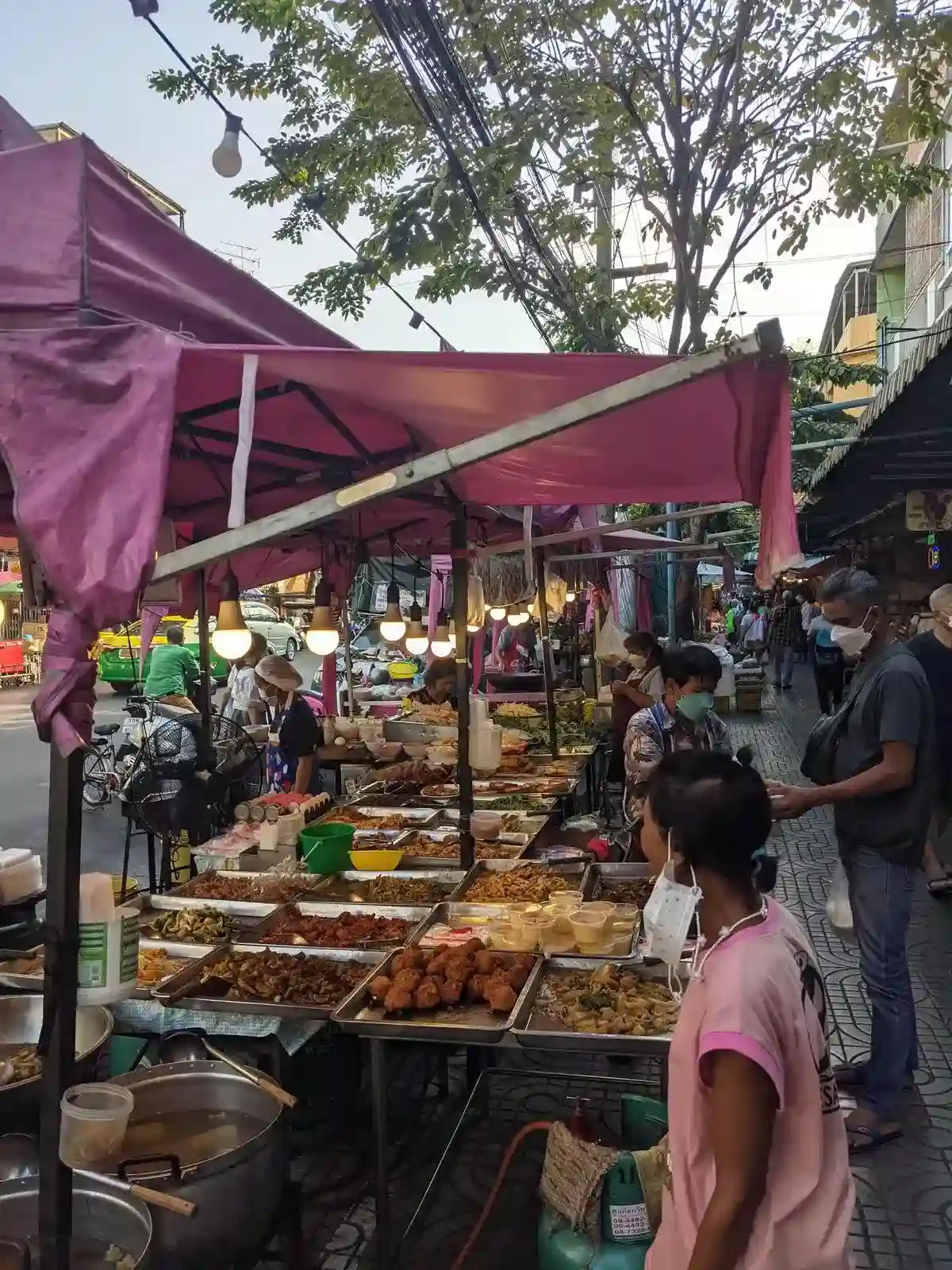
A street food stall in Bangkok, Thailand with about twenty local dishes, each on individual pans. The pans are placed against one another along a few tables, allowing customers to see everything on display and choose their next meal.

… and more food!:
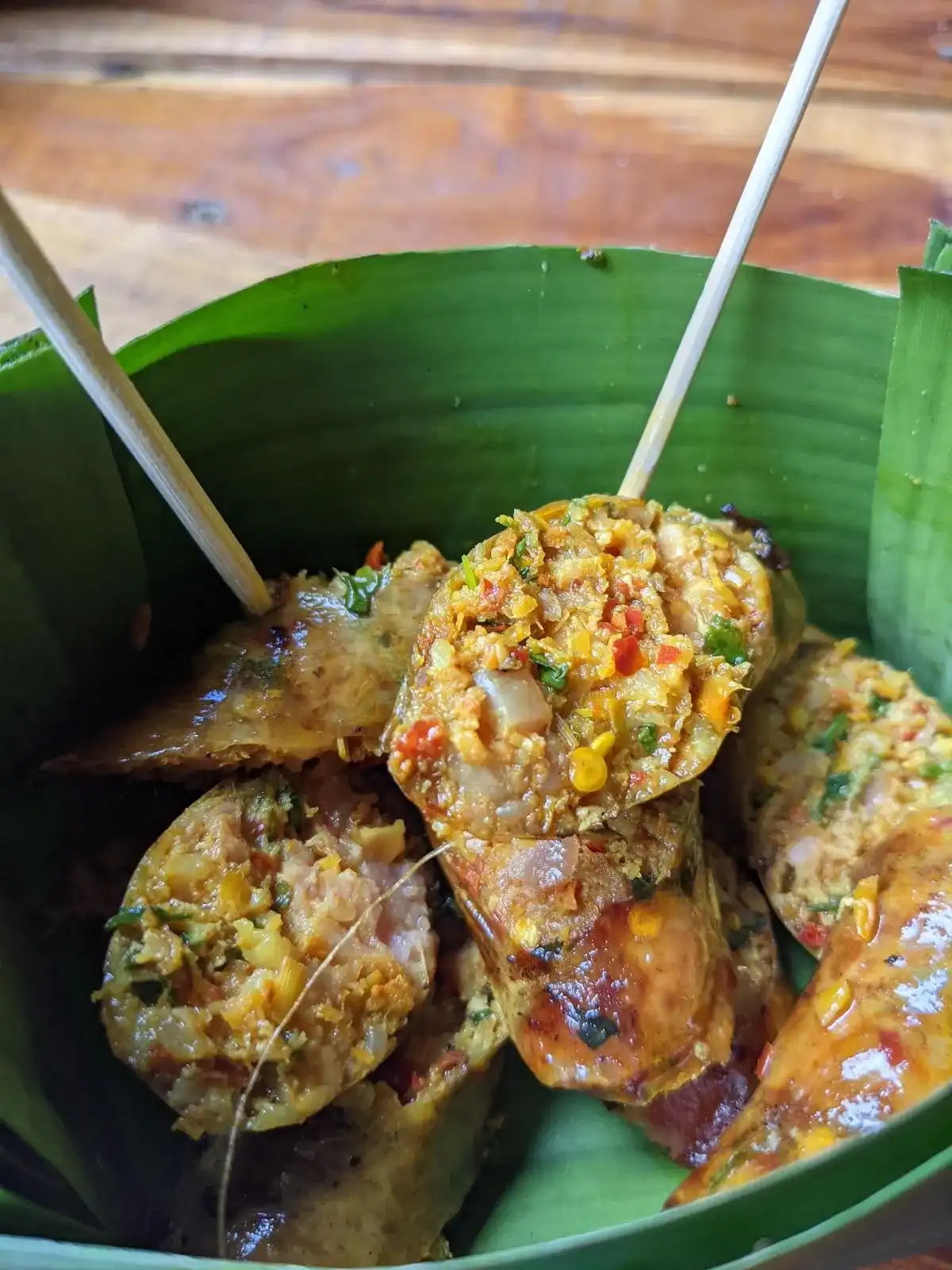
Pieces of a sliced-up grilled Thai sausage, where you can see the inside of it. This is called Sai Oua (aka Lao sausage) and is similar to a German Bratwurst sausage. Per Wikipedia, it is made with coarsely chopped fatty pork seasoned with lemongrass, galangal, kaffir lime leaves, shallots, cilantro, chilies, garlic, salt, sticky rice, and fish sauce. Two bamboo sticks, like a bigger tooth pic, are stuck into pieces of the sausage and used as a fork.
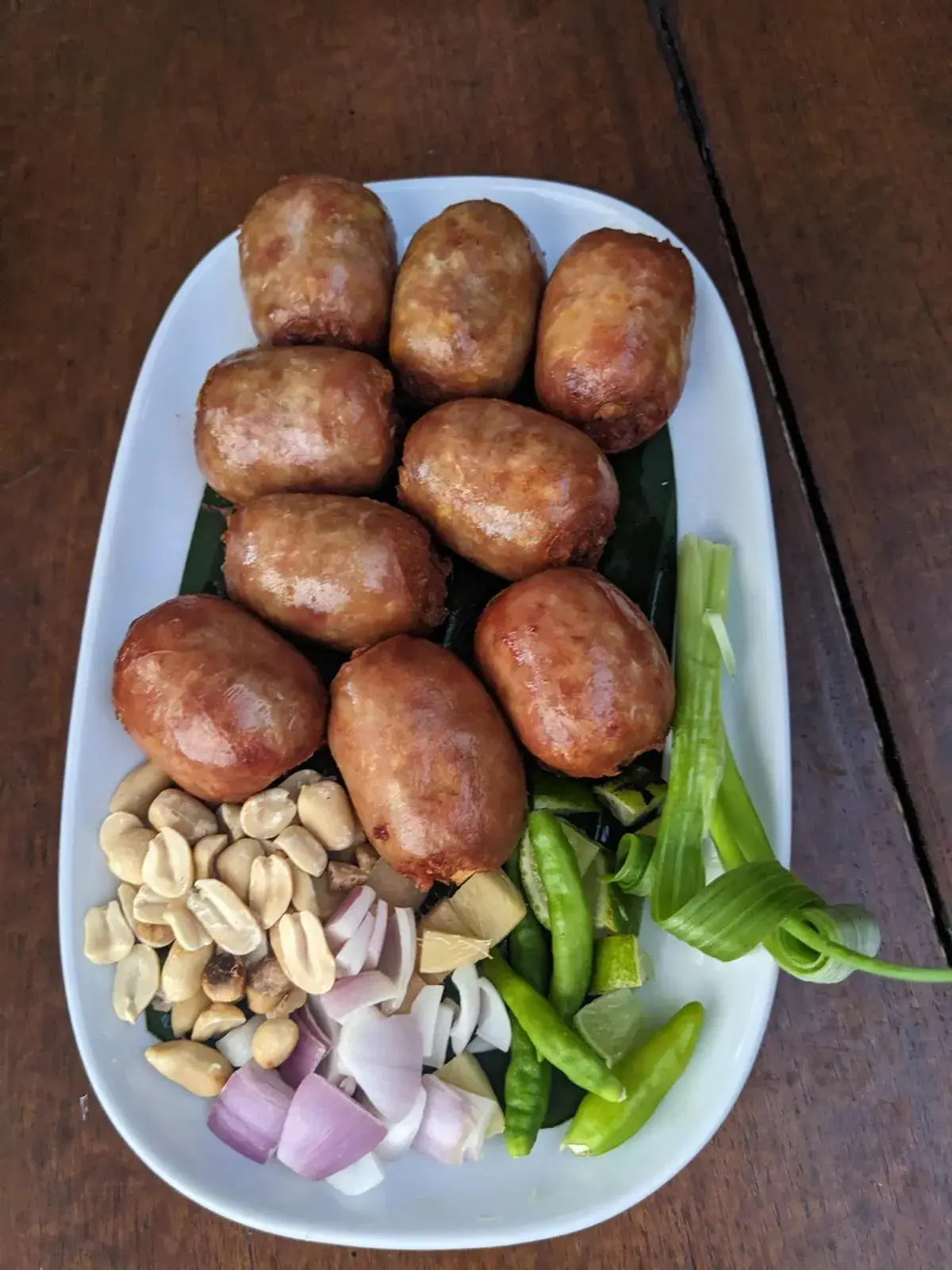
Nine grilled fermented pork Thai sausages. This is called Naem. They are chunky and thumb-sized in length. You can eat them as they are, or with any or all of the condiments included - sliced onion, peanuts, and chilli peppers.
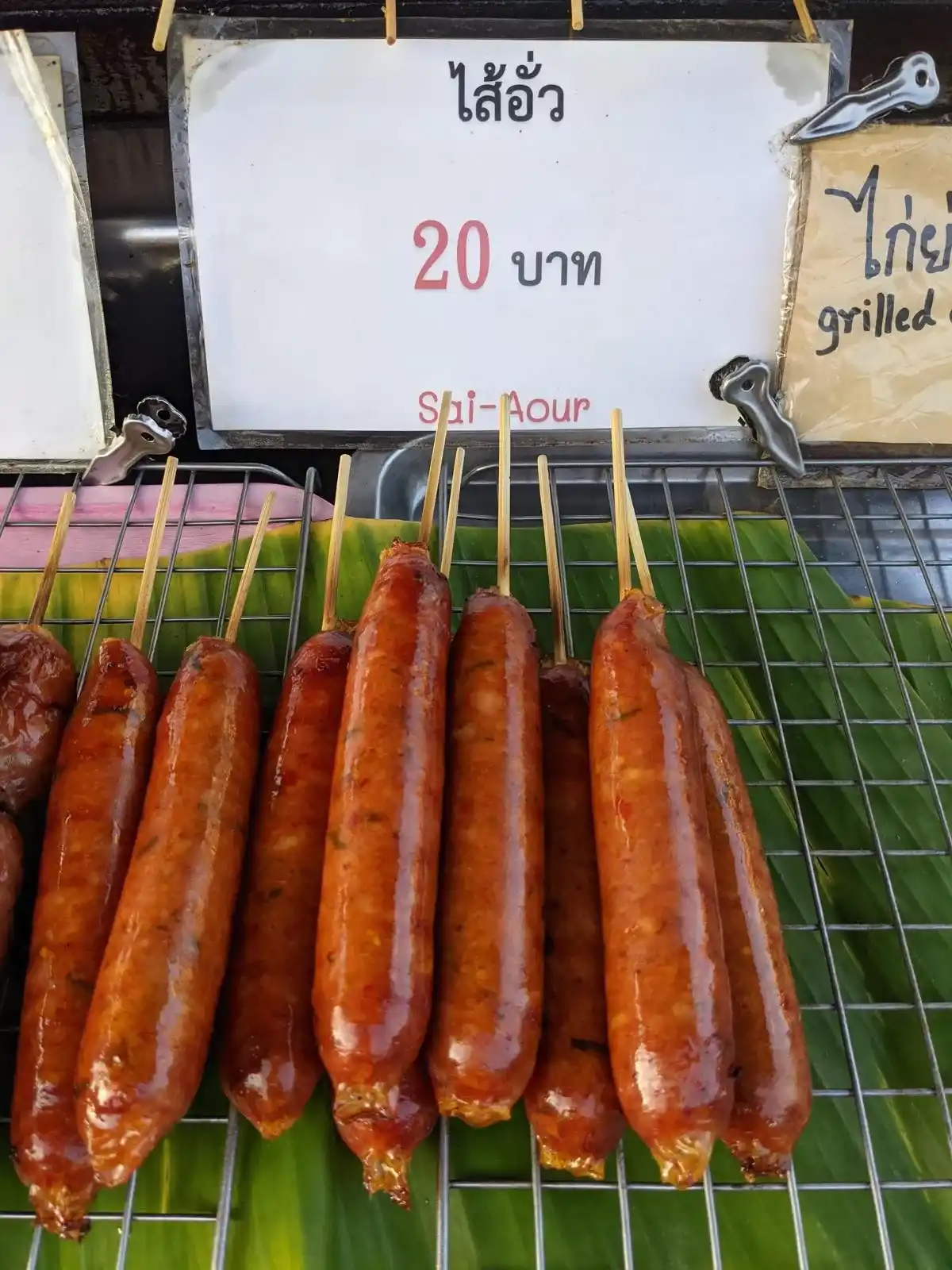
A street food stall in northern Thailand selling long and thin grilled sausage at a price of twenty Thai Baht (about 65 US cents). This is called Sai Oua (aka Lao sausage) and is similar to a German Bratwurst sausuage. Per wikipedia, it is made with coarsely chopped fatty pork seasoned with lemongrass, galangal, kaffir lime leaves, shallots, cilantro, chilies, garlic, salt, sticky rice, and fish sauce.
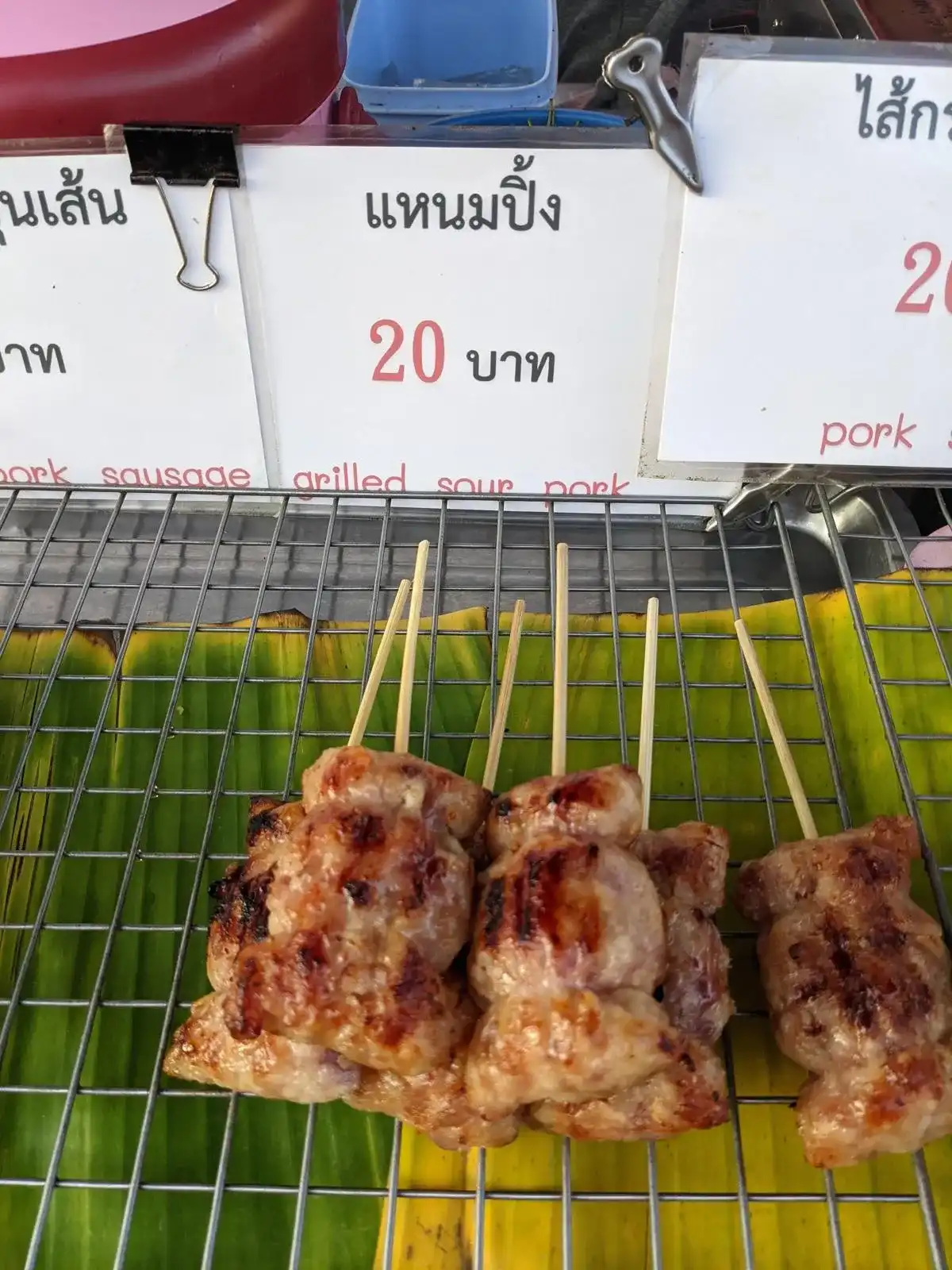
A street food stall in northern Thailand selling grilled sour pork at a price of twenty Thai Baht (about 65 US cents).
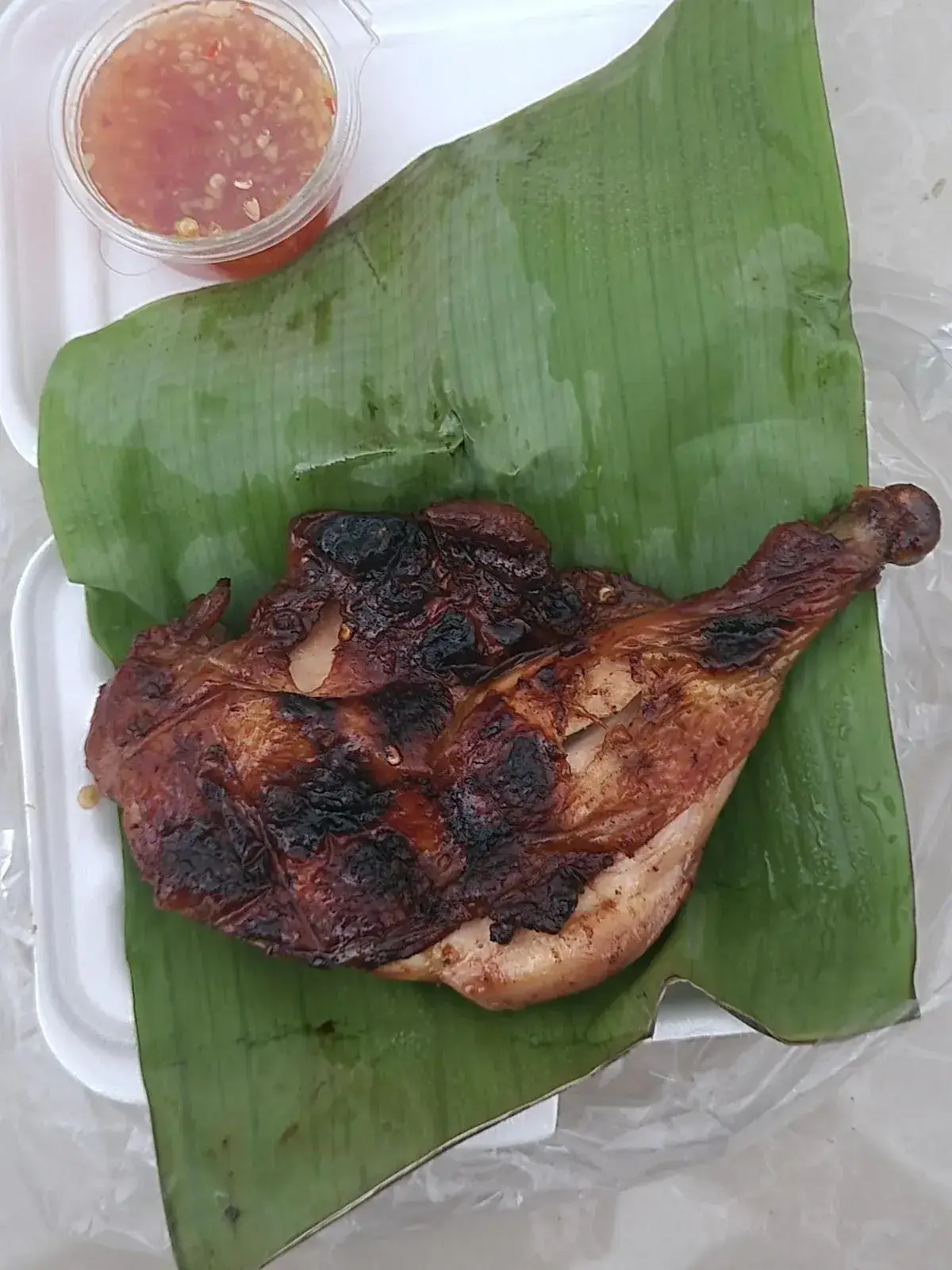
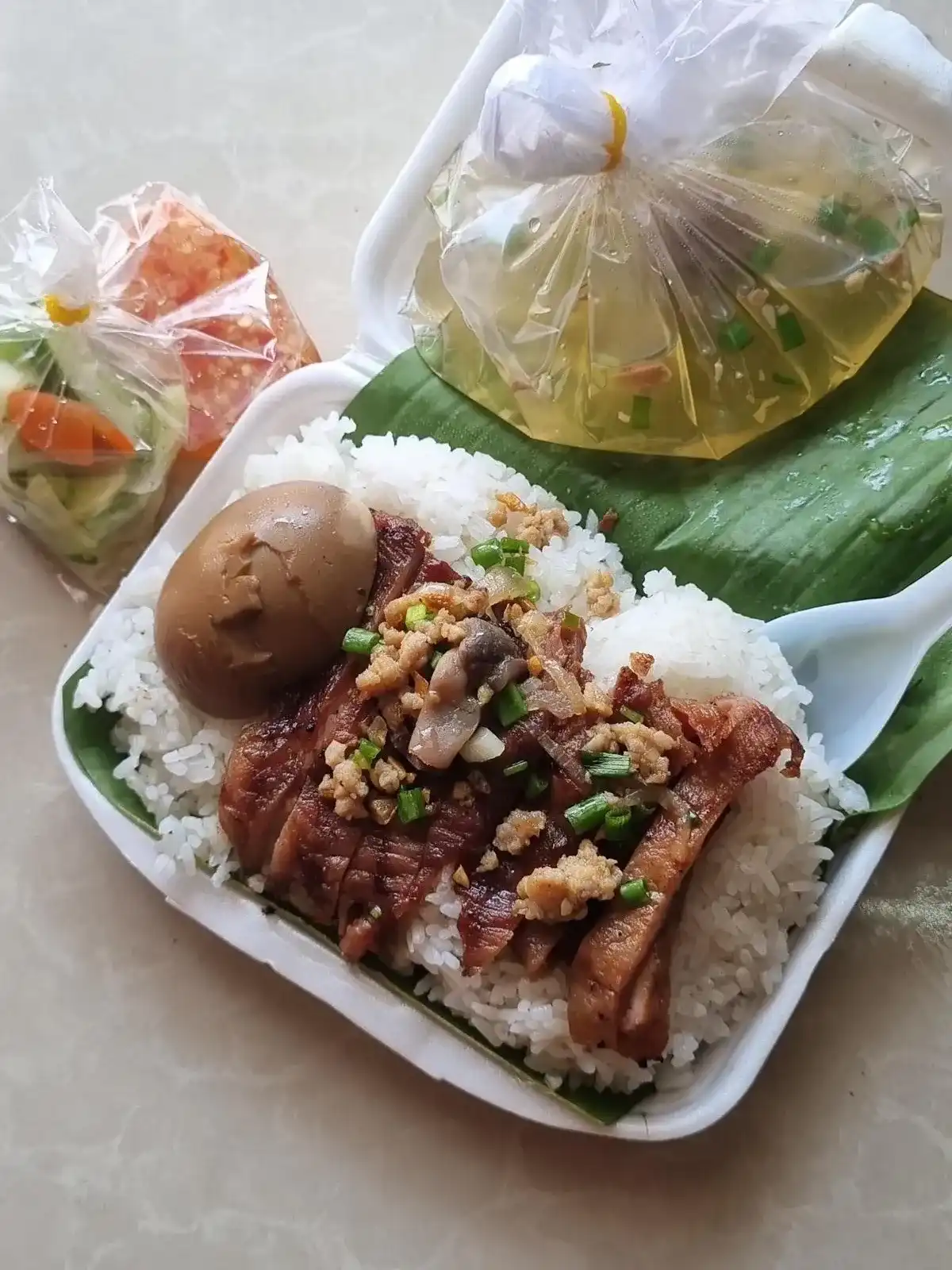
Grilled chicken chop with a side of garlic sauce in Cambodia. The chicken is laid on a banana leaf within a styrofoam take-out container.
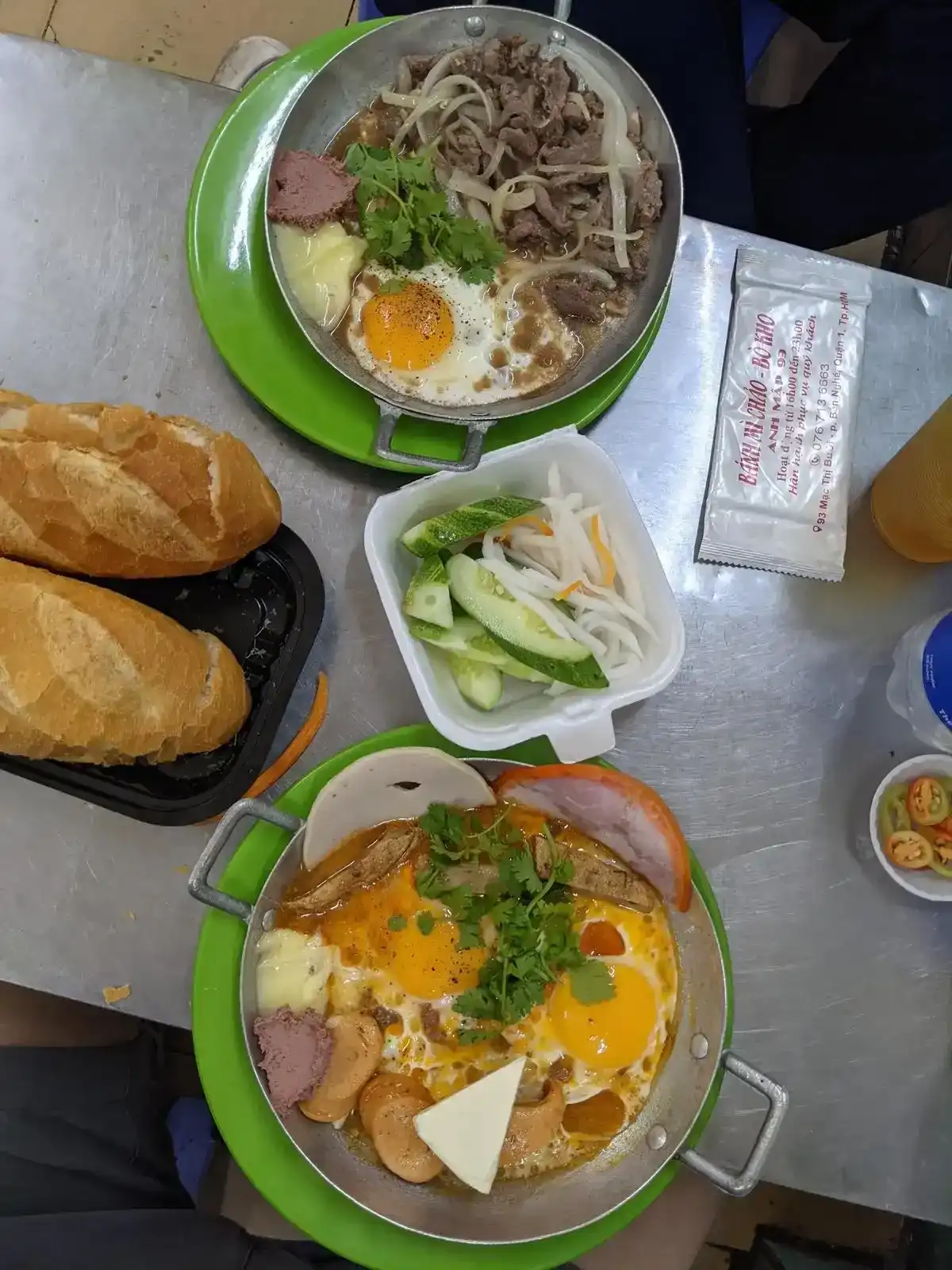
Two breakfast skillets with French bread on the side on a table in Vietnam with wet wipes as a napkin. This is called banh mi chao in Vietnamese. Different toping can be chosen. One of the dishes in this image have steak, onions, fried egg, cilantro, pate, and mayonaise. The other dish has ham, hot dog, cheese, fried eggs, cilantro, pate, and mayonaise. At the center is bowl of pickled vegetables, too.
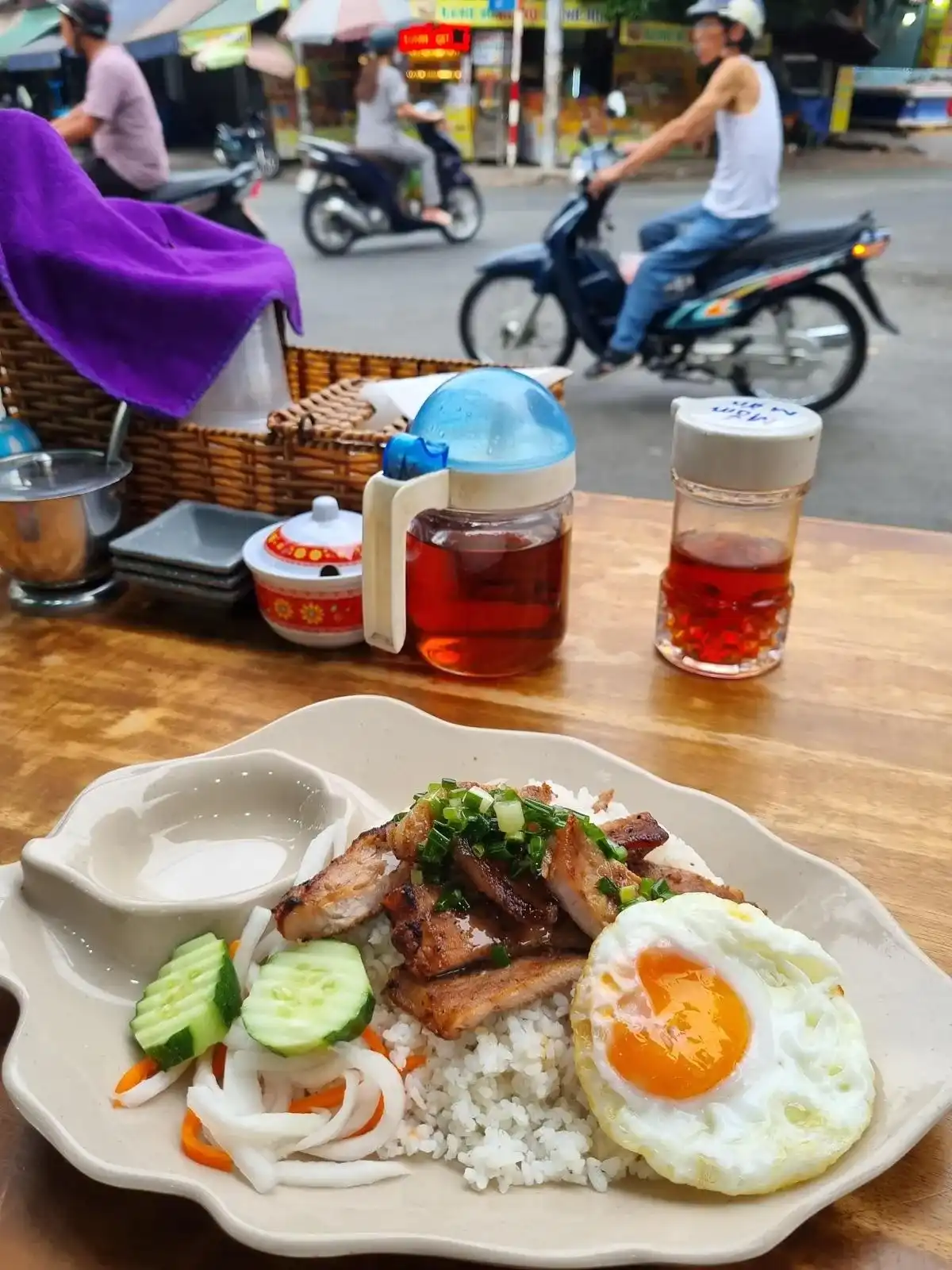
A dish of pork rib on rice with a fried egg, pickled vegetables, and sauce on the side. The table is on a street corner watching motorbike (aka scooter) traffic riding by. These restaurants serve food called "Com Tam" (gum tam), meaning "broken rice", which refers to the type of rice served - it is small as if it was broken in half.
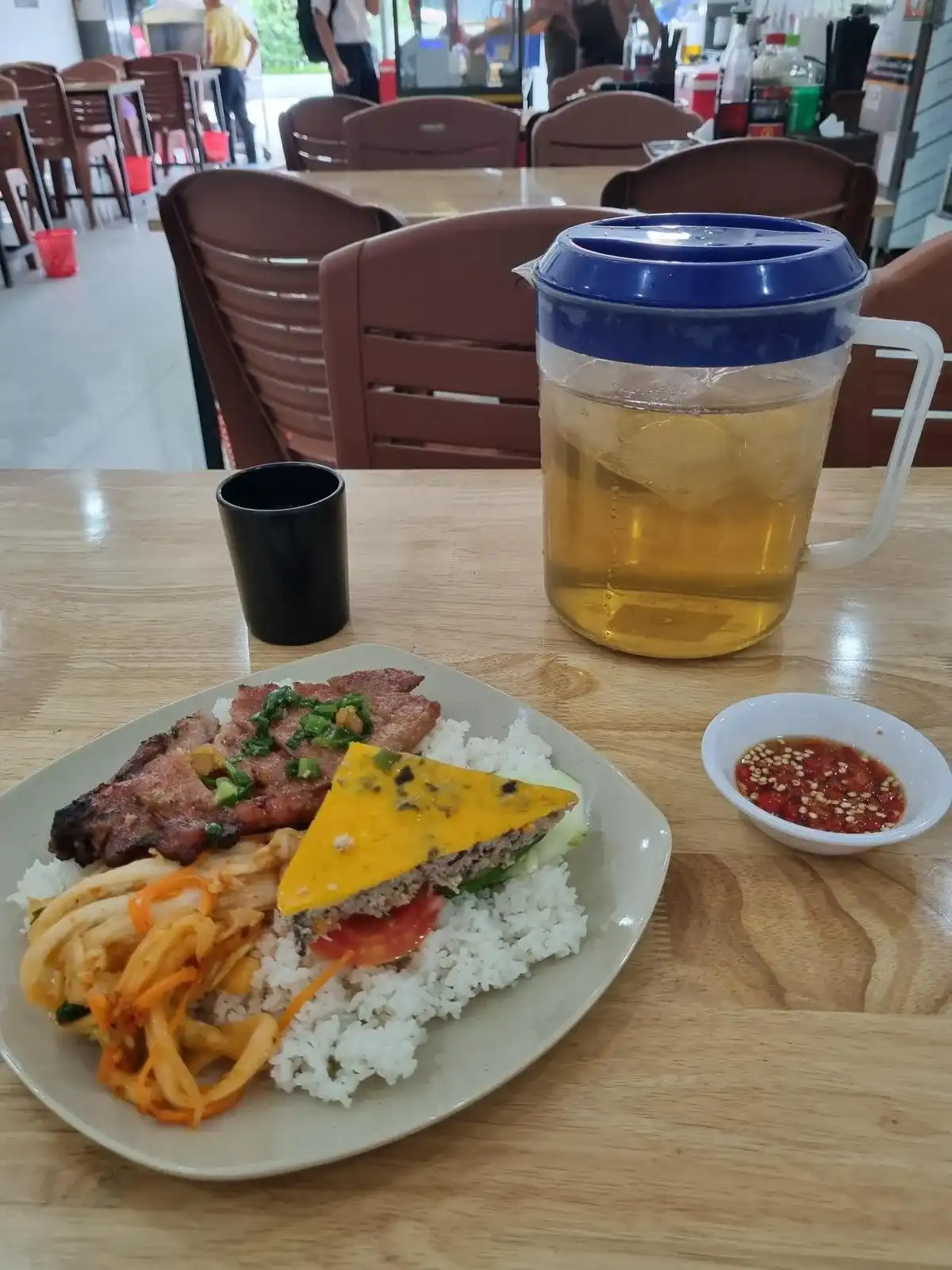
A dish of pork rib on rice with a Vietnamese meat loaf, Korean kimchi instead of pickled vegetables, and spicy-looking soy-based sauce on the side. A jug of iced team is on the table for customers. The table is inside a Com Tam restaurant. These restaurants serve food called "Com Tam" (gum tam), meaning "broken rice", which refers to the type of rice served - it is small as if it was broken in half.
A portion of sliced grilled pork on rice with a boiled egg, pickled vegetables, and a packet of sauce with red chillies inside. The dish comes with a soup. This dish is from Cambodia, but closely resembles a Vietnamese version.
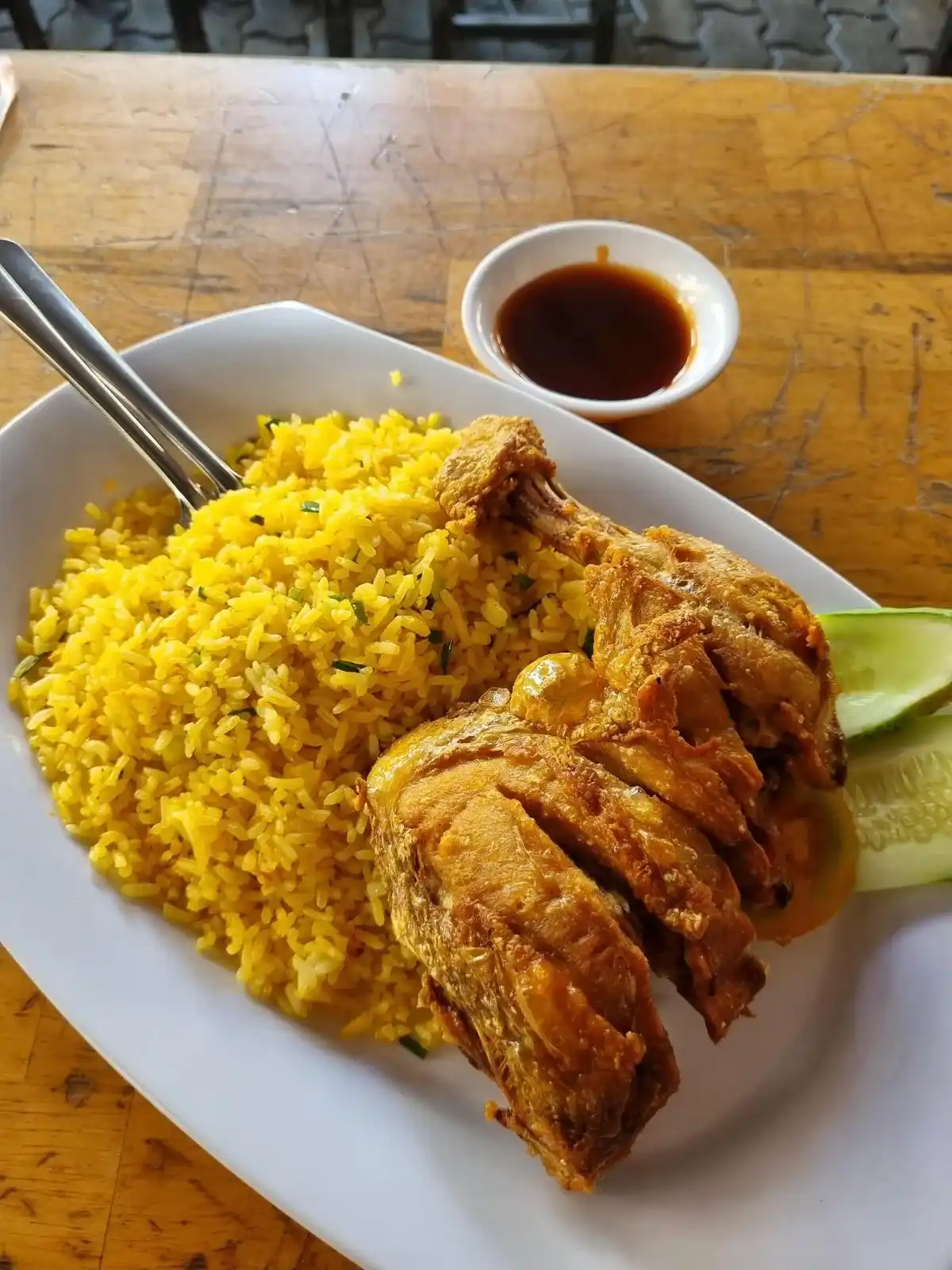
A plate of Com Ga, which is Vietnamese meaning "Rice Chicken". The rice is fried, the chicken deep fried, and there is a side of brown sauce and sliced cucumber.
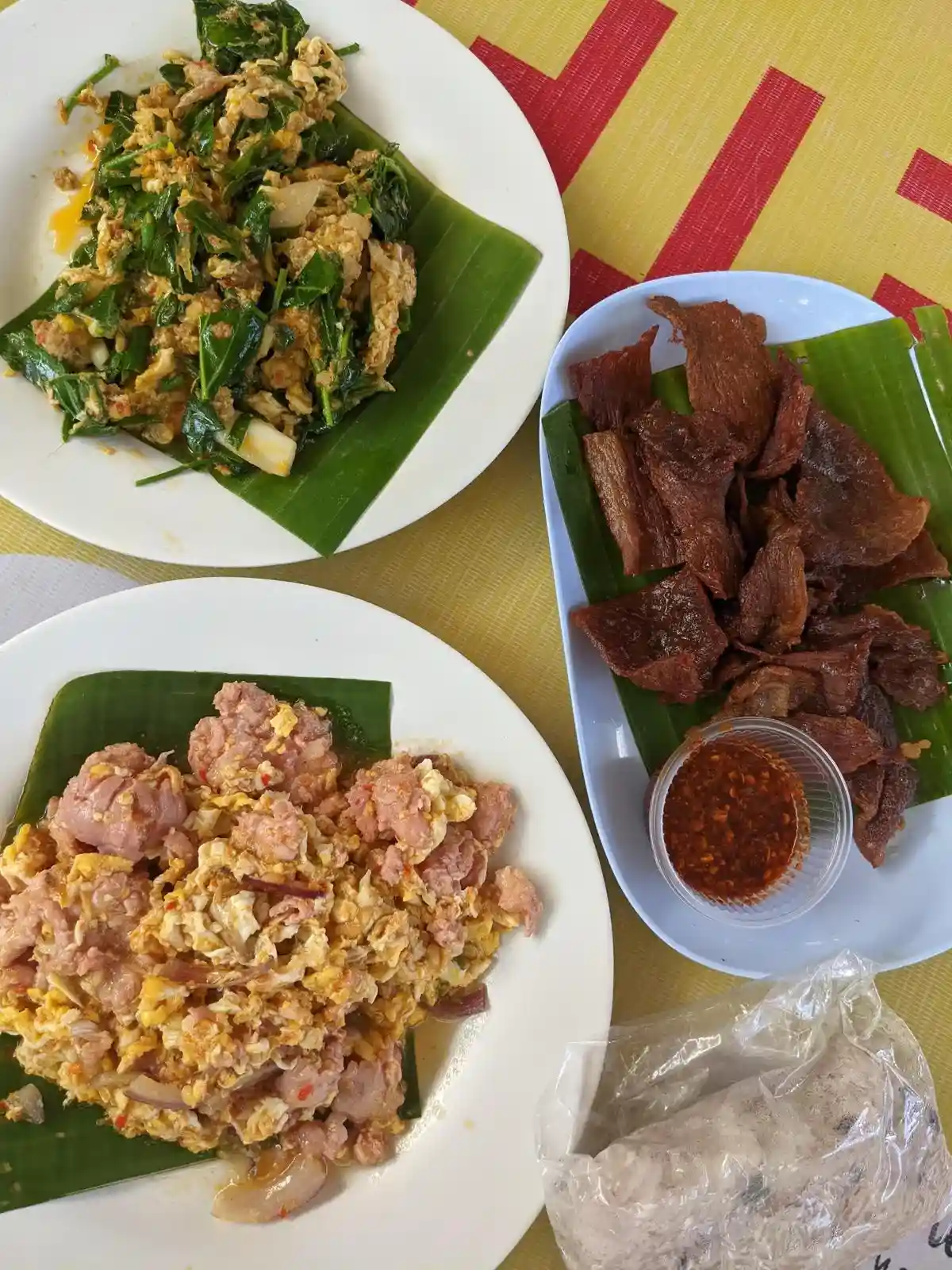
Three plates of northern Thai dishes. One is a meat jerky with dipping sauce.
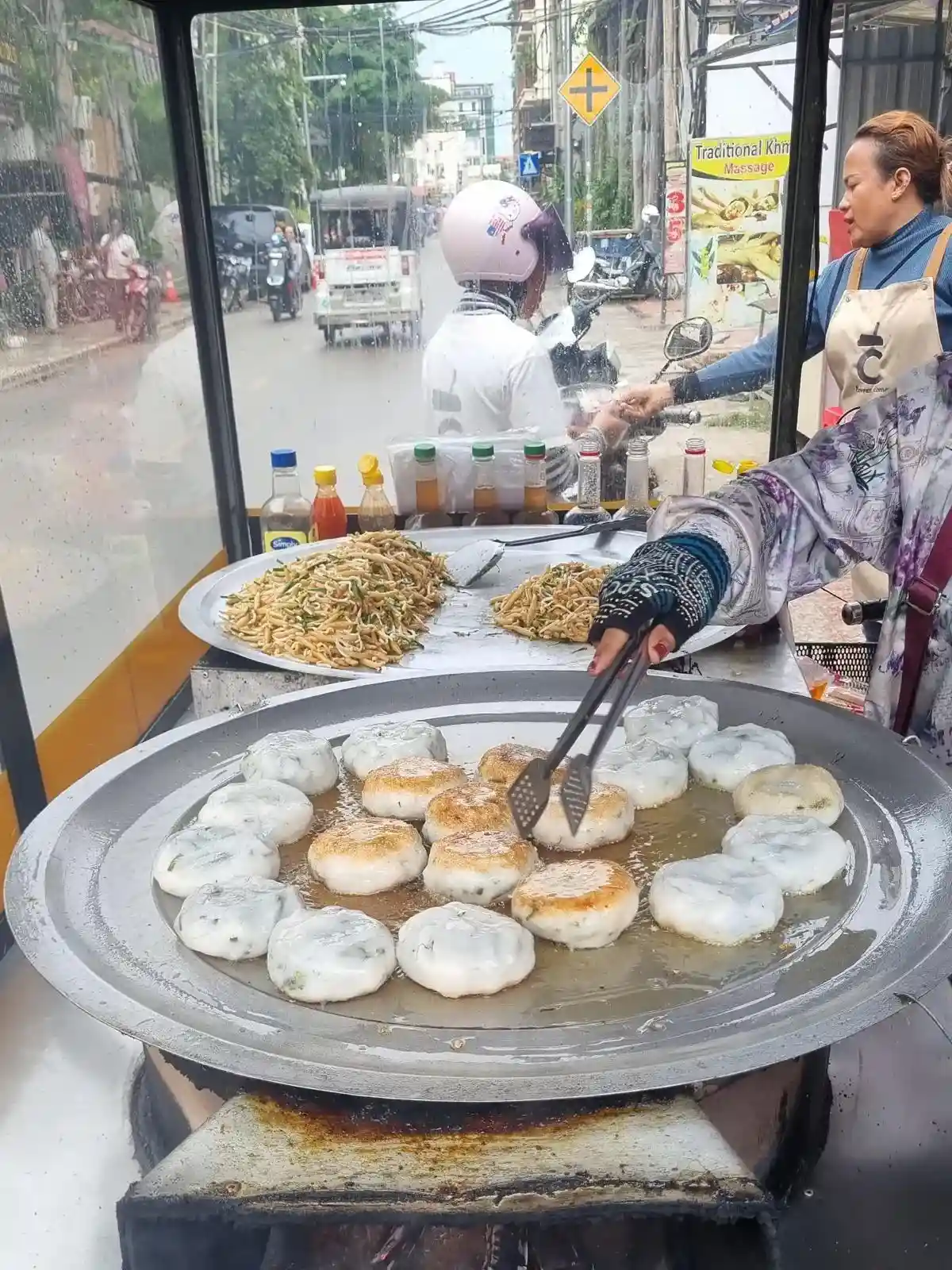
A woman with an enclosed food cart is pan frying chive cakes on the side of a narrow street in Cambodia. The cart has several sauces to choose from. The pan is large - about twenty inches in diameter - and is heated underneath with wood fire stove burning small pieces of chopped wood. In the background, a customer is purchasing some food.
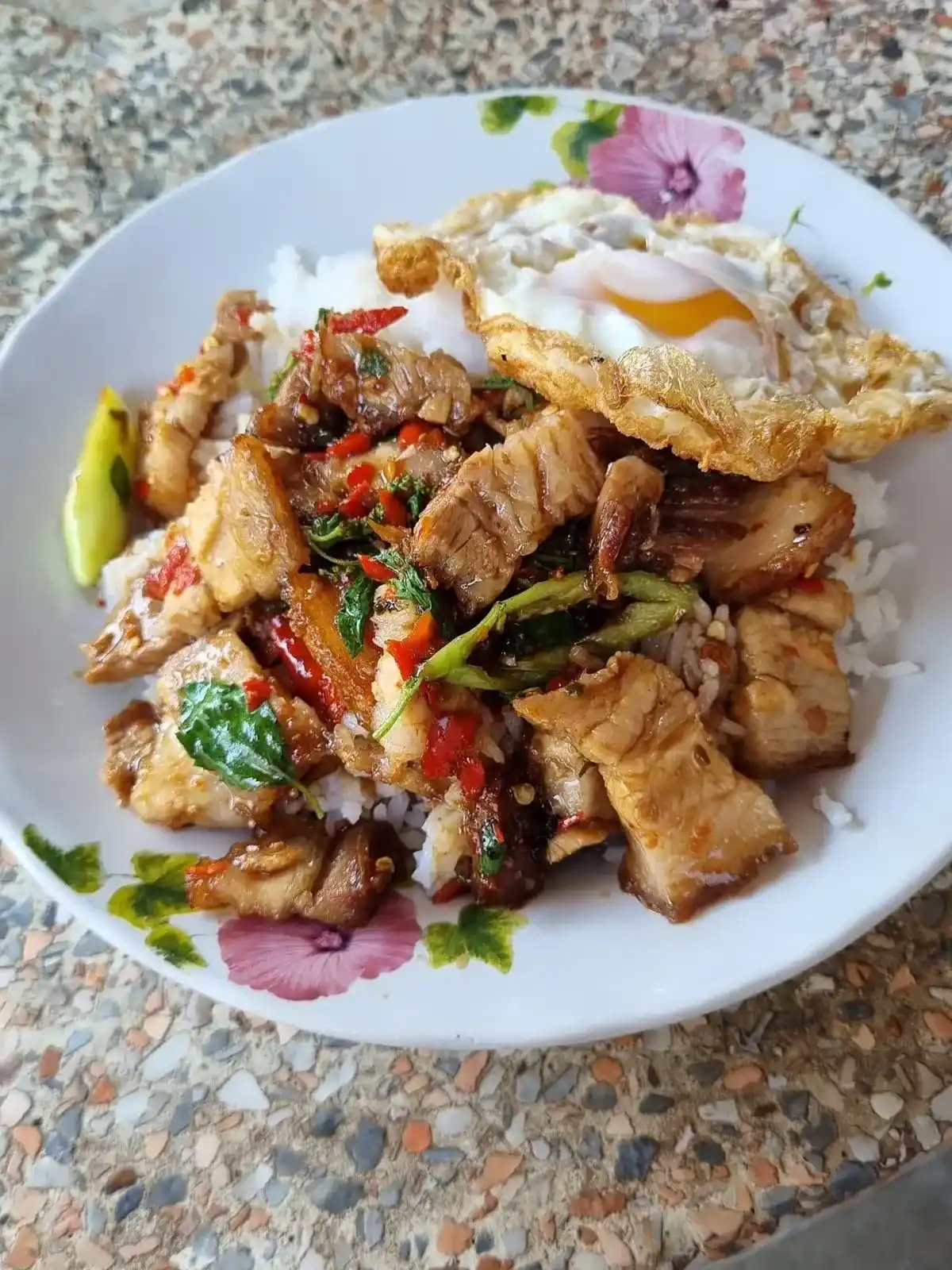
Thai stir-fried crispy pork on rice with a fried egg. The dish has Thai basil and red chillis mixed in. Crispy pork the meat as bacon, but small chunks instead of long thin slices. The meat has a thin batter on the edge, causing it to be crispy when fried.
A Laotian pork dish. Aside from the cut of pork mean, it includes two slices of Chinese sausage, half of a boiled egg, a stick of green onions (i.e. scallions), a soy-based sauce on the side, and a simple soup. Utensils used are spoon and a fork to push the food onto the spoon.
Thai stir-fried crispy pork on rice with sauce on the side. Included is a small simple soup with some vegetables inside. Crispy pork the meat as bacon, but small chunks instead of long thin slices. The meat has a thin batter on the edge, causing it to be crispy when fried.

Humble road-side stalls

Without the overhead of maintaining a restaurant and paying rent, their food costs are competitive – lower, fresh, and often times cooked on the spot just the way you need it!

Don’t go to the food – eat where the food comes to you, along the paths of foot traffic.  Here, you’ll see hungry customers ride their motorbikes and grab an order to go.  No local likes to eat dirty food, so although these eateries are humble they are clean, despite your impression.
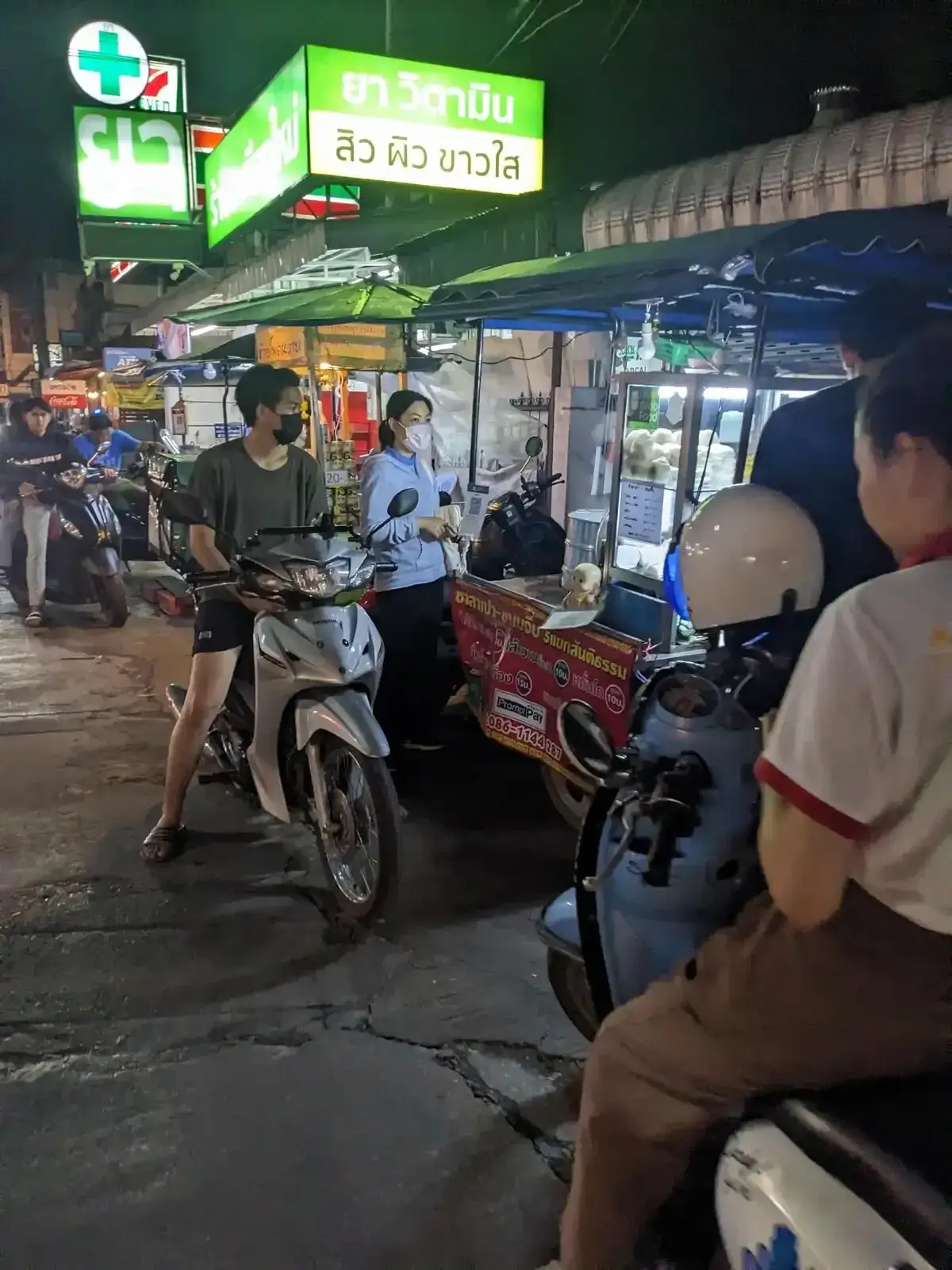
Food stalls along a small street at night in Thailand. People park their motorbikes (scooters) next to the food stalls to order foor to-go.
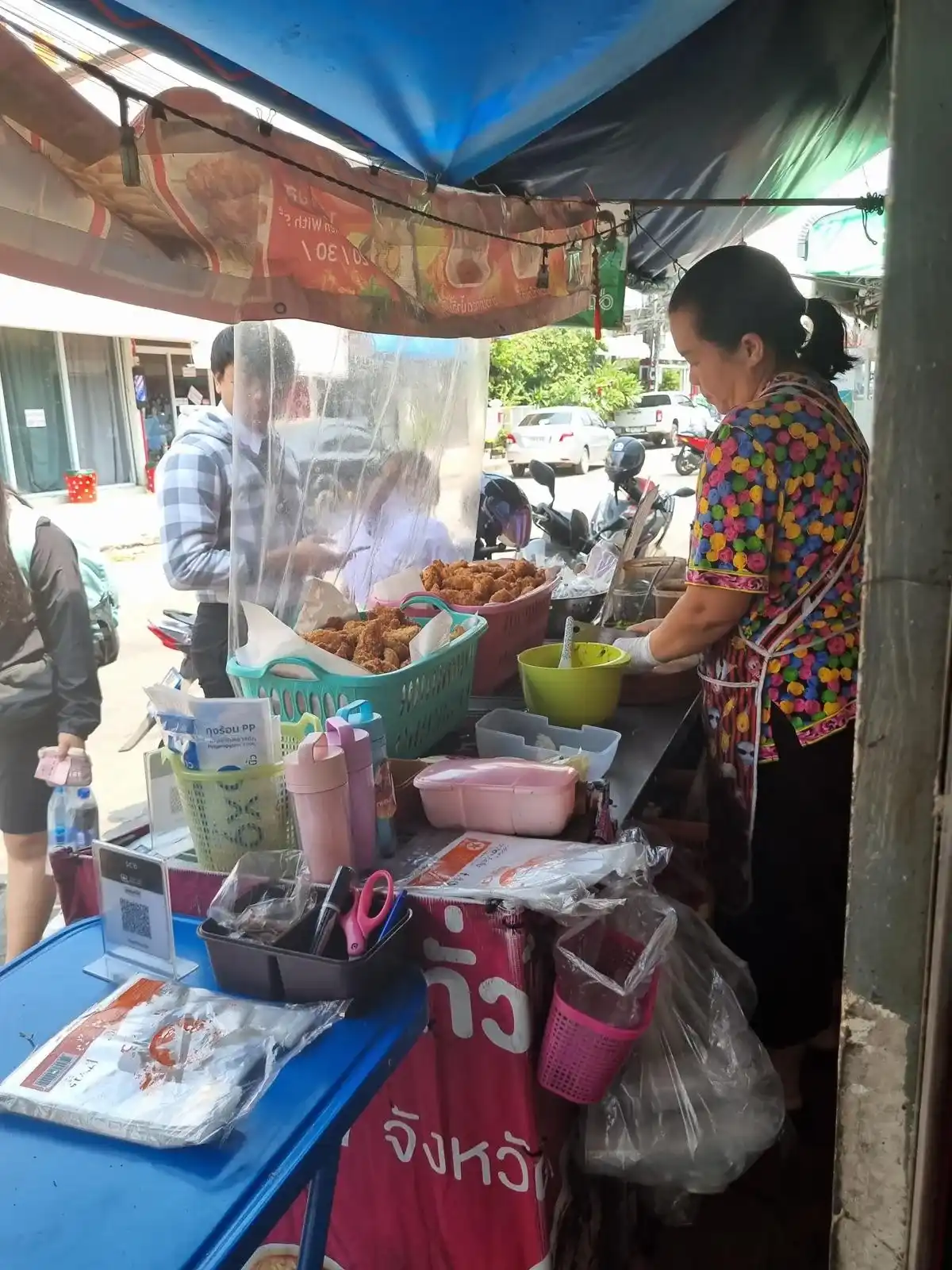
A food stall along a small road in Thailand serving food for people on foot and/or parked motorbike (scooter). The female seller is preparing a dish made with fried chicken tenders on rice. The chicken tenders are mixed with various sauces or spicies per the customers' choosing.
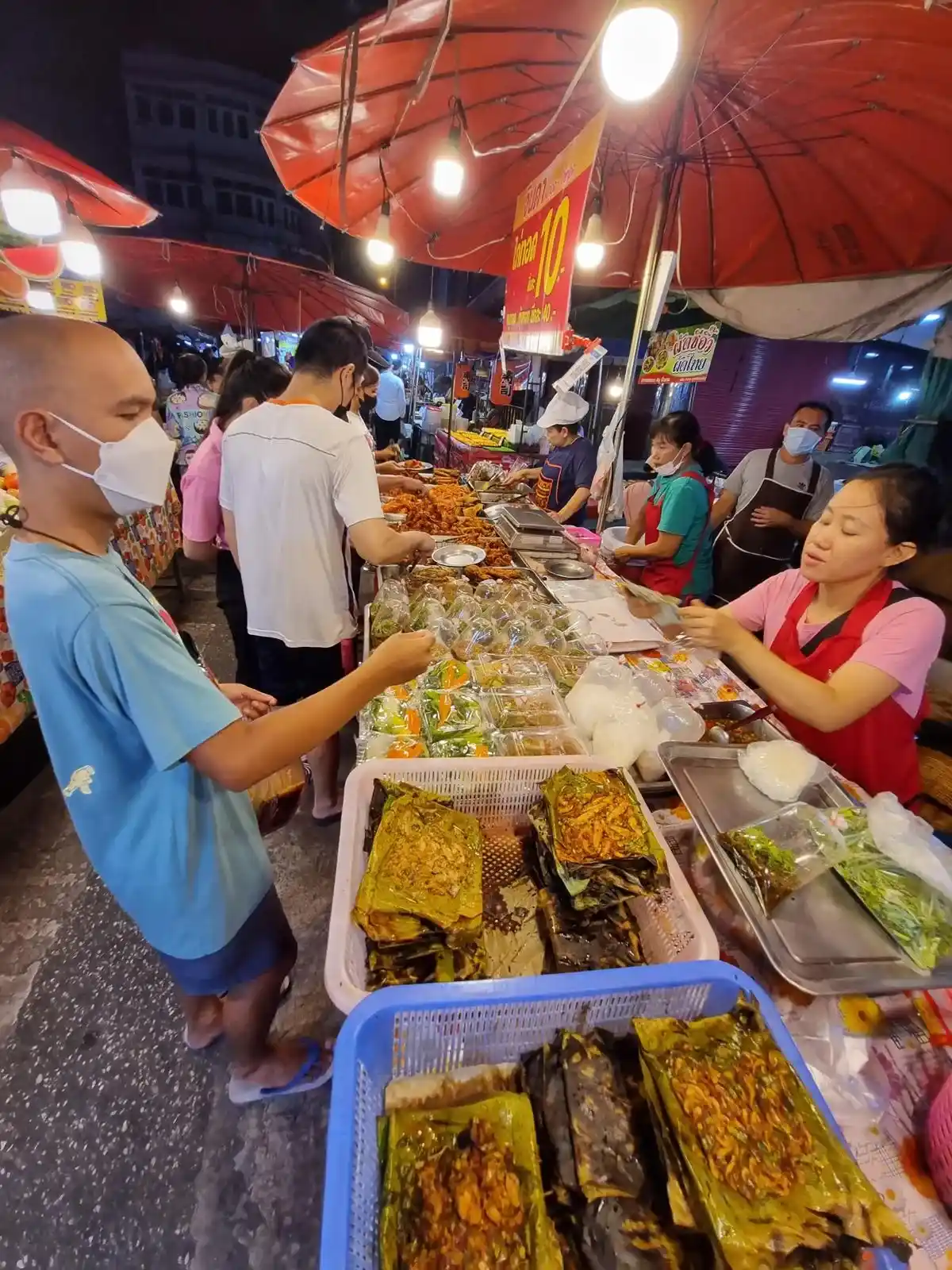
A row overlooking a long table full with various food choices at a bustling food night market in Thailand. A seller is handing back change to a customer who purchased food, holding it in a plastic bag to-go. There are several other people in the background. There is a small walkway (about two people wide) with tables all along each side of the walkway. This image focus on the tables on the right-hand side.

The more humble the place, the cheaper the food is.  Focus on the food, not the décor and fanciness of the place.  Do you really need to ‘eat with your eyes’ – let the flavor do the talking.  It’s more of a cultural experience, and the flavors may surprise.  Seek your inner Anthony Bourdain (R.I.P).
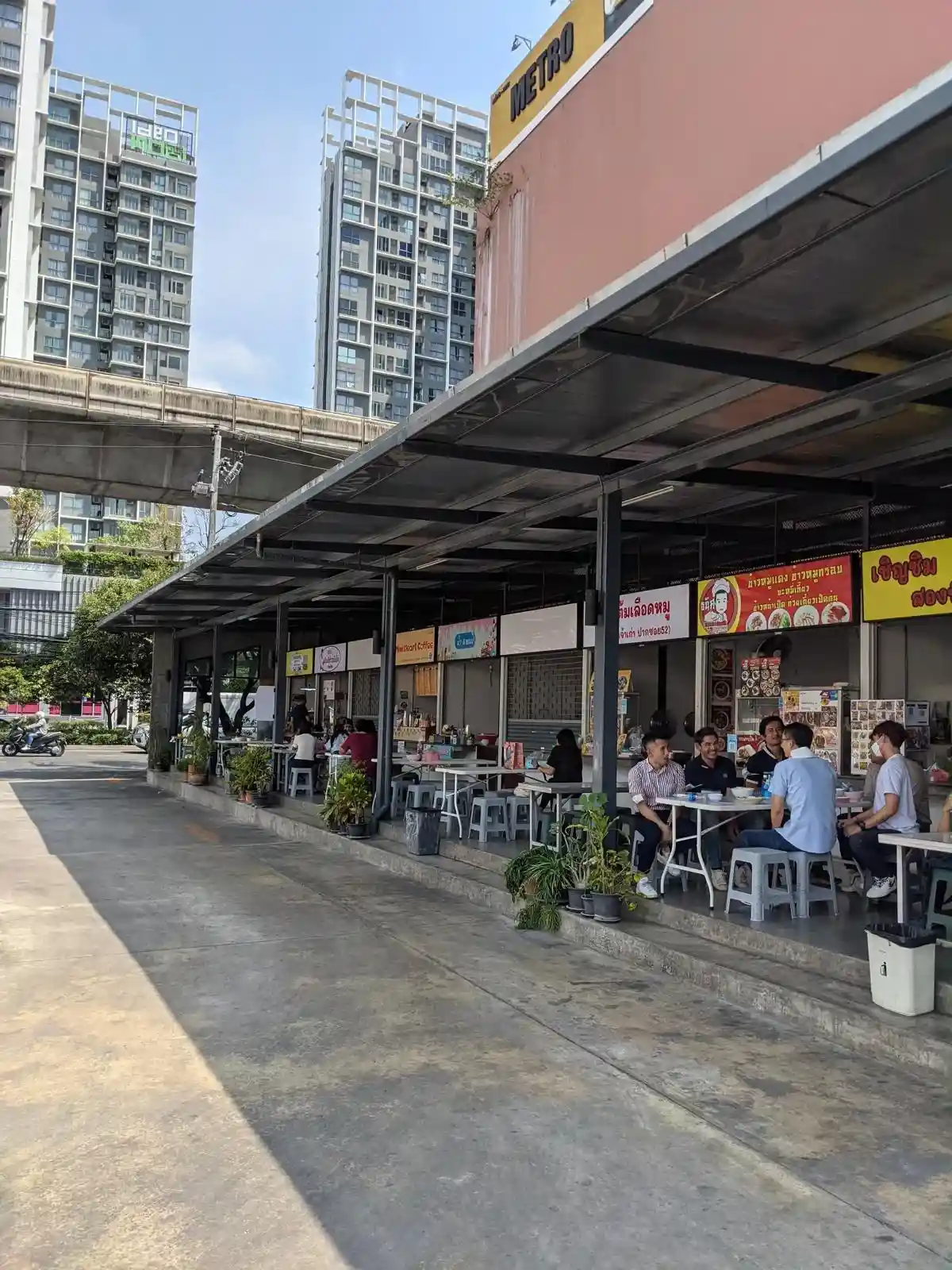
A strip of local food stalls in a clean environment in On Nut area of Bangkok, Thailand. Several office workers are eating lunch. Located off of the main street, there is a strip of food stalls that resemble outdoor storage units - each unit being a food stall - with a large overhead covering that has tables and seating underneath. The tables & seating are directly in front of the food stalls.
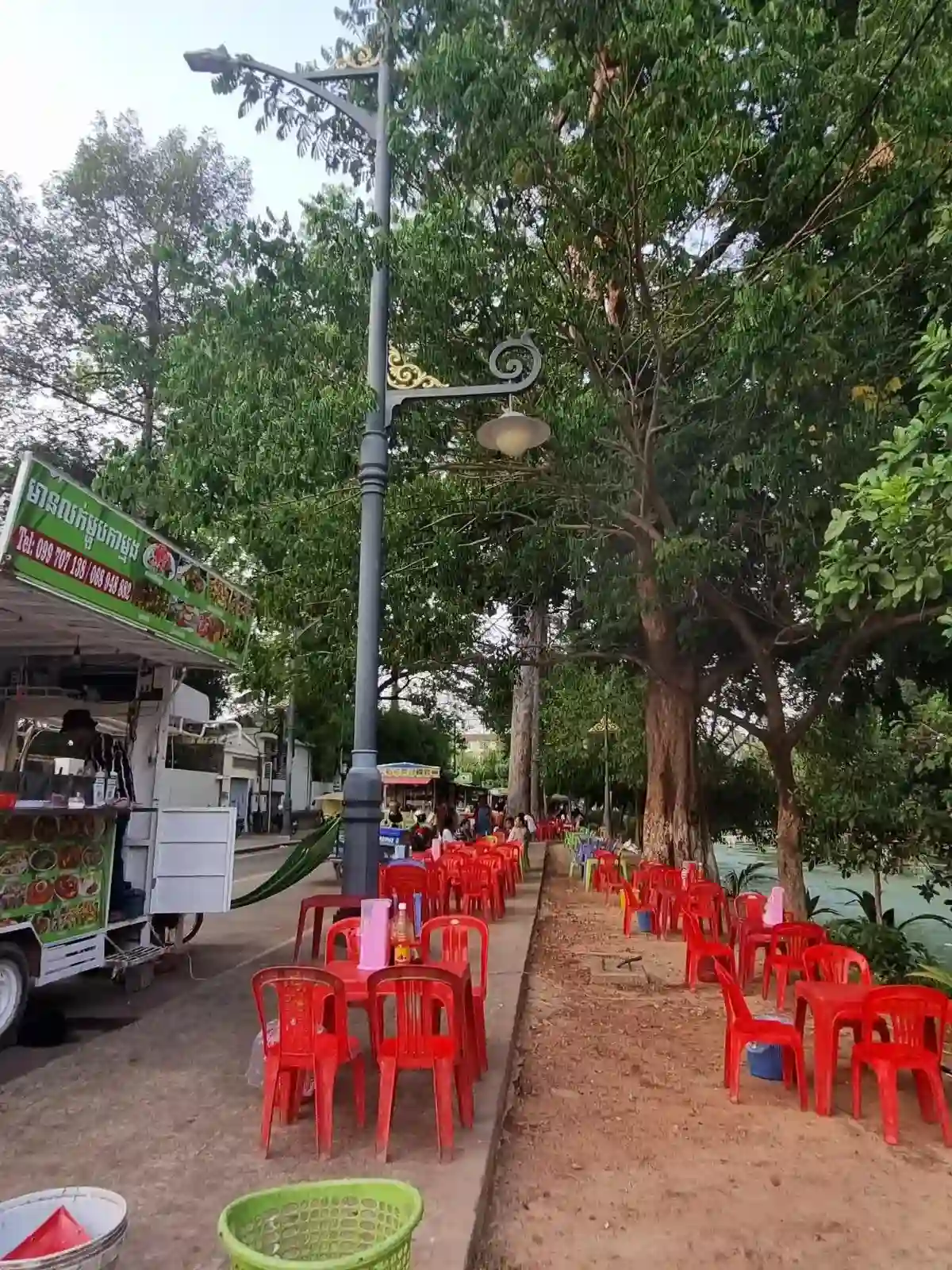
Plastic tables and chairs set up along the river in Siem Reap, Cambodia. This seating is on a small plot of land between the river and sidewalk, with some seating also on the sidewalk. Next to the sidewalk are food trucks and stalls parked along the street, in which customers can order food at, and the seller will cook it within their stall. Keep in mind that walking on sidewalks in Southeast Asia can be challenging as they are often used by local businesses as an extension of their business.
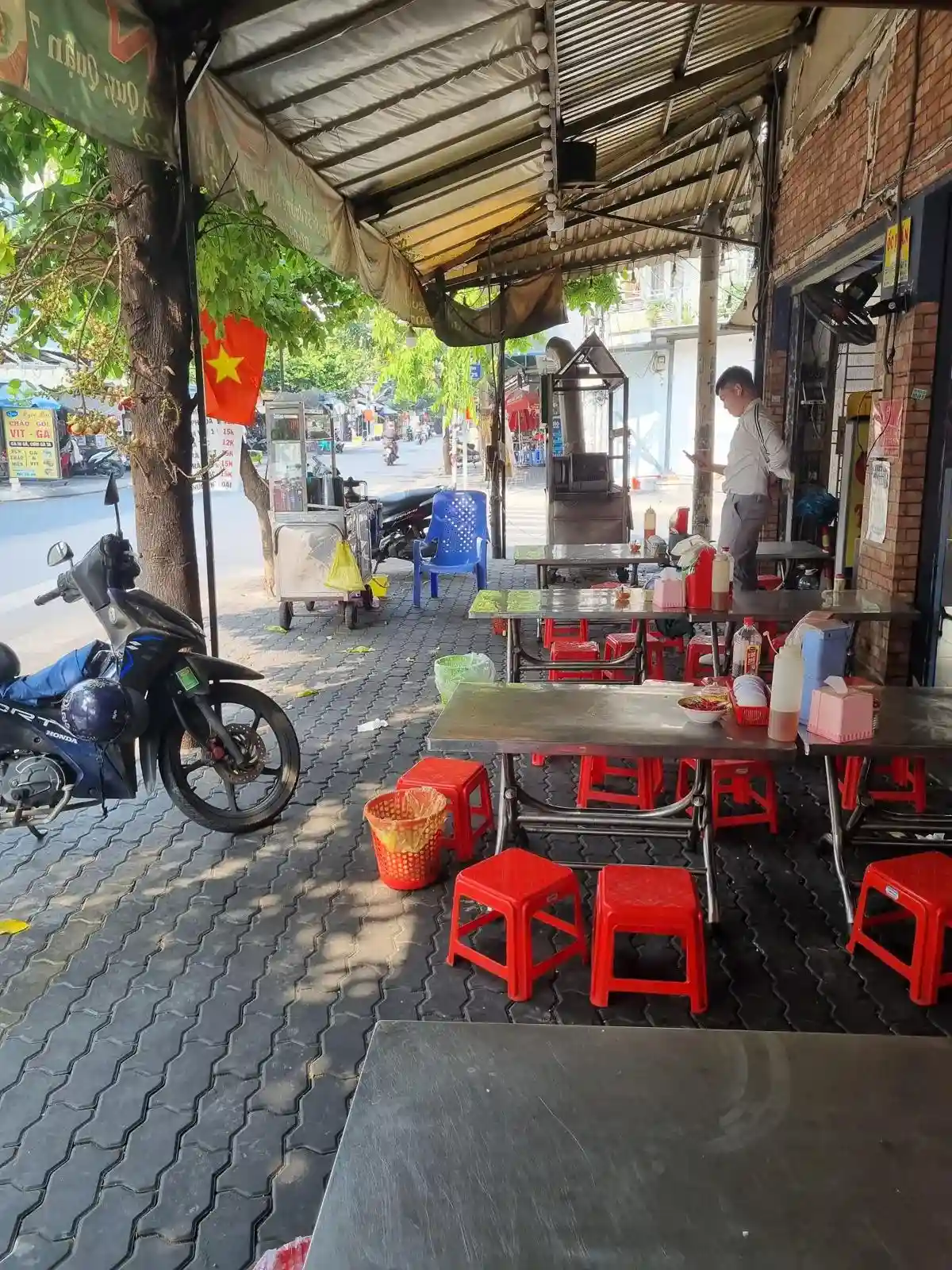
The seating area of a food stall on the sidewalk of a street in Vietnam. An overhead awning covers the sidewalk, and thus the seating area. A motorbike (scooter) is parked on the sidewalk next to one of the tables. It is common in Vietnam to use sidewalks as a parking lot, and some busy businesses have a security guard that will tend the motorbikes.
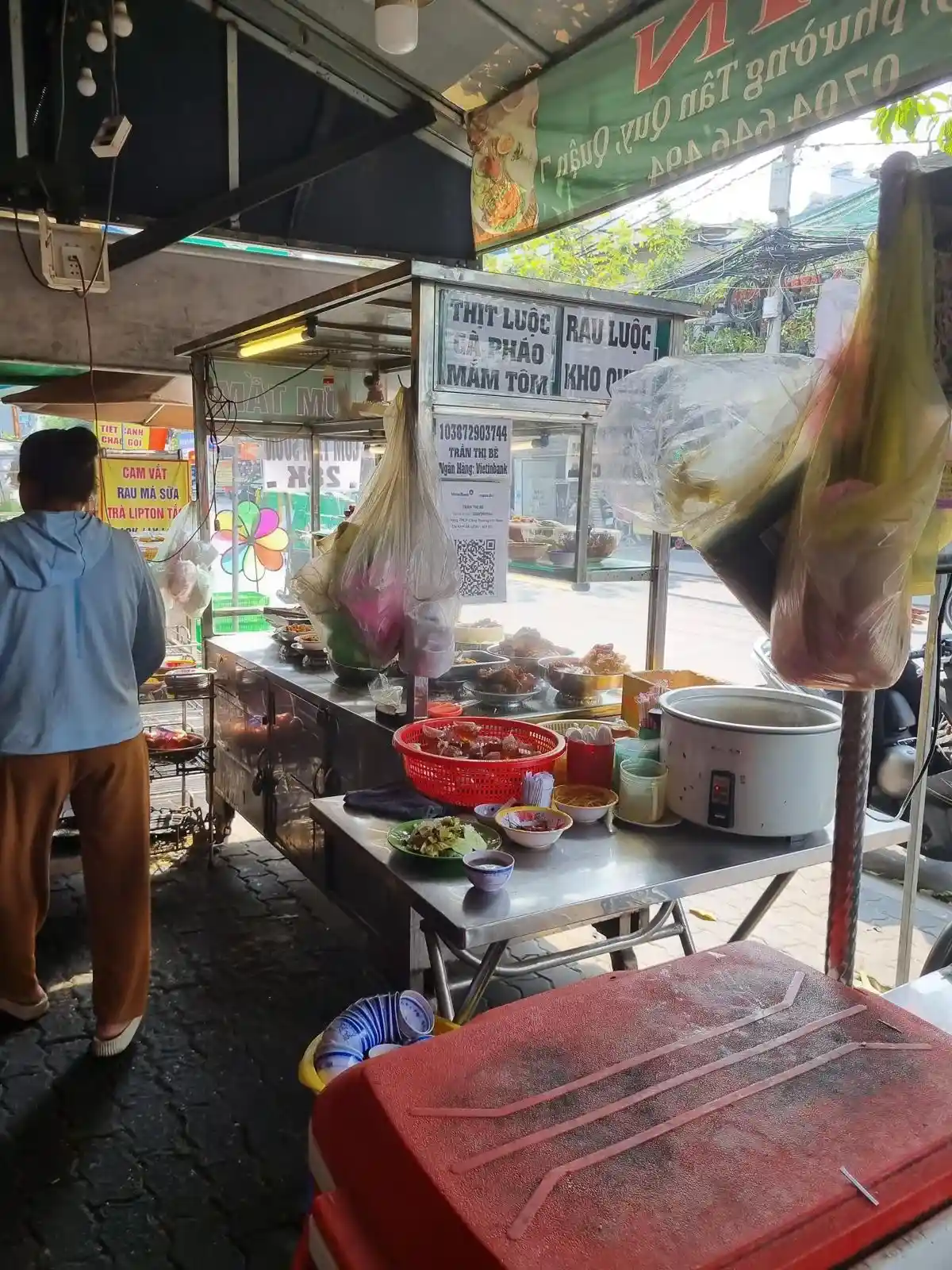
A food stall on the sidewalk of a street in Vietnam. An overhead awning covers the sidewalk, and thus the food stall.
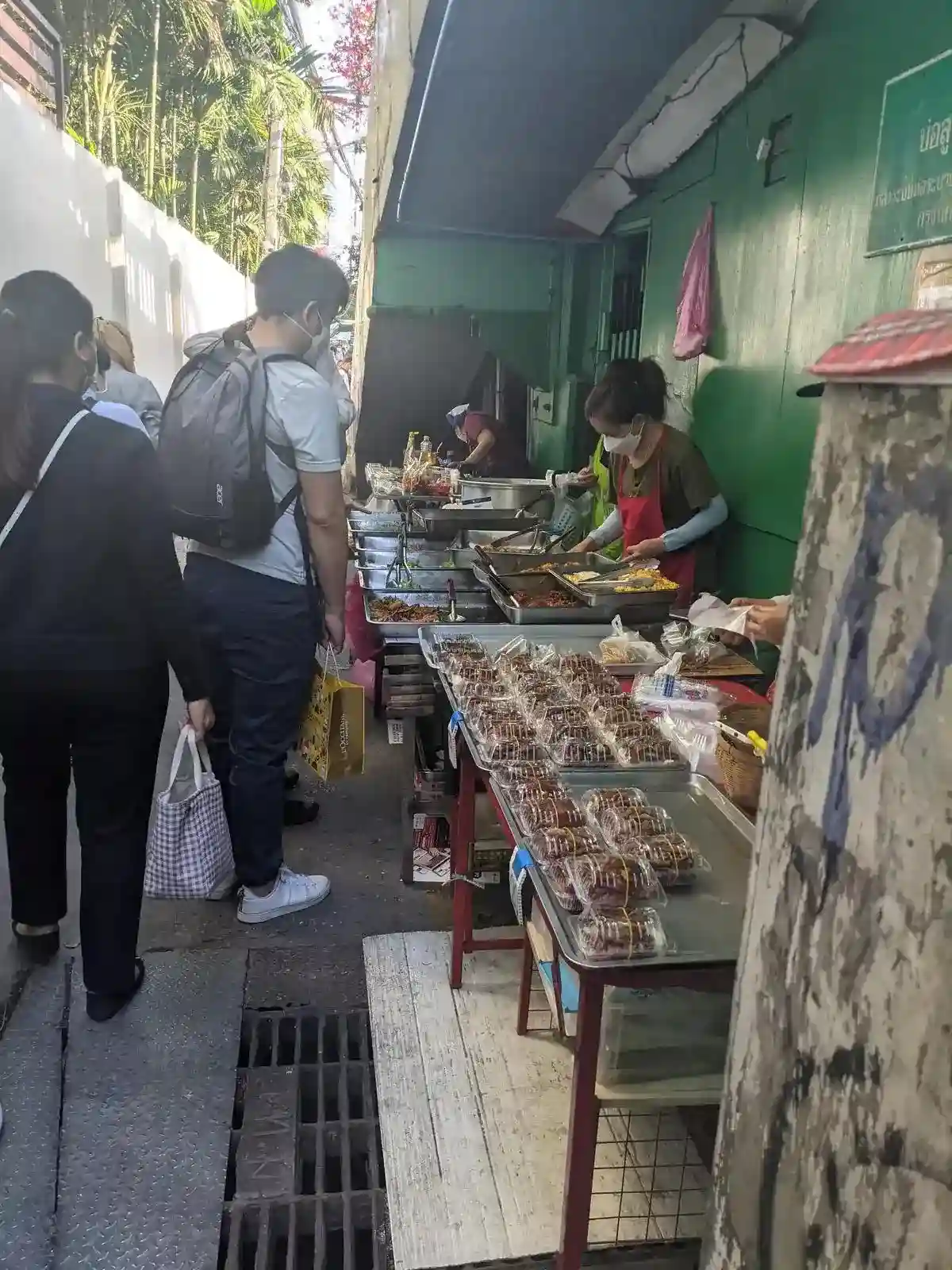
A food stall setup to take advantage of the high foot traffic at an exit stop of a water bus station in Bangkok. The walkway is narrow.
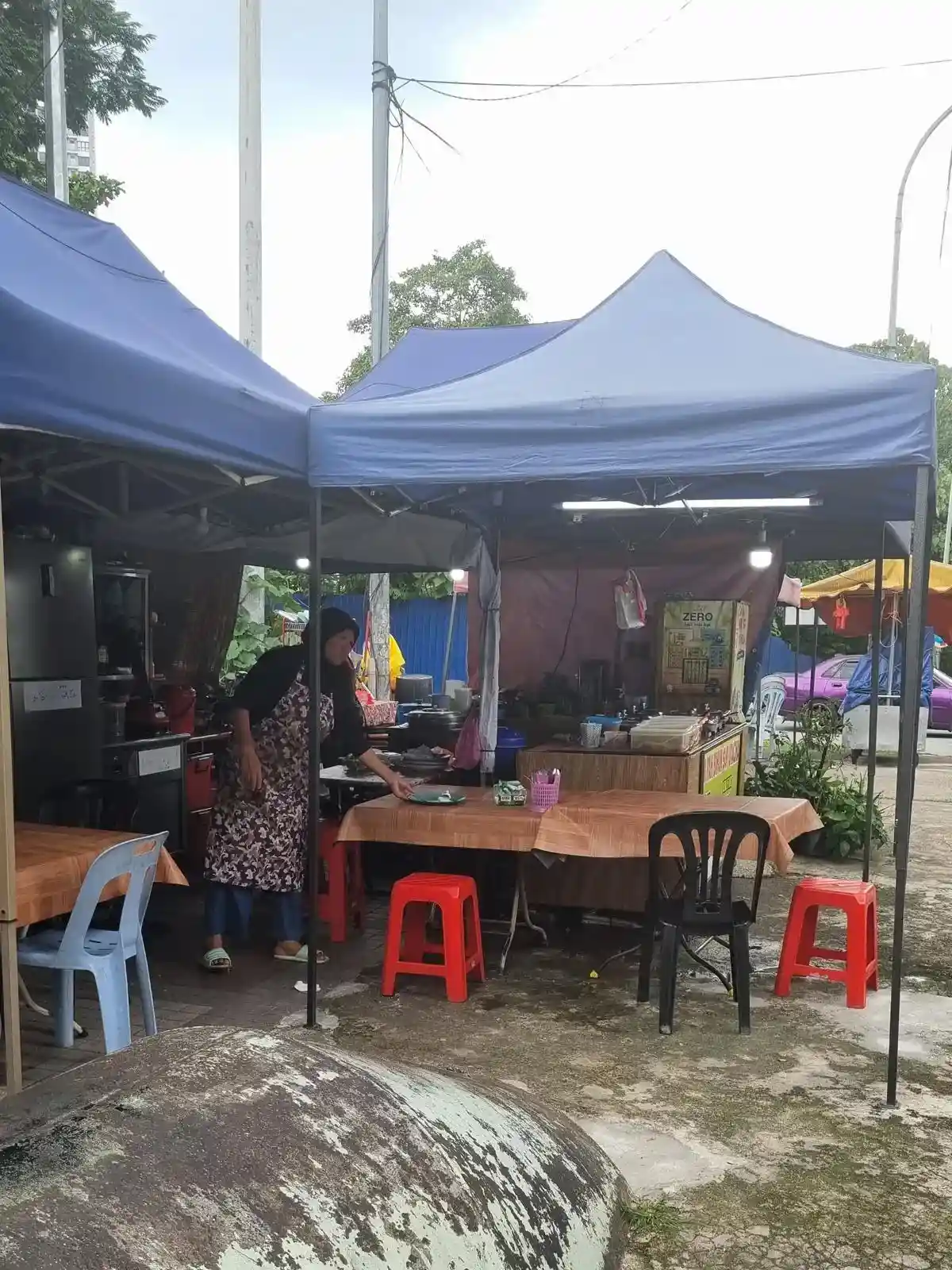
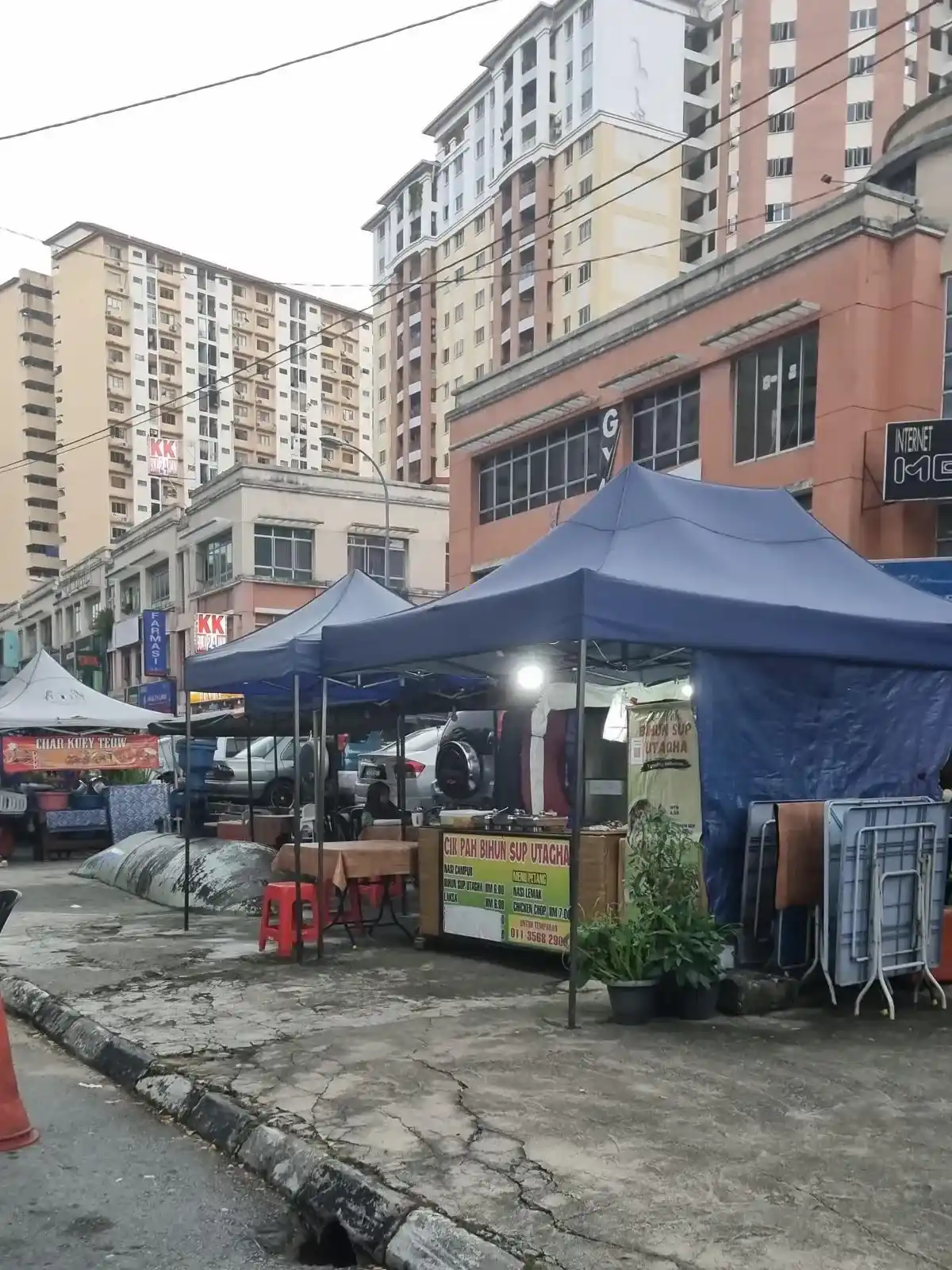
A food stall on the sidewalk of a street in Kuala Lumpur, Malaysia. There are two pop-up canopies and a tarp covering the area with seating, the food stall, and a kitchen area underneath. A full-sized refigerator and a stove are visible.
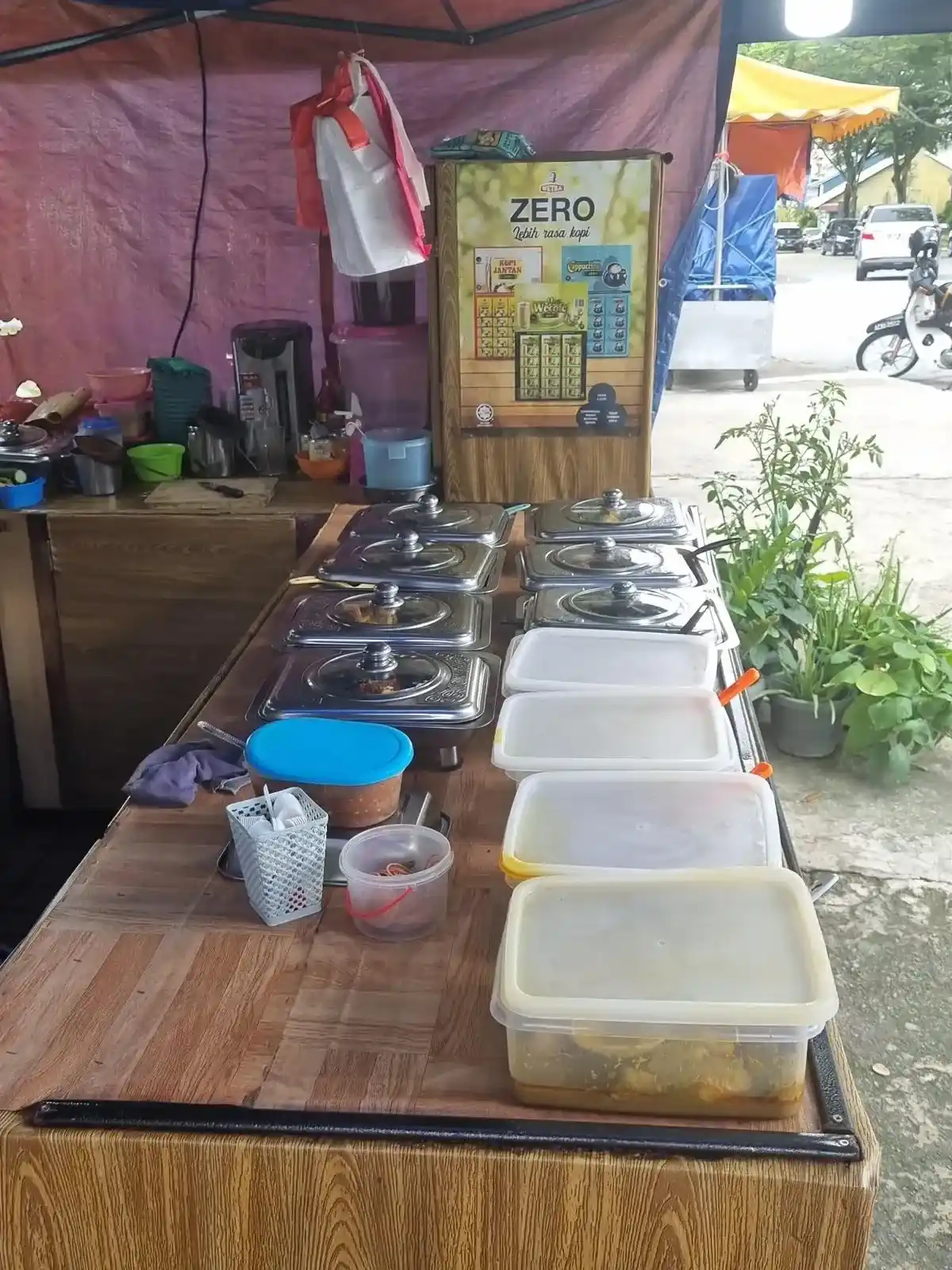
Food on display on a table for customers to choose from at food stall on the sidewalk of a street in Kuala Lumpur, Malaysia. Four dishes are in tupperware and seven are in metal containers with a heating element underneath.
A food stall on the sidewalk of a street in Kuala Lumpur, Malaysia with high rise housing an and another food stall with canopy in the background. There are two pop-up canopies and a tarp covering the area with seating, the food stall, and a kitchen area underneath.
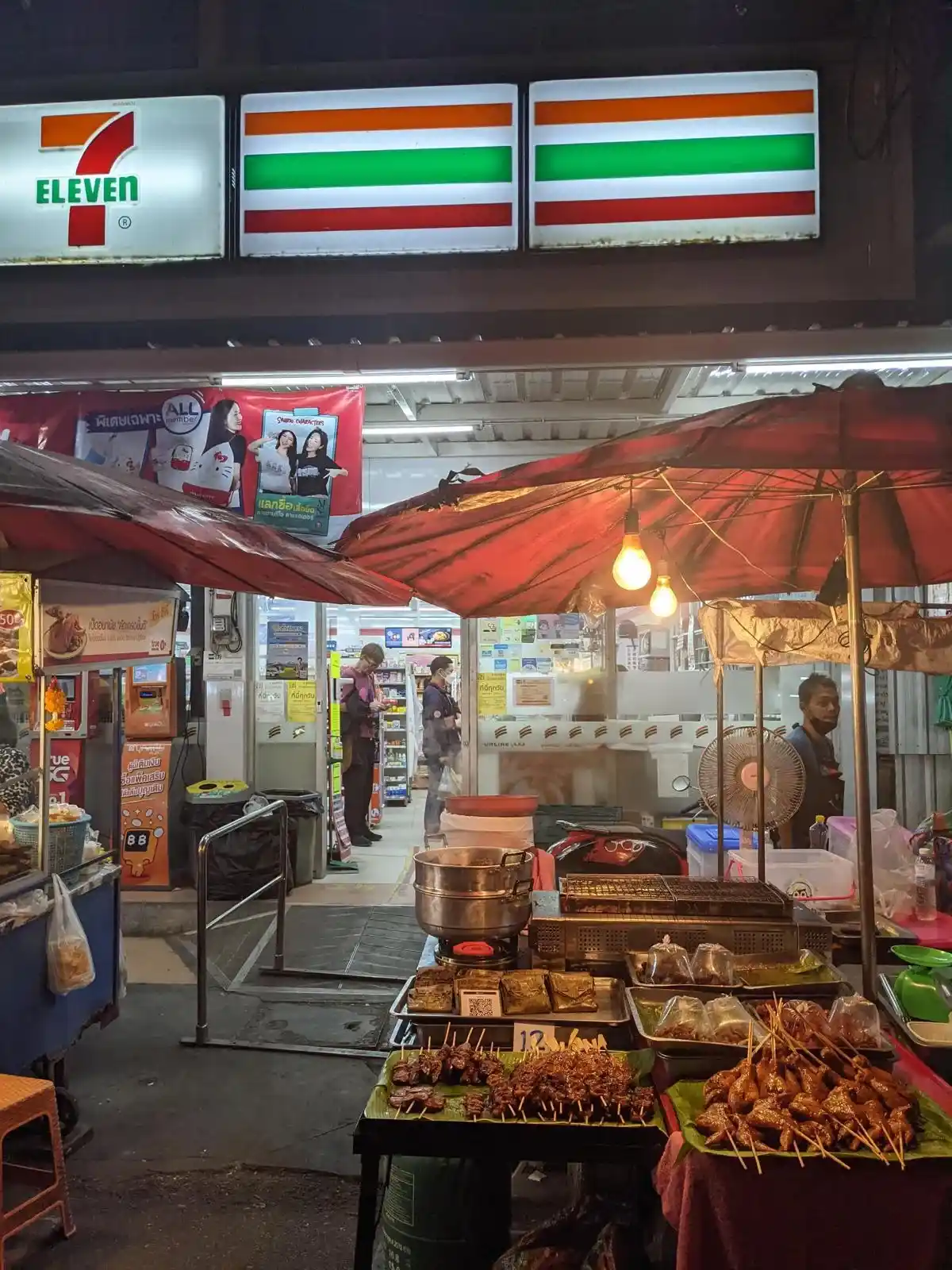
A Seven Eleven convenience store in Thailand with food stalls outside the entrance. Food includes a few different grilled meats and a few Thai dishes packaged in plastic bags.
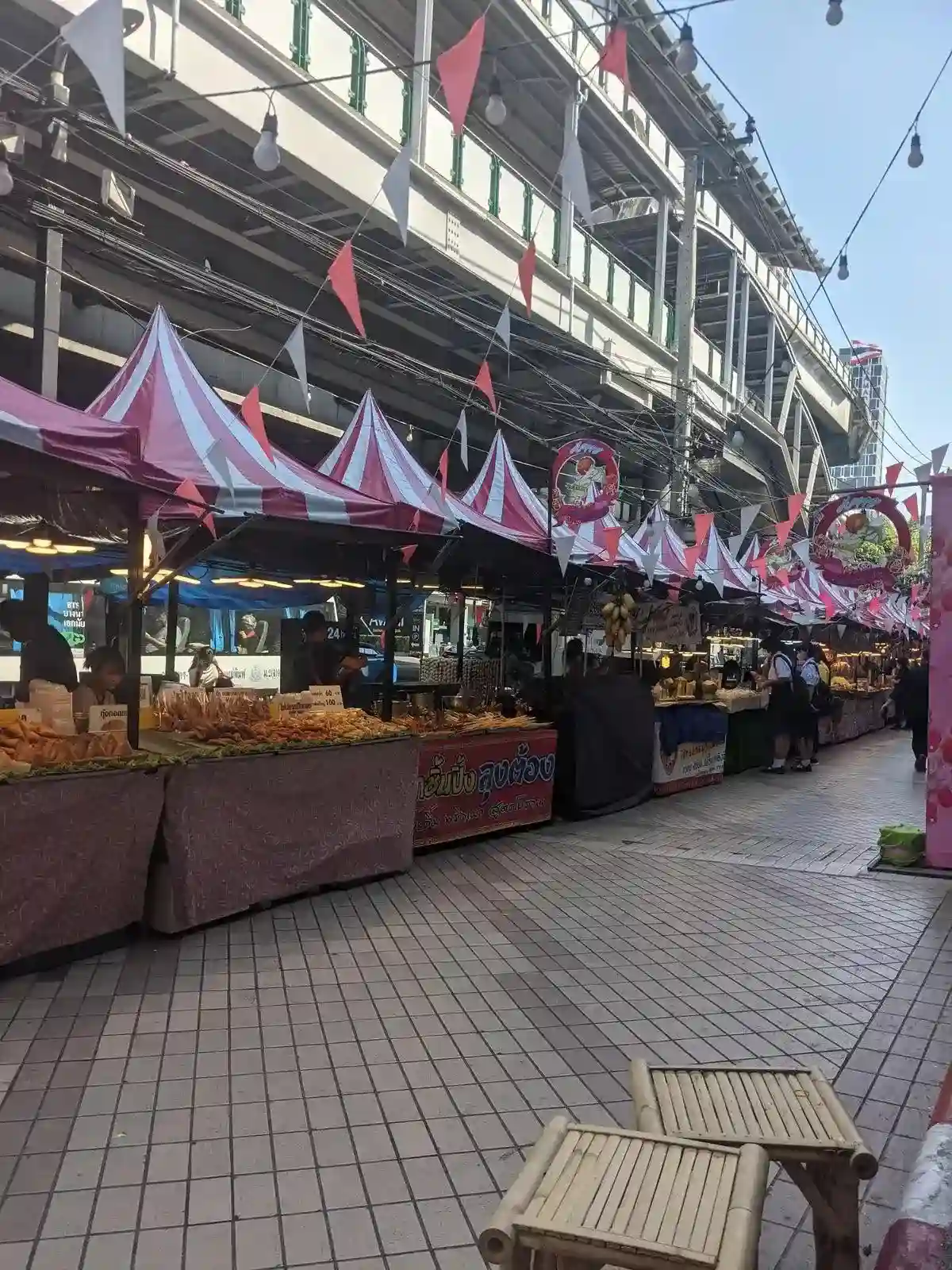
A line of food stalls with canopies, side-by-side, down a sidewalk. This is located below the tracks of an elevated subway line (aka metro or tube) in Bangkok, Thailand. There is plenty of walking space, and the presentation is orderly.
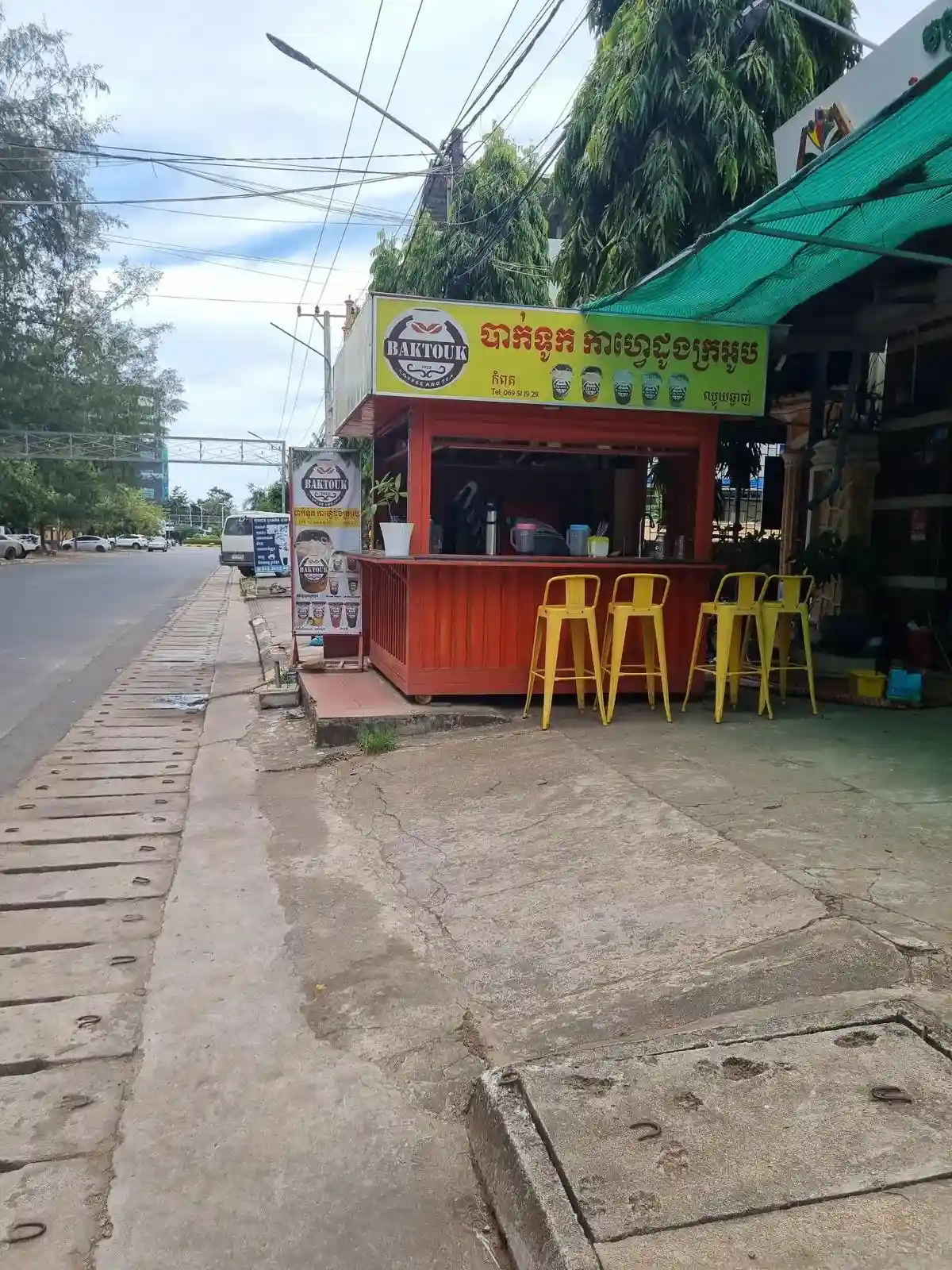
A simple and humble outdoor café along the road in Cambodia. Typically, people get coffee to-go from this style of cafes. It's shape is boxed (about six feet wide, six feet long, and six feet tall) and made of steel. It has a counter/bar that goes around it's perimeter with four chairs. It is in front of a building and takes up the entire sidewalk, blocking it.
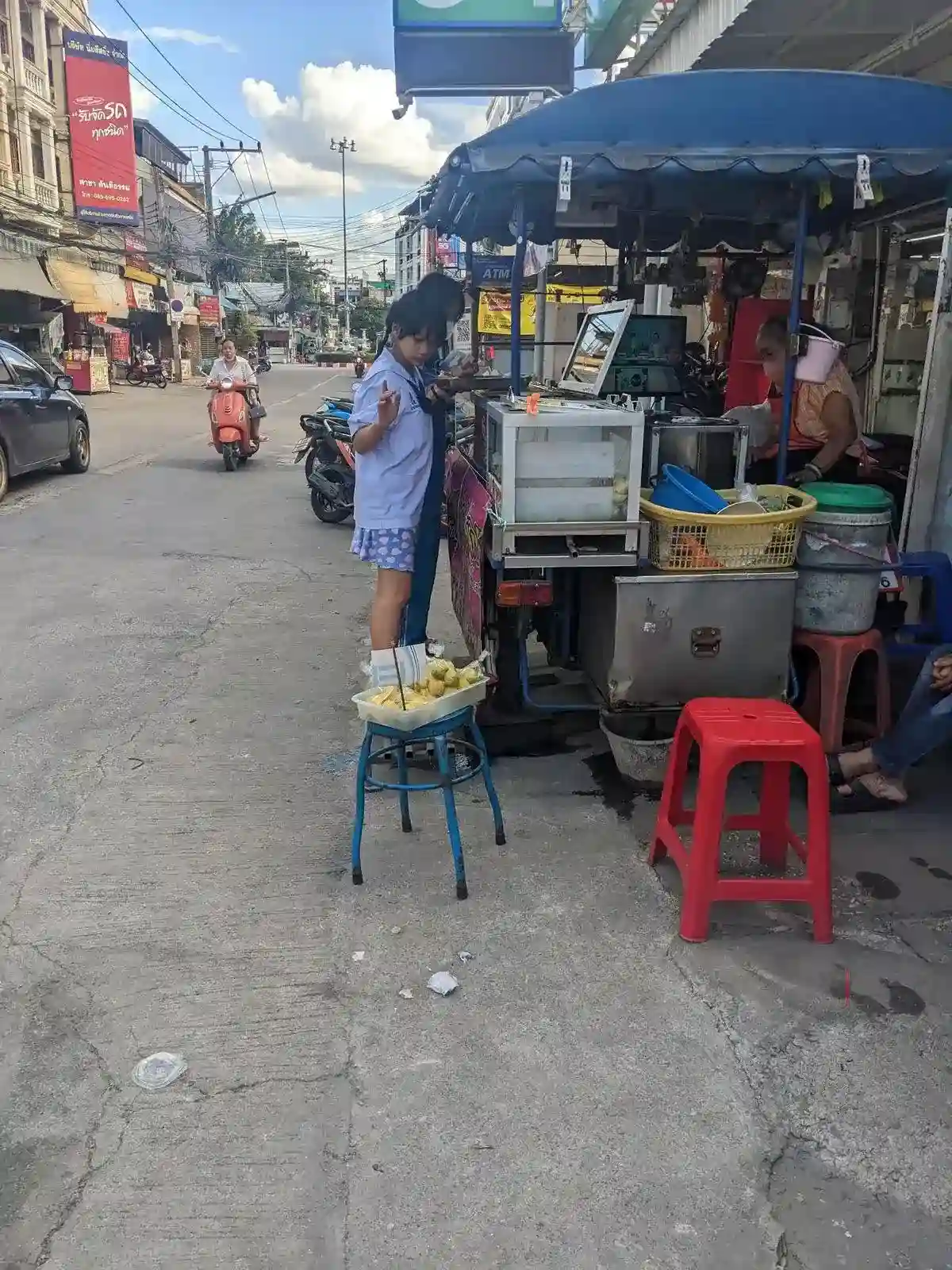
A motorbike-mounted food stall along a road in Thailand. Two people are ordering food. The food cart attached is a metal side cart with cooking setup built onto it. It has a glass container for a food storage area, and has a canopy. This style of food cart is portable, and all the seller needs to do is ride to their selling spot and leave at the end of the day.
A street food stall in Bangkok, Thailand with about twenty local dishes, each on individual pans. The pans are placed against one another along a few tables, allowing customers to see everything on display and choose their next meal.
Thai street food stall with canopy. About twenty different dishes are on display to take to-go in Thailand.
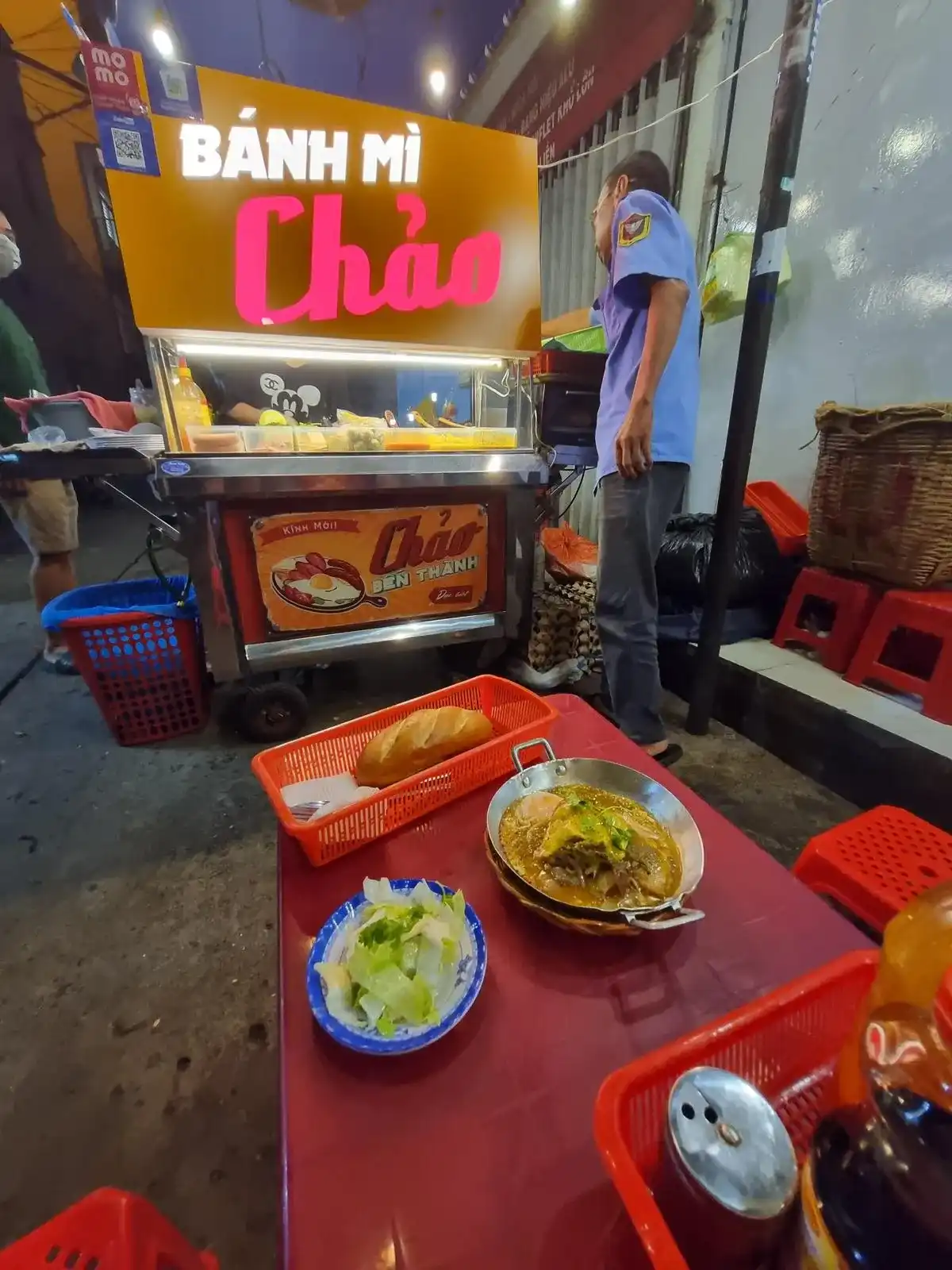
A small food stall specializing in a Vietnamese dish called banh mi chao in Saigon (aka Ho Chi Minh City), Vietnam. Banh mi chao, as pictured on a table next to the stall, is a skillet with a loaf of French bread. Although it is typically a breakfast dish, it is being served at night time in this image. The stall has a pleasant sign that lights up saying "Banh Mi Chao".

However, do note to use your best judgement.  If you are not comfortable eating there, then do not push yourself.  The places that are truly dirty (not just humble) are blatantly obvious.  The goal is to find the balance between pushing your comfort zone to experience something wonderful and great -vs- putting your health at risk, which is rare. 

Tip

Slowly ease your way into “localized” eateries.  You will gain a sense of what is pushing yourself too hard – your stomach will inform you.

Yogurt for an upset stomach. Drink a yogurt or probiotic drink sold at the nearest convenience store. This is good to prevent getting sick, and helps heal you when you do get sick from food.


Clear and transparent pricing

Expect to pay more when prices are not listed.

Places with prices listed are much more trustworthy.  Not always, but often enough, you will get charged a higher price if you are not clear about it before ordering.  We will simply state that this is a cultural negotiation ordeal.  This technique, no prices listed, creates ambiguity for tourists and puts them in a vulnerable position where they are pushed to pay an inflated price.
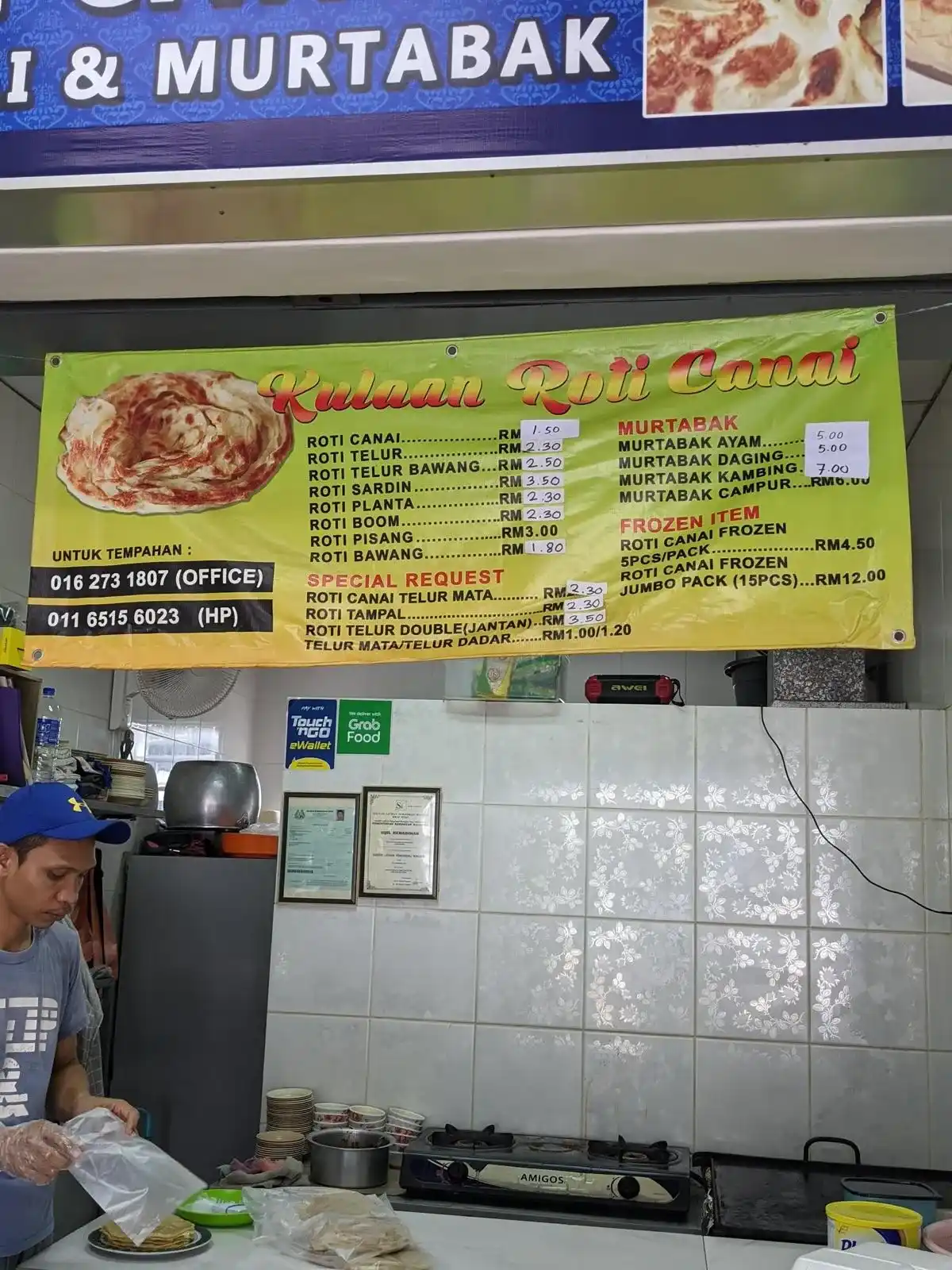
A price list for food at a small restaurant in Malaysia. This restaurant serves Roti Canai, which is a southern Indian-style dish (Malaysia has a large population Tamil-ethnicity Indians from Southern India). The menu shows a roti, which is a soft, round, flat bread that has a unique flavor, which is accompanied by a chosen type of sauce. Meat can be added. Canai is pronounced the same as "Chennai", the large southern Indian city.

Unfortunately, some places have 2 menus – 1 for locals and 1 with higher prices for tourists.  We have caught them red-handed doing this in Bali and in Vietnam.  Dual pricing in some SE Asia is protected by law and/or local culture.  Confirm prices before you order to avoid an argument when time to pay.
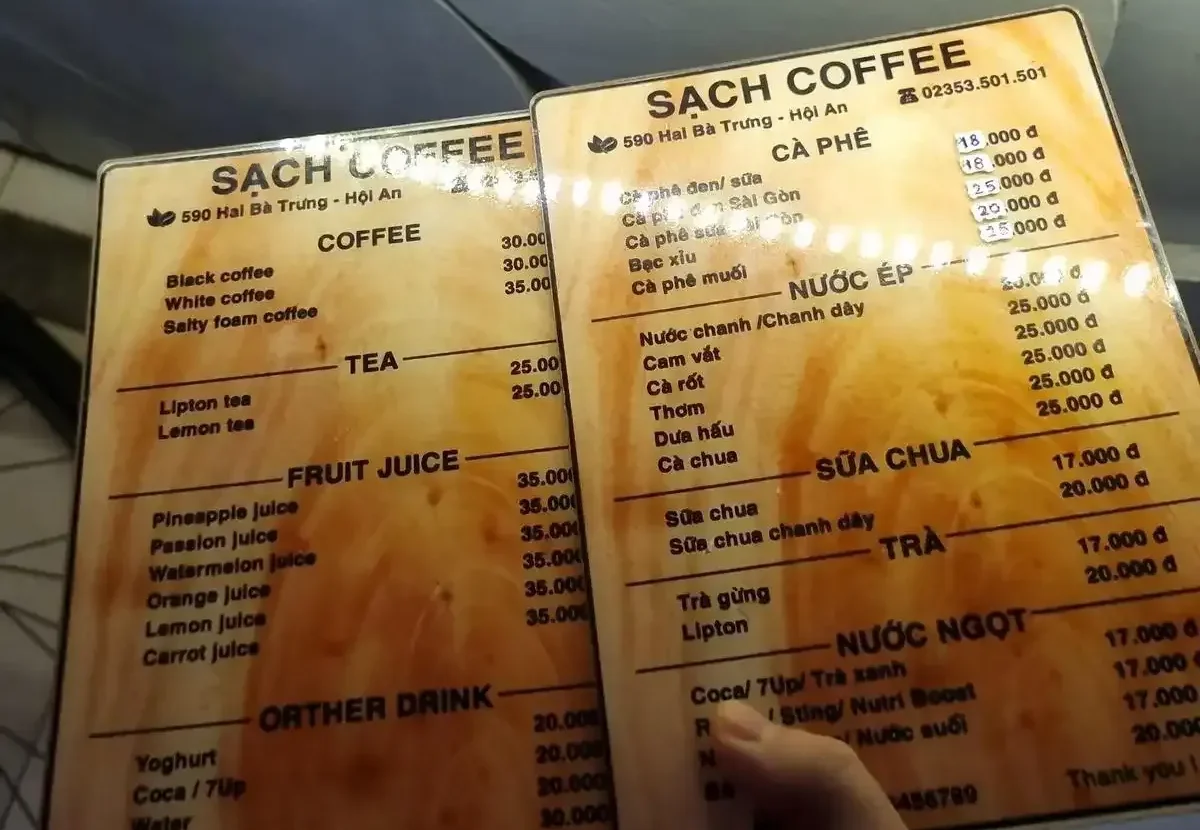
Two menus at a café in Vietnam, one for locals (written in Vietnamese) and one for foreigners (written in English). The menus have different pricing, where the foreigner menu pays more. The foreigner menu costs thirty thousand Viet Dong for a "Black coffee", while it's Vietnamese-written counterpart "Ca phe den" (coffee black) costs eighteen thousand Viet Dong. That is a forty percent increase for being foreign. A can of Coca Cola is twenty thousand for foreigners versus seventeen thousand for locals.

Away from the tourists

Eat at places where tourist are not at, do not go to, and do not eat at.

Places that profit from serving tourists primarily tend to be priced higher (much higher) than the local price for the same thing.  Reasons for this vary, just expect that if you are looking to save money on food.


Go to the side roads and back roads

Eat on the side roads and back roads where there is less traffic, not at place off the main road.  Go to eateries away from the main road.  These places do not benefit from the traffic flow of people and motorbikes, thus they compensate with lower prices.  And, bonus points are given since the food can be better quality, too!


Eat rice

Rice fills you up.  It’s cheap ($0.25 USD for a portion) and it comes with basically every meal – it’s a stable in SEA.

Steamed rice, sticky rice, red rice… try them all.  The food dishes of SE Asia are meant to be paired with rice – it just makes sense.  The rice evens out the flavors and sauces.  It just compliments the food.’


Small portions

Get used to smaller portions, which are common in SEA.  Americans, for example, are used to eating massive portions of food.  Getting used to eating less is beneficial.


Check prices on food delivery apps

The prices here are usually more expensive than a local eatery.  So, these prices are what you should be paying, at most.  But, do expect to pay lower at local eateries.


Cook yourself (or not)

This, actually, might not even save you money!  This might be more expensive, since local eateries are very competitive with pricing.

However, “cooking yourself” is listed here just so that you know it is not forgotten about as a potential way to save money.  It’s just that in SEA, cooking yourself won’t help you save money, let alone save you much.  Especially since, your housing may come with cooking utensils, but if they do not then you will need to purchase them.
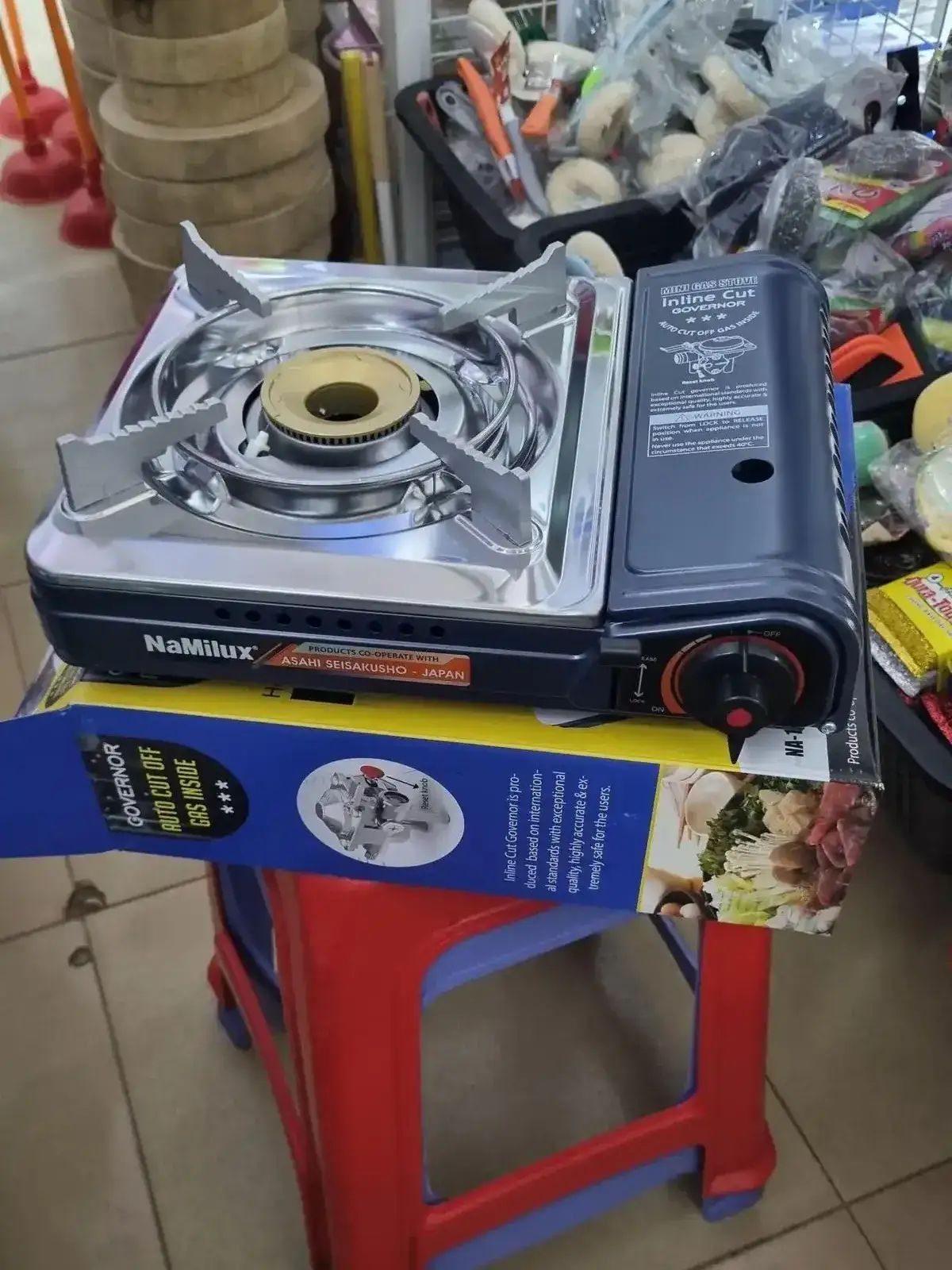
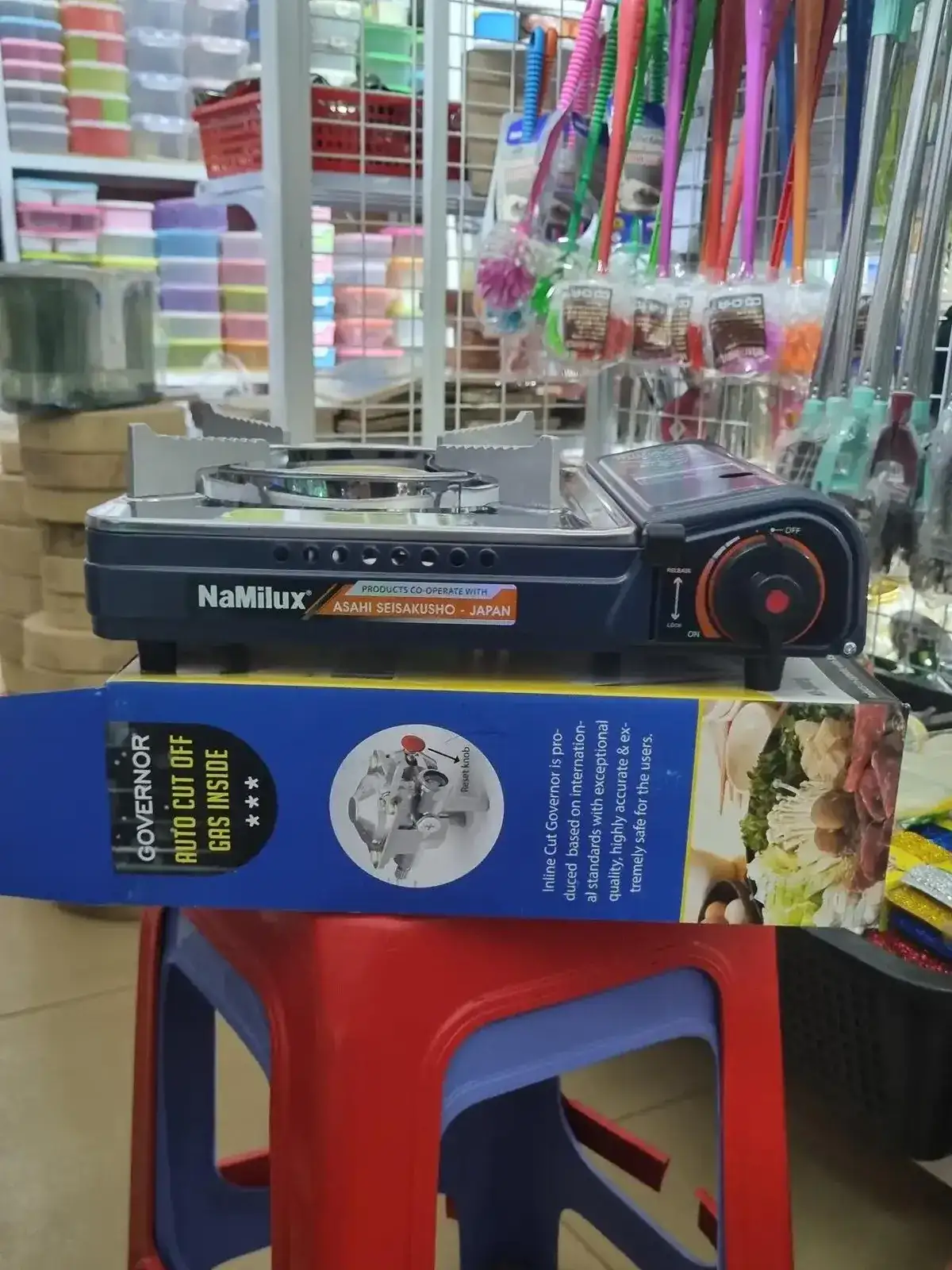
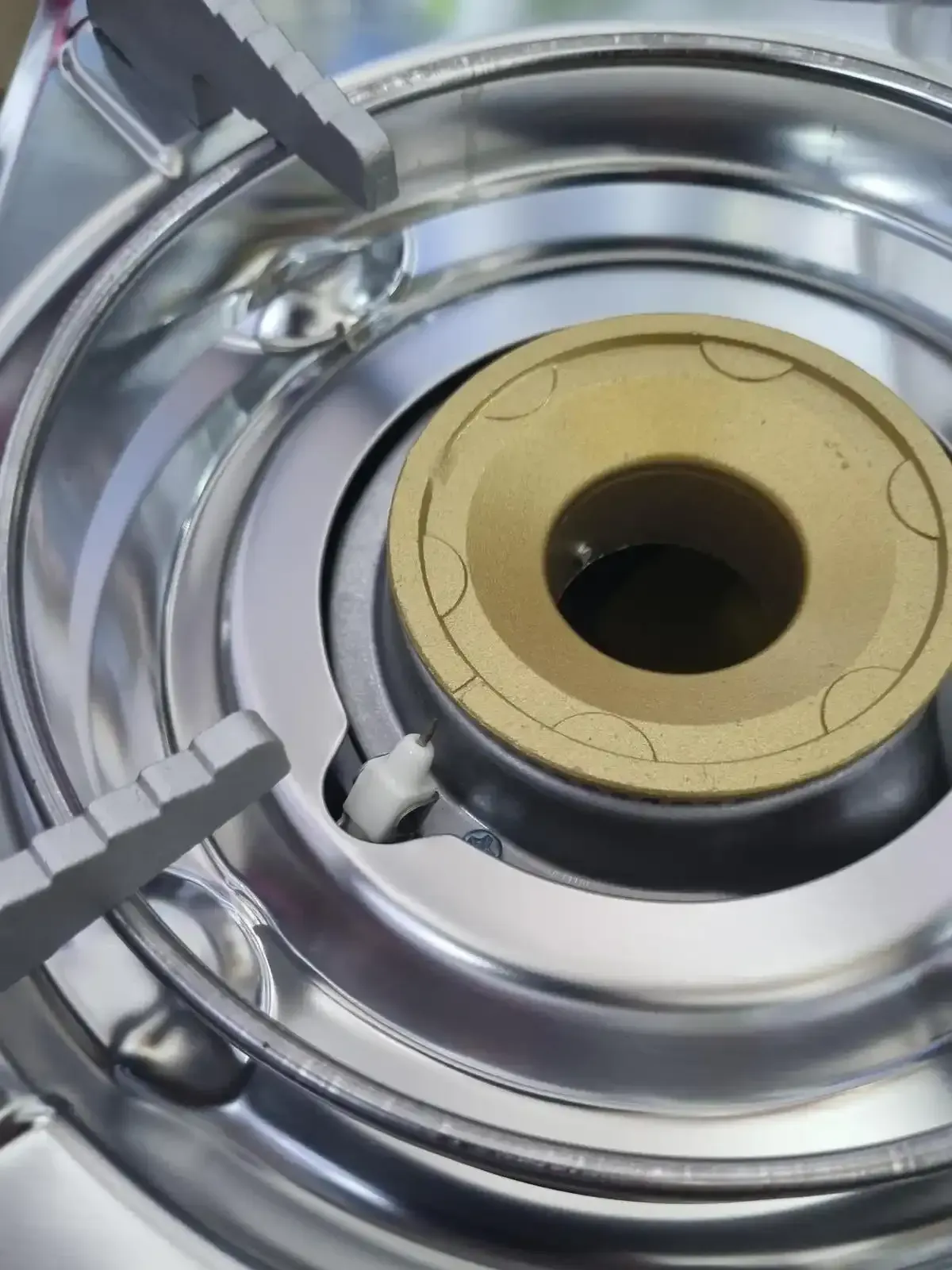
A portable gas cooker for sale in a store in Southeast Asia. The gas canister is inserted on the side, and it's compartment takes up the length of the cooker. It has a stove with holders in all four corners to set pans ontop of. The holders are long, meaning they can hold different sizes (small or large) of pots or pans. It is about one and a half feet wide, two feet long, and five inches tall (61 cm by 61 cm by 2.5 cm).
A side view of a portable gas cooker for sale in a store in Southeast Asia. This image shows how tall the cooker and it's stove section is. The gas canister is inserted on the side, and it's compartment takes up the length of the cooker. It has a stove with holders in all four corners to set pans ontop of. The holders are long, meaning they can hold different sizes (small or large) of pots or pans. It is about one and a half feet wide, two feet long, and five inches tall (61 cm by 61 cm by 2.5 cm).
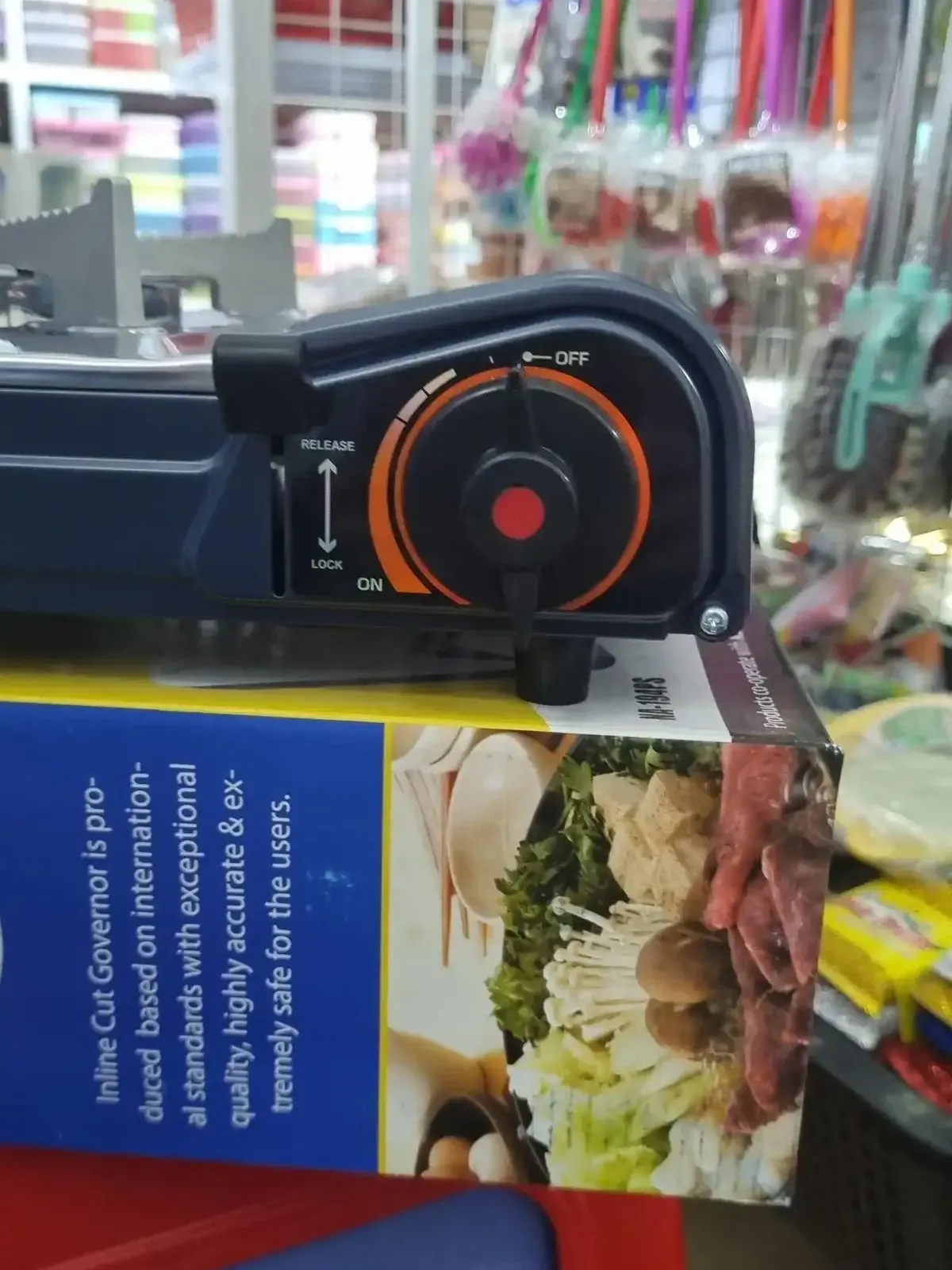
A close-up view of the on/off controll switch that controls the flame on a portable gas cooker for sale in a store in Southeast Asia. This on/off switch is variable - by twisting it between off and on, the strength (and thus heat) of the flame can be adjusted. When the switch is pointing to "ON" the flame will be at full-blast (i.e. the strongest and hotest) settting that the cooker can do. There is also a clamp to "Release or Lock" the gas canister into the stove cooker.
A portable gas cooker for sale in a store in Southeast Asia. The gas canister is inserted on the side, and it's compartment takes up the length of the cooker. It has a stove with holders in all four corners to set pans ontop of. The holders are long, meaning they can hold different sizes (small or large) of pots or pans. It is about one and a half feet wide, two feet long, and five inches tall (61 cm by 61 cm by 2.5 cm).
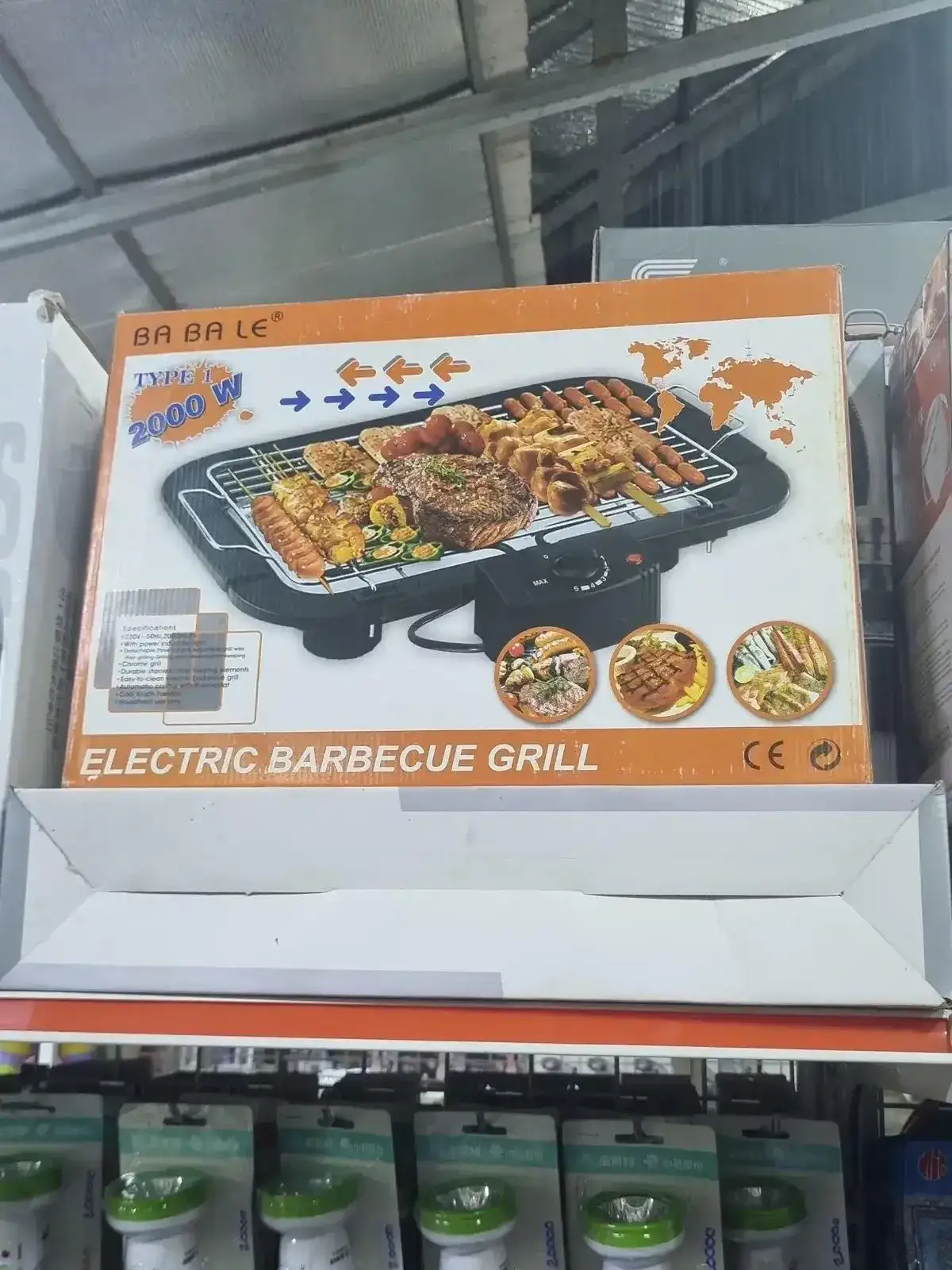
A portable electric barbecue grill for sale at a store in Southeast Asia. The grill is two thousand Watts (i.e. two kilo Watts). It does not have a cover - it's open-air. It has an on/off temperature setting, adjusted by twisting a switch. It also has a grill plate made of wire in which juice can drip through (not a solid plate like sheet metal). The grill plate has metal handles on each end to lift it off the grill, but be carefull as metal handles might get hot.
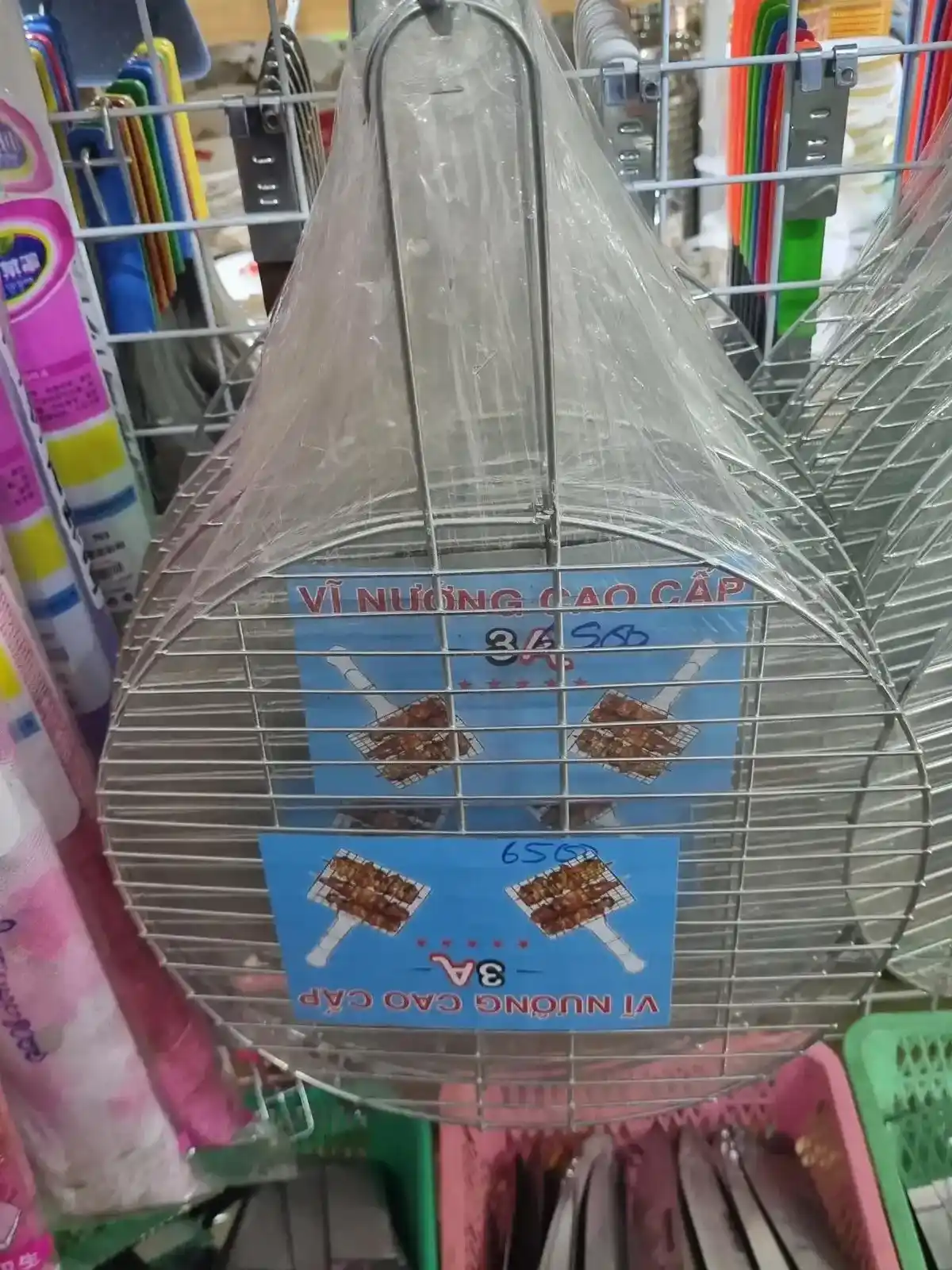
Grill plate to grill food on. A circular grill plate made of wire in which juice can drip through (not a solid plate like sheet metal). The grill plate has long handle on only one side to lift it off a grill. The handle is an extension of the wire (or metal rod) that is used to make this grill plate. It is at a shop in Southeast Asia.
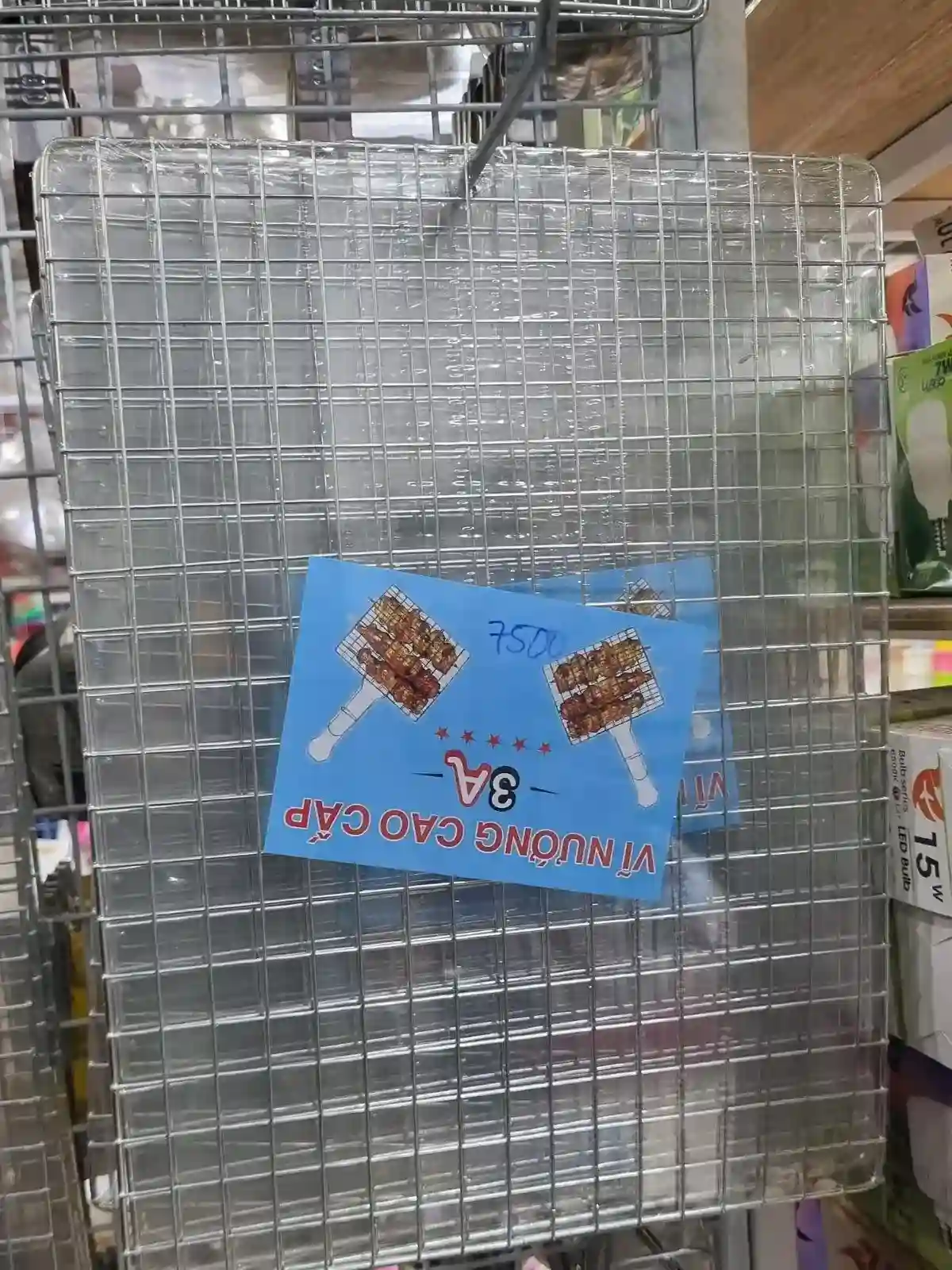
Grill plate to grill food on. A rectangular grill plate made of wire in which juice can drip through (not a solid plate like sheet metal). It is rectangular and long. It is at a shop in Southeast Asia.

DIY Coffee

Make your own coffee.  Use instant coffee, or carry around beans & a French press.  Save money, save time, and make coffee just how you like it!  It’s an investment that really pays off.

Takeout coffee price at a store range from $0.50 to $1.5, but if you are a heavy coffee drinker you can save a lot of money by making coffee yourself.  The wonderful thing is, you can buy all types of coffee brands & beans – cheap coffee beans or even premium beans.  Make it to your taste, budget, and preference.

Are you able to fit the word coffee into any sentence?  “Coffee is where where the heart is”, “Coffee for breakfast, coffee for lunch, coffee for dinner…”, “All day I dream about coffee!”

Tip

☕ French press too big to carry around?  Try using a Vietnamese Phin!
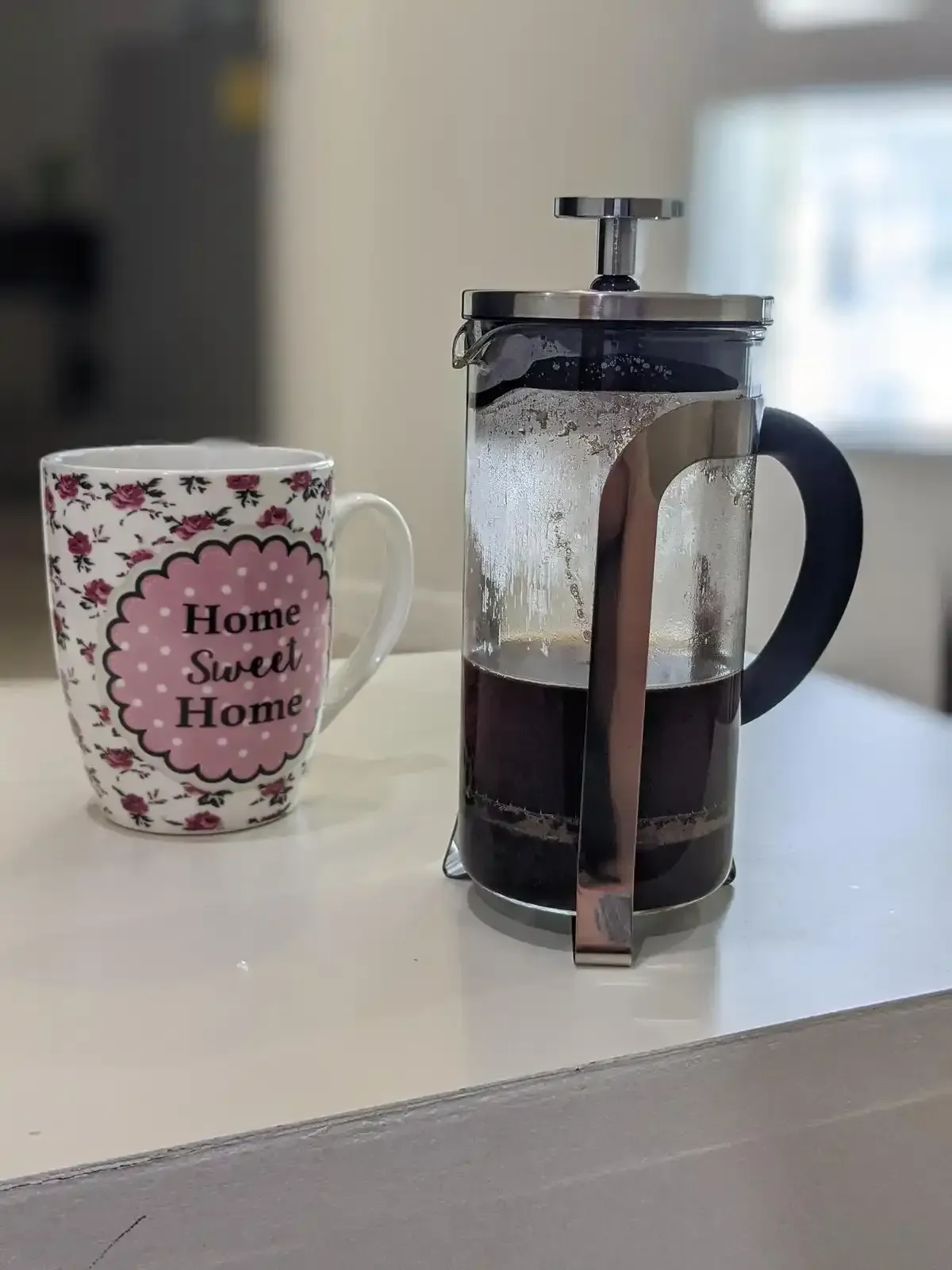
A coffee mug and a French press for brewing coffee on a table in an apartment. The coffee mug says "Home Sweet Home" on it. A french press has a glass tube (resembles a long cup), a plunger filter, handle, and a lid with an opening. Ground-up coffee beans are put inside the glass tube, hot water is added to brew the coffee, then the plunger attachment is put onto the glass tube. This attachment has a lid with a plunger going through it. The lid has an opening to pour the coffee into a coffee mug. After the coffee has finished breweing, the plunger is pushed downward throught the glass tube. It has a metal mesh filter on the end of it that pushes the ground coffee to the bottom of the glass tube, so that it does not get poured into a coffee mug. Drinking the grounds is not ideal. Therefore, the coffee grounds at the bottom are separated from the liquid coffee.
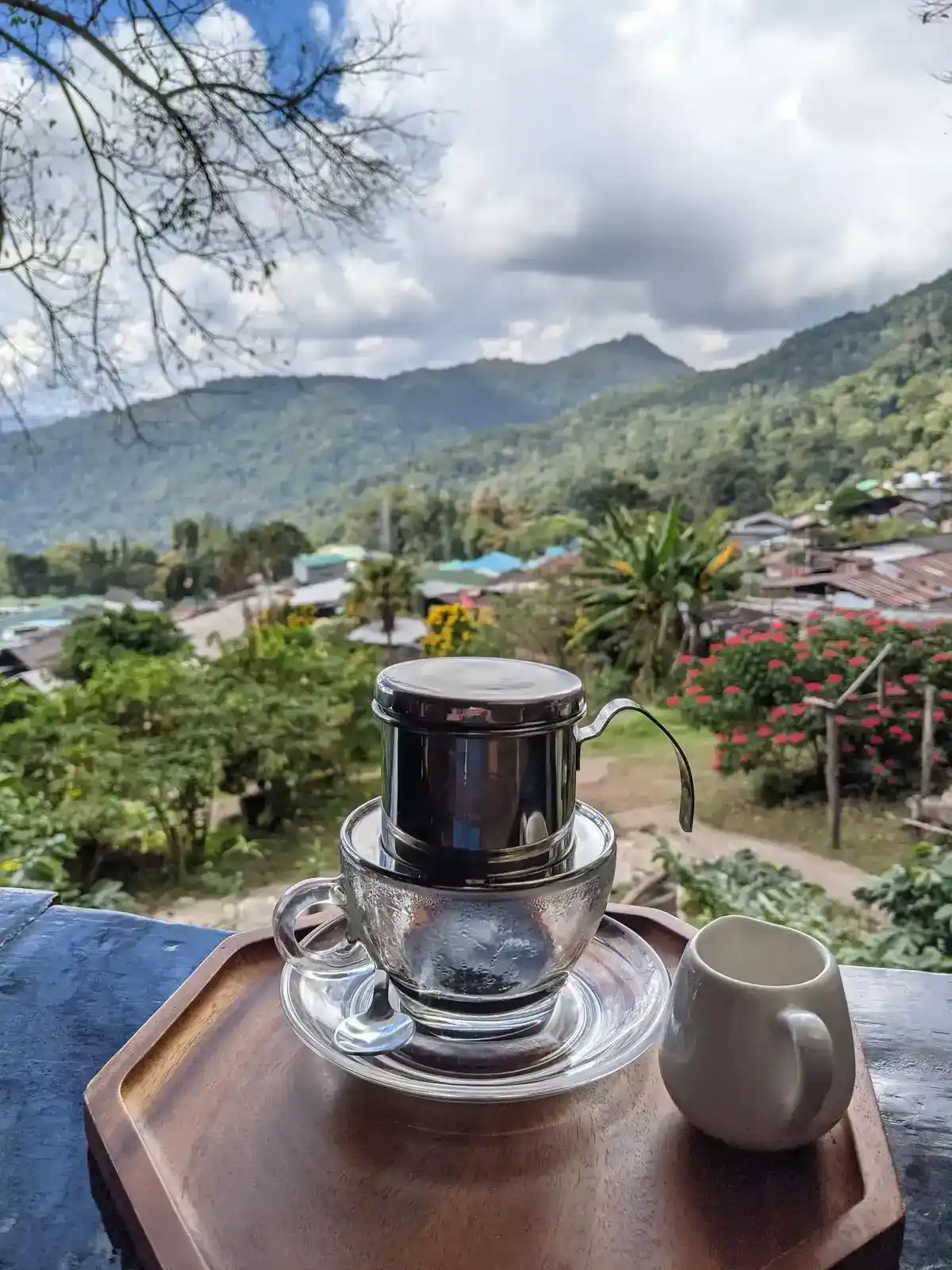
A Vietnamese Phin (pronounced "feen" as in the ending of the wording "caffeine") resting on top of a glass cup, brewing coffee, with an view of mountains in the background. This coffee filter is filled with ground coffee beans, and hot water is added inside. It uses gravity to slowly percolate (drip) hot water through the coffee grounds. At the bottom of this filter, the hot coffee drips out into a cup. This brewing method was introduced to Vietnam by the French during the colonial occupation time period.
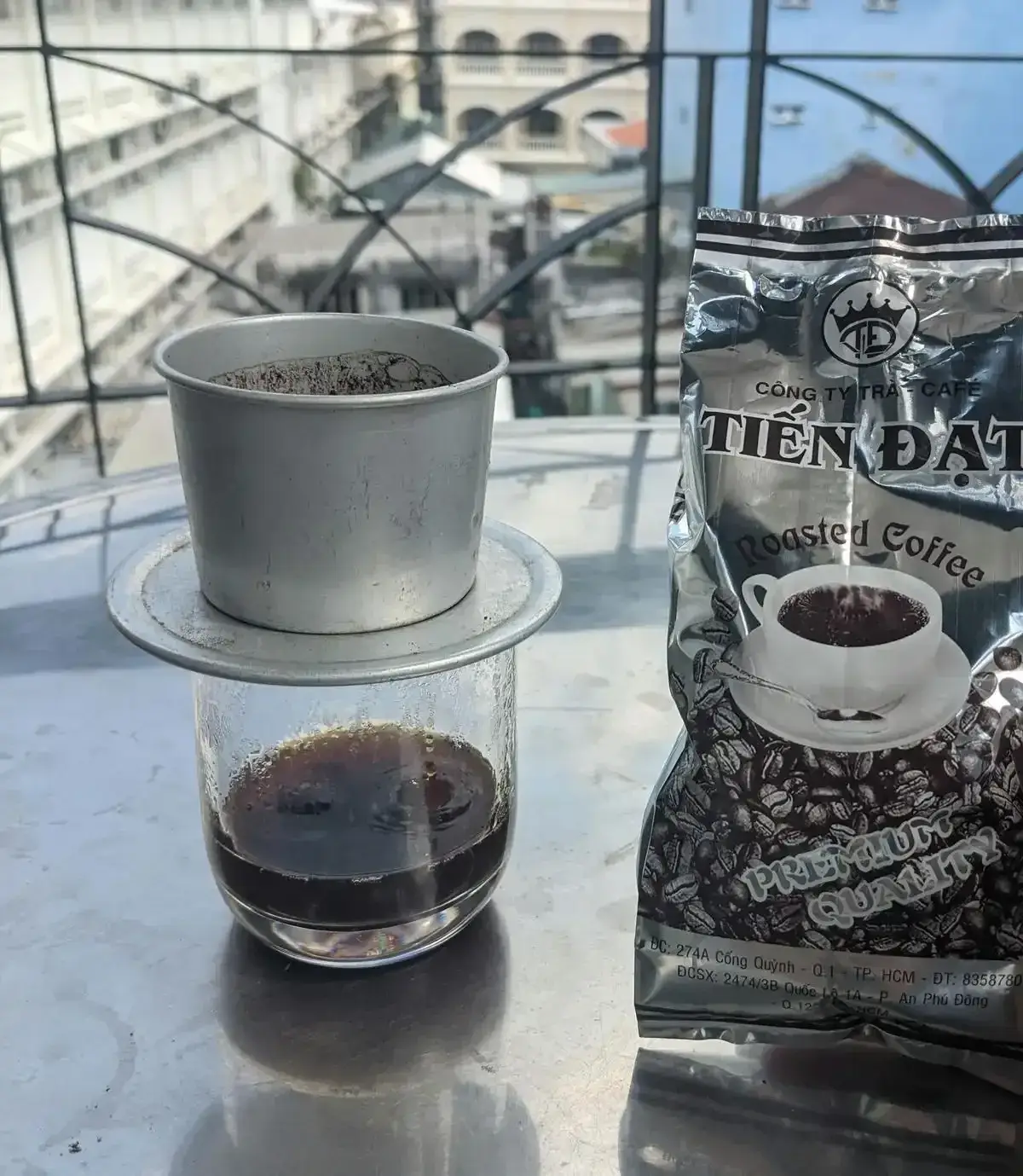
A bag of coffee beans, and brewing a cup of coffee using a Vietnamese phin filter.

BONUS TIPS!

Tip

[ 1 ] Learn how to ask “how much [is the price]?” and the numbers in the local language.  This will help you so so so so much! Use our guides: 🇻🇳 Vietnamese, 🇹🇭 Thai, 🇰🇭 Khmer (Cambodian)

[ 2 ] Confirm the price before ordering or purchasing something! If you are concerned with the price, then insist on paying when they bring the food to you and before you start eating.  That way, you paid before you consumed and got what you ordered.

[ 3] Food delivery apps provide a good reference to the local food options are, and their prices. But food apps are always a bit pricier.

[ 4 ] Online reviews set expectations:  Research the price on online reviews such as Google Maps, so that you know what to expect.